|
Council of Producers & Distributors of Agrotechnology
Terry Kippley, CPDA
| | |
One Big Beautiful Bill – Provisions for Agriculture
On July 4, President Trump signed the One Big Beautiful Bill Act (OBBBA) into law, following weeks of intense negotiations and late-night vote wrangling in both chambers. After passing the Senate 51-49, the bill returned to the House, where it narrowly cleared final passage 218-214 following a long night of political drama. Leadership from both chambers, the Trump administration, and President Trump himself worked late into the evening to secure votes from holdouts on both ends of the Republican spectrum.
The final package includes $66 billion in new funding for farm programs, the most significant investment in agriculture since the 2002 farm bill. That funding is offset largely through changes to the Supplemental Nutrition Assistance Program (SNAP), including expanded work requirements and a new cost-sharing requirement for states. These changes helped get the bill across the finish line, but they may complicate negotiations on a follow-up “skinny farm bill” by limiting support from across the aisle.
| | |
For agriculture, OBBBA delivers several wins:
- The package strengthens the farm safety net by updating ARC and PLC programs, increasing reference prices and loan rates to reflect today’s costs, and expanding eligibility by up to 30 million acres
- Lower crop insurance premiums
- Increased funding for ag research and trade promotion initiatives
| | |
OBBBA extends several tax provisions that are especially important to agriculture. It makes permanent the 20 percent Small Business Deduction (Section 199A), raises the small business expensing threshold, maintains lower individual tax rates, and expands the estate tax exemption to help protect family farms. The legislation also renews the 45Z biofuels tax credit, providing continued support for the ag-based renewable fuels sector.
Despite these successes, many policy-based farm bill priorities had to be removed to comply with Senate budget rules. Under reconciliation, only budget-related provisions are allowed, which meant Congress could not include key updates like expanded USDA loan limits or suspend outdated permanent price support authority.
That suspension is a routine but critical piece of every modern farm bill. Without it, current programs like PLC and ARC would eventually expire, triggering a reversion to commodity programs from the 1930s and 1940s that are both outdated and prohibitively expensive. To avoid this outcome, Congress will need to pass a follow-on “skinny farm bill” later this year. CPDA will continue working with congressional leaders to ensure our members’ priorities are positioned for inclusion as those discussions move forward.
| | |
CPDA Explores Framework to Streamline EPA Notification Reviews
CPDA’s EPA Working Group met to discuss potential enhancements to EPA’s notification process under PR Notice 98-10 and 98-1. The discussion focused on improving commercial certainty for registrants while preserving EPA’s robust regulatory oversight.
The group is developing a proposal where each submission would include a standardized checklist. Under this proposal, registrants would submit a properly completed, EPA-approved checklist. EPA would then have 30-60-days to review each label notification. A properly completed checklist would serve as a signal of compliance, and if EPA does not act within 30-60 days, the notification would be accepted by default, allowing the registrant to move forward with product marketing.
Notifications would be submitted through the CDX Pesticide Submission Portal and tracked via the MyPEST portal. Automated communications would confirm submission, alert EPA staff to approaching deadlines, and document final status for both EPA and the registrant. These MyPEST confirmations would also serve as evidence for state regulators that the notification was filed and accepted.
To maintain oversight, EPA would retain authority to conduct random or for-cause audits of submitted notifications. If a submission is later determined to be inappropriate, EPA would notify the registrant and provide a reasonable timeframe for correction. Products already in distribution would not be subject to recall unless there was clear evidence of intent to deceive or a significant risk to human health or the environment.
Remember that this is still a work in progress and any changes must be approved by EPA. CPDA will continue to refine this framework and gather member input ahead of future engagement with EPA.
| | |
MyPEST Working Group Update
The MyPEST Working Group continues to meet on a reccurring basis. The rollout of MyPEST is through a phased implementation process with new features, along with improvements, added with each deployment. The next deployment of MyPEST is scheduled for August 21, with its availability to the user community on August 22.
Prior to this deployment, the PRIA Coalition will offer a webinar, featuring speakers from OPP, to provide an overview of the upcoming new features being added to MyPEST. The new features include a Data Call-in tile, basic information on registration review for products in the establishment’s portfolio, further specificity on where applications are in the review process, and certification of compliance with bilingual labeling.
If you have comments, issues or questions please contact your CPDA Working Group representatives Jayne Walz, walzj@helenaagri.com or Jeremy Malone jeremy@springregulatory.com.
| | |
CPDA Meets with EPA on InertFinder
CPDA’s Andrew Walmsley, Dr. Ray McAllister and I met with staff from EPA’s Office of Pesticide Programs (OPP) to discuss the current limitations of the InertFinder tool and explore opportunities for collaboration to improve its functionality, particularly related to non-food inert ingredients.
The conversation focused on the difficulty of accessing non-food inert data due to outdated infrastructure and limited download functionality within InertFinder. CPDA proposed partnering with EPA to enhance the tool by linking additional information to existing tables and developing a simplified positive list, rather than undertaking a full database overhaul.
EPA acknowledged that updating the non-food inert database would be highly resource intensive, which would be difficult to accomplish given OPP’s limited resources.
EPA expressed interest in hearing from stakeholders about which InertFinder features are most valuable. CPDA will follow up with members to gather input that can help guide potential improvements to the tool. Please reach out to Dr. Ray McAllister, CPDA Technical Advisor at ray.mcallister@cpda.com with comment.
| | |
CPDA Collaboration with WSSA on Tabular Label Format for Adjuvants
CPDA continues to work with the Weed Science Society of America (WSSA) to support the development of a simplified, tabular format for EPA pesticide use labels that includes a dedicated section for adjuvant use recommendations. Bill Chism and Dr. Stanley Culpepper recently provided an update on the concept, which aims to streamline label clarity and improve usability for applicators.
CPDA, with technical input from Dr. Eric Spandl of WinField United and Chair of the CPDA ESA committee, is advocating for the inclusion of an adjuvant-specific section in the table that allows registrants to clearly indicate when an adjuvant is “Not Recommended,” “Not Required,” or specify a product category such as NIS, COC, MSO, AMS, DRA, or VRA, along with a recommended use rate. This structure would help prevent misuse and ensure consistency in the field.
For DRAs and VRAs, the format under discussion would include a clear “Is Required” designation and allow space to reference a website when applicable. CPDA and WSSA agree that consolidating adjuvant guidance into a single, uniform table would increase label clarity and support compliance, particularly as more products include Endangered Species Act (ESA) mitigation language. CPDA continues to provide input and support for this effort as discussions move forward.
| | |
CPDA Webinar Planning: Season IV – Adjuvant Advantage for the Sales Agronomist
Plans for the upcoming fourth season of the highly successful Adjuvant Advantage for the Sales Agronomist webinar series are underway. The series will once again offer CEUs for Certified Crop Advisers (CCAs) and focus on timely, field-relevant topics.
Preliminary themes include:
- Integrating Adjuvants with Biologicals
- ESA Compliance, Drift Mitigation, and Buffer Zone Strategies
- Tank Mix Optimization: “Tune-Up Your Tank Mix”
- DRA and Effective Nozzle Selection
- Adjuvants and Insecticide Use (including ESA strategy updates)
We are also working on improving participant retention through structured messaging to include previewing content (“tell them what we’re going to tell them”), delivering concise sessions, and reinforcing key messages via post-event follow-up and repeated exposure.
| | |
CPDA Participates in June PPC Meeting
Andrew Walmsley participated in the latest Pesticide Policy Coalition (PPC) meeting where the agenda included updates on USDA and EPA staffing developments, and priority issues such as PRIA appropriations, the Farm Bill, and ESA compliance efforts.
CPDA remains active in both the full PPC and the Legislative Advocacy Subcommittee, where it is helping to draft advocacy materials for use on Capitol Hill related to the MAHA Commission’s recommendations. The coalition also discussed upcoming opportunities for engagement with Congress and the Trump administration ahead of the next PPC meeting on July 17.
| |
Deadline Extended: California DPR Proposed Groundwater Regulation
California’s Department of Pesticide Regulation (DPR) has proposed a regulation that would revise how pesticides are evaluated for potential groundwater contamination. The updated methodology would create a unique-to-California approach that allows DPR to list active ingredients based on potential degradants, not just the AIs themselves.
While the proposal includes removing some pesticides currently deemed unlikely to contaminate groundwater, it would also add more than 50 active ingredients under the new criteria. This marks a significant expansion from earlier DPR communications, which framed the effort primarily as a cleanup of misclassified products.
CPDA is reviewing the proposal closely and coordinating with stakeholders. The deadline for public comments has been extended to July 15.
Full proposal: https://www.cdpr.ca.gov/proposed-regulation/dpr-25-002-groundwater-protection-list/
| | |
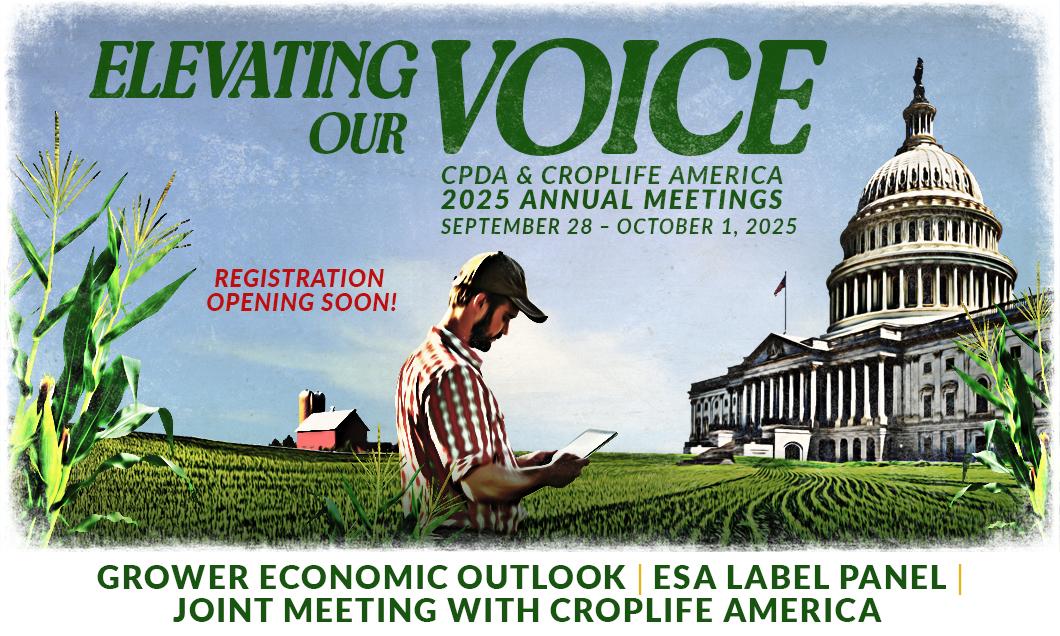
Registration Opens Soon for the CPDA 2025 Annual Meeting
September 28 – October 1, 2025
Grand Geneva Resort & Spa, Lake Geneva, WI
Join us for three days of unparalleled industry insights and top-tier networking! This is your chance to connect with industry leaders, gain invaluable knowledge, and be part of the conversations that are shaping the future of our field.
Don't miss out on this incredible opportunity for growth and learning!
Mark your calendars and get ready to elevate your expertise. Registration opens soon. Together, we can cultivate a brighter future for agriculture!
| | | August 5, 2025 | AgriBusiness Global Trade Summit
Lake Buena Vista, FL
CPDA Members use code: CPDA25 for $100 off! Hotel Discount ends 7/11/25 | | September 16, 2025 | Keller and Heckman Annual Practical Primer on Pesticides
Indianapolis, IN | | September 28, 2025 | CPDA Annual Meeting
Lake Geneva, WI | | October 5, 2025 | Western Plant Health 2025 Annual Meeting
San Diego, CA | | October 28, 2025 | Faegre Drinker 2025 Food and Agribusiness National Conference
Minneapolis, MN | | February 2026 | CPDA DC Fly-In
Washington, D.C. | | April 27, 2026 | CPDA Adjuvants, Inerts & Crop Protection Conference
Austin, TX | | | | | |