|
The Dorchester Reporter
If our city changed a few things, more of us might turn out at the polls
by Bill Walczak, Reporter Columnist
Last week’s column addressing Boston’s preliminary election and two reforms the City Council and Mayor could implement to address dismal turnout provoked strong responses. Readers were aghast at how few registered Bostonians voted, and a number of them remarked about how the low turnout fulfilled the pundits predictions: neighborhoods with more, and older white property owners voted at higher rates, pushing Annissa Essaibi George into second place over Andrea Campbell and Kim Janey.
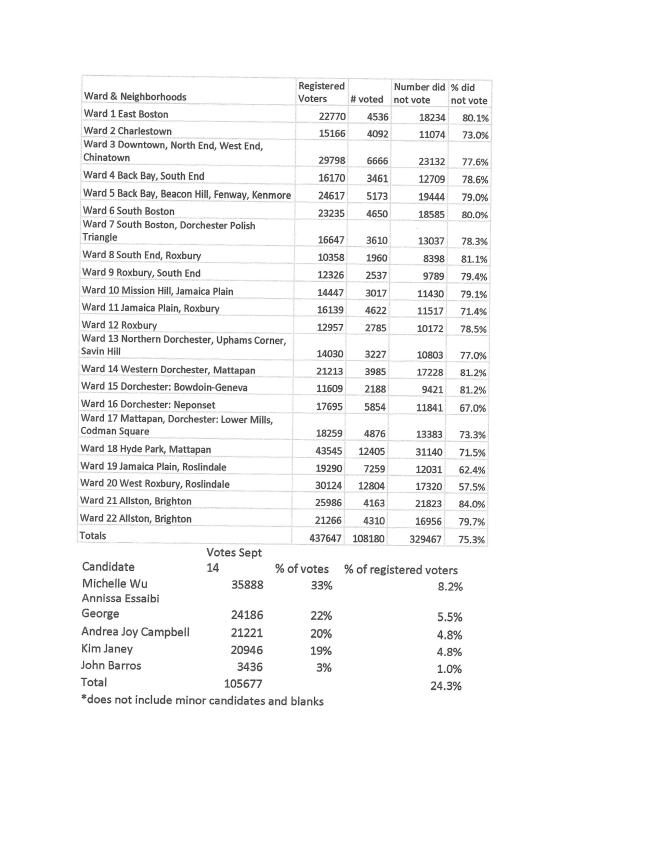
Most wards had turnouts in the 20-30 percent range, and only three had more than 30 percent: Ward 20, which is mostly West Roxbury, which had the highest turnout at 42.5 percent; Ward 19, which straddles Jamaica Plain and Roslindale, with 37.6 percent turnout, and Ward 16, anchored in Neponset, with 33 percent of registered voters voting. Contrast this with San Diego, which considered their special election for mayor in 2014 to have a low turn-out with 43.58 percent voting.
Many readers either saw the results by ward and didn’t understand which neighborhoods were in the ward, or didn’t see the results by neighborhood. To explain better, below are two charts on the preliminary election. The top one shows the results by ward and neighborhood for the preliminary election for registered voters who did and did not vote. The bottom chart shows the preliminary vote by candidate, and by percentage of registered voters.
According to current election laws, Wu's 8.2 percent and Essaibi George's 5.5 percent of the votes of registered voters were enough to get them into the final election to run a city with a $3.6 billion budget and 20,000-plus employees.
My problem is not with the two finalists; it’s with the 329,467 registered voters who decided not to take the minute or two it would take to fill out a ballot. Perhaps if everyone voted it would work out with the same two finalists, but we’d have a November election which would be the result of Bostonians exercising their democratic right to nominate them, rather than another example of Americans failing to participate in their own democratic electoral process.
My suggestion as a partial solution to the turnout problem is to eliminate separate years for municipal elections, as turnout is generally double when state and federal office holders are on the ballot. Perhaps, in that case, more people would pay more attention to city elections, saving the city at least $2 million bi-annually by combining the elections.
Neither Wu nor Essaibi-George supports such a change, though neither candidate has elaborated why she is opposed to this progressive measure. California has adopted this change statewide for its municipal elections. It is common sense.
The other suggestion which provoked feedback from readers was to implement term limits for Boston’s mayors. In 2009, the Boston City Council voted 7-6 against establishing mayoral term limits. Today Wu and Essaibi-George both oppose mayoral term limits, but have not explained why they do. Negative responses from readers centered around the notion that voters can just vote out mayors they think are not doing a good enough job. This argument fails to understand the role of money in both determining whether an incumbent mayor has opponents, and if an opponent of an incumbent mayor can mount an effective campaign.
The position of mayor of Boston is the most powerful elected office in Massachusetts. The mayor controls virtually every aspect of governance in Boston, with the city council having almost no power to reign in the mayor. As a result, mayors can raise many millions of dollars for campaigns from donors who want access to the mayor’s office. In Boston, the major donors are from the development community, which has made enormous profits, and has learned over the decades that projects that meet with the mayor’s approval are more likely to be built.
Mayors learn quickly that they can build up millions of campaign dollars from continuous political fundraisers. Marty Walsh, who was planning a re-election campaign for mayor if the Secretary of Labor position didn’t materialize, had over $5 million in his campaign account before the campaign would have begun.
This ability of incumbent mayors to raise campaign money has two effects on potential opponents. Since all political contributions are disclosed within hours on the internet, donors to opponents are known quickly, and those with business dealings with city government can be very reluctant to be contributors to the opponent of the all-powerful mayor. Serious potential candidates against an incumbent mayor can also be scared off by knowing the size of the incumbent’s war chest. Having a new mayor every eight years would eliminate the financial advantage of incumbency every eight years, and also be a way to ensure that there’s a true debate on the management and future direction of the city.
My great fear is that maybe it doesn’t matter what we do; maybe the average Bostonian is just not that interested in democracy. Readers also pointed out that we do not do a good job of teaching civics and the role of government in our schools. In that, we can all agree, but we can also take steps like those I suggested to help engage more Bostonians in the voting process. The future of our city is at stake.
Bill Walczak is a Dorchester resident who was a candidate for mayor of Boston in the preliminary election of 2013.
Support community newspapers. Subscribe or donate to The Dorchester Reporter at www.dotnews.com
|