|
When A-Players Drown in Email
A tweet crossed my feed recently that stuck with me. The author wasn't writing about business at all — they were describing how, for some people, reading a message instantly turns it into an obligation, while an unread message can feel like it doesn't exist yet. That's exactly how your best people relate to their inbox.
A-players don't read email the way most people do. They read it as a task list. Every message they open is implicitly a commitment: respond, decide, forward, follow up, remember. That's part of what makes them A-players — they take ownership of what lands in front of them. But it's also exactly why runaway email volume is one of the most under-the-radar threats to their productivity.
The Real Cost of Volume
The problem isn't just that a full inbox is annoying. It's what it does structurally to your highest performers:
-
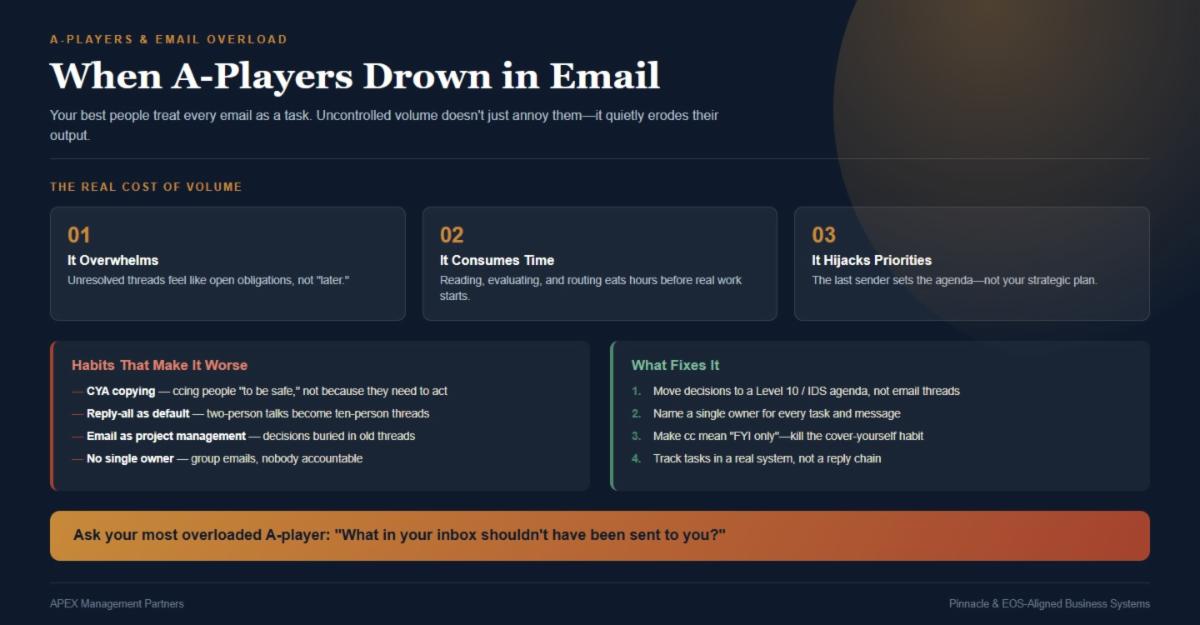
It overwhelms. A-players are wired to close loops, not leave them open. A hundred unresolved threads doesn't feel like "later" to them — it feels like a hundred unfinished obligations sitting on their shoulders right now.
-
It consumes time that should go to production, not triage. Every email has to be opened, read, evaluated, and routed. That's cognitive overhead before any real work happens. Ten minutes here, three minutes there — by 10 a.m. your best operator has spent an hour deciding what to do instead of doing it.
-
It hijacks priorities. Email is inherently reactive. Whoever sent the last message effectively gets to set the recipient's agenda for the next five minutes. A-players who are diligent about "clearing the inbox" end up working someone else's priority list instead of their own — and often instead of yours.
The irony is that the trait that makes A-players valuable — conscientiousness, follow-through, a sense of ownership — is the same trait that makes them most vulnerable to email overload. Your weakest performers ignore email. Your best ones feel obligated to it.
The Bad Habits That Make It Worse
Volume rarely comes from nowhere. It's usually the byproduct of a handful of internal habits that quietly compound:
-
CYA copying. Someone gets nervous about accountability and adds three extra names to an email "just to keep everyone in the loop." Now four people feel obligated to read and possibly respond to something only one person actually needed to act on.
-
Reply-all as default. A two-person conversation becomes a ten-person thread because nobody trims the recipient list.
-
Email as a project management tool. Decisions, approvals, and task assignments get buried in threads instead of living in a system built to track them, so people have to re-read old email to figure out what's still open.
-
No single owner. When a message goes to a group instead of a named individual, everyone assumes someone else will handle it — or everyone feels they should, and three people duplicate the work.
-
Using email to avoid a five-minute conversation. Decisions that need real-time back-and-forth get dragged through six email exchanges instead of one phone call or a stand-up.
-
Vague subject lines and buried asks. If the ask isn't clear in the first two lines, every recipient has to read the whole thing to figure out if it applies to them.
None of these habits are malicious. They're almost always well-intentioned attempts to be transparent, cover risk, or avoid friction. But the cumulative effect is that your organization's communication system taxes its most capable people the hardest.
What Happens When It Breaks
When an A-player's inbox becomes genuinely unmanageable, you don't usually get a dramatic failure. You get something quieter and more costly:
- They start triaging instead of thinking.
- Deep work gets scheduled around inbox management instead of the other way around.
- Strategic priorities slip because the urgent-but-unimportant crowds out the important-but-not-urgent.
- And eventually, the same instinct described in that tweet kicks in — they start leaving things unread, not because they don't care, but because reading it means committing to it, and they're already committed to more than they can deliver.
- That's when relationships and trust start to erode, often invisibly, because the sender assumes silence means the request was ignored or the person doesn't care.
That's the moment you lose the value of an A-player without losing the person. They're still on the payroll. They're just spending their best hours managing a channel instead of running the business.
What to Do About It
You can't fix this with a "please keep emails short" memo. It requires changing the operating system around communication, not just the etiquette.
-
Move decisions and recurring items out of email entirely.
-
Give everything a single owner.
-
Kill the CYA cc habit on purpose. Set an explicit norm: cc means "for your information, no action needed," and if you need someone to act, put them in the To line and say so. Make it safe for people to trust a scorecard and a weekly meeting instead of a paper trail for cover.
-
Put tasks and projects in a system built for them. Project management tools, scorecards, and to-do lists preserve ownership and status far better than a thread twenty replies deep. Email should transmit information, not store commitments.
-
Protect blocks of uninterrupted time. A-players do their best thinking away from the inbox. Encourage batched email windows — twice a day, not continuously — and back it with a leadership example, since this rarely sticks if the owner is firing off replies at 11 p.m.
-
Audit the "reply-all" and distribution list habits quarterly. Ask simply: who actually needs this, and why. Trimming distribution lists is one of the cheapest productivity gains available to any organization.
-
Set a response-time expectation, not an availability expectation. If people trust that a same-day or next-day response is the norm, they stop treating every email as an interruption that must be handled immediately — which is a big part of what turns an inbox into a task list in the first place.
None of this eliminates email. It just puts it back in its place — a channel for information, not the operating system for how work gets assigned, tracked, and decided. Your A-players will thank you for it, even if they never say so directly. They'll just start getting more of their best work done again.
Question for You to Ponder
Are you ready to lead your business to its Pinnacle?
Outcome (if you act)
More valuable company, higher profit, and a better quality of life.
Call to Action
-
Ask me for a copy of the Path to Pinnacle
- Schedule a Meeting with Me
Our Mission: Accelerate Profitable Growth and Improve Execution
|