|
In November 2015, The Daily Jot raised a question that remains relevant today: Can the United States legally admit immigrants who advocate replacing our constitutional government with a religious or political system imposed through force? The Immigration and Nationality Act of 1952 established restrictions on admitting foreigners who threaten national security or seek to overthrow the government. Those provisions remain in effect, although amended over the years. The issue deserves renewed attention concerning Islamic political movements advocating Sharia as the supreme governing authority, particularly those willing to impose it through violence or unlawful means. This is a threat to America.
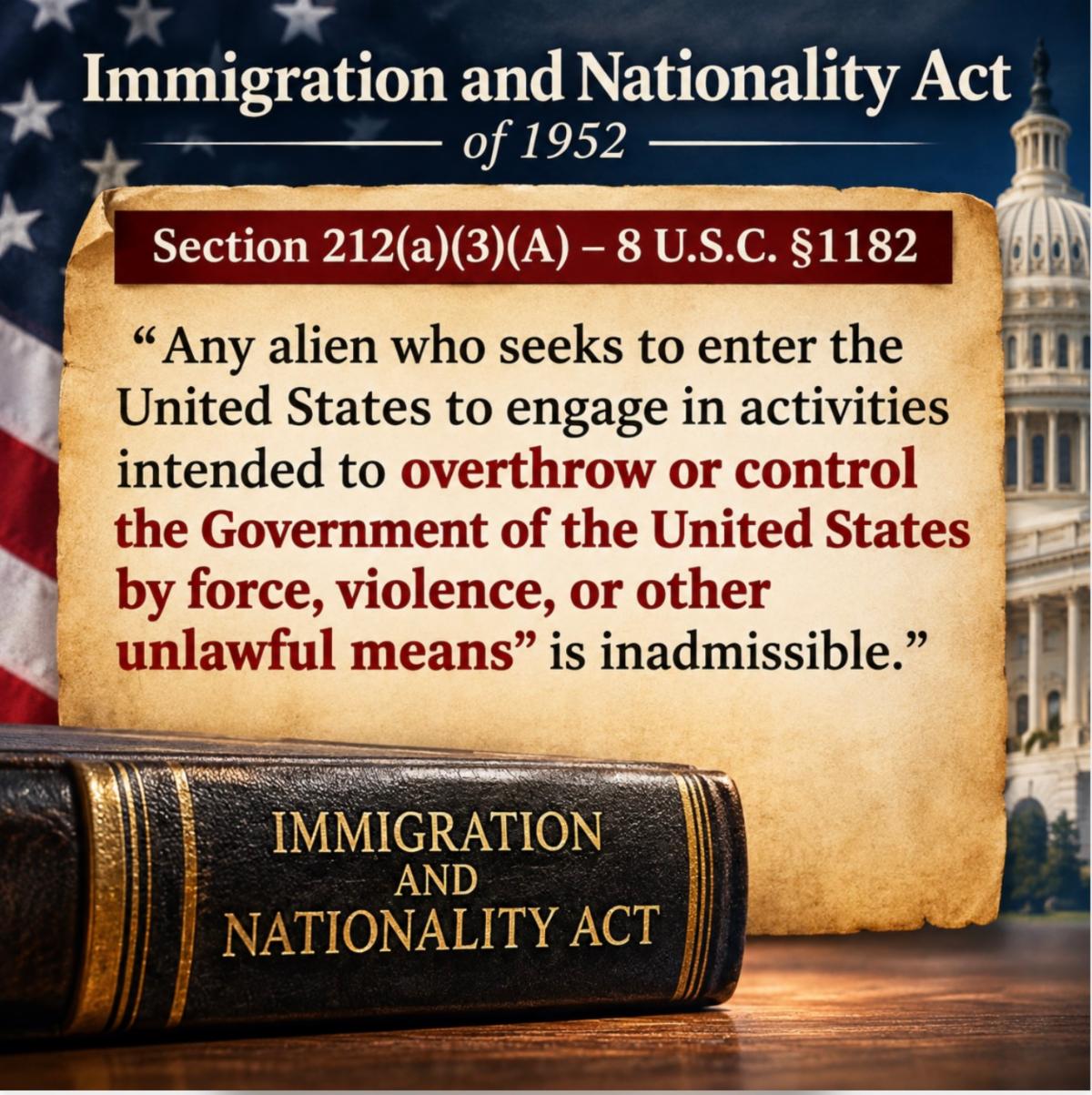
Section 212(a)(3)(A) of the Immigration and Nationality Act, codified at 8 U.S.C. §1182, makes inadmissible foreigners seeking entry to overthrow or control the American government through force, violence, or other unlawful means. Additional provisions address terrorism, while Section 313 restricts naturalization for certain advocates of unconstitutional overthrow. These are substantial protections established by Congress. Islam encompasses diverse religious and political interpretations, including movements seeking government under Sharia. The critical legal distinction concerns those actively pursuing the unlawful replacement of constitutional government. Religious convictions alone do not establish inadmissibility. Evidence of terrorist involvement, unlawful intentions, or other statutory grounds can.
This distinction becomes especially important when religious beliefs and political ambitions intersect. America guarantees freedom of religion, including the freedom of Muslims to worship according to their conscience. Christians likewise recognize an authority higher than earthly government. Acts 5:29 says, "We ought to obey God rather than men." Yet religious conviction and the unlawful imposition of religious government are different matters. The Constitution protects religious exercise while establishing the framework for civil government. Immigrants may hold deeply rooted religious beliefs and respect that framework. Those seeking to destroy it through violence or unlawful activity present a different question. Immigration authorities must examine credible evidence and apply the law consistently. And they must take it seriously.
Islamic political movements seeking to impose Sharia through coercion or replace constitutional government unlawfully challenge America's constitutional guarantees and national security. Religious liberty protects belief and worship. It provides no right to use violence, intimidation, or unlawful activity to impose religious government. Immigration authorities must distinguish peaceful religious conviction from credible threats to national security. Romans 13:1 reminds us that governing authorities carry responsibilities before God. Compassion for those seeking a better life is a worthy American virtue, but compassion must operate within the rule of law. Congress established immigration safeguards for a reason. And these need to be enforced stringently since we are now seeing Islamists being elected to office.
Sources
Immigration and Nationality Act, Section 212, 8 U.S.C. §1182:
https://www.law.cornell.edu/uscode/text/8/1182
Immigration and Nationality Act, Section 313, 8 U.S.C. §1424:
https://www.law.cornell.edu/uscode/text/8/1424
USCIS, August 19, 2025, Consideration of Anti-Americanism in Immigration Benefit Requests:
https://content.govdelivery.com/accounts/USDHSCIS/bulletins/3ee8afe
The Daily Jot, November 20, 2015, "Islam, by law, is prohibited from US immigration":
https://myemail.constantcontact.com/Islam--by-law--is-prohibited-from-US-immigration.html?soid=1102218983435&aid=fDjt6jwCwf0
|