|
“Imagine walking into a kid’s bedroom, the mattress is floating in five feet of water, and there’s no sign of the child.” Manny Cox was at Mexico Beach helping with search and recovery after Hurricane Michael devastated the city in 2018. Sergeant Pete Bozarth of the Emergency Response Unit saw something similar at the Standard Apartments in Clearwater after Hurricane Milton in 2024, when up to eight feet of water flooded into the complex (which wasn’t in an evacuation zone) and resulted in the largest high-water rescue Pinellas County has ever seen, with more than 500 people evacuated. During and after Helene that same year, the Pinellas County Sheriff’s Office (PCSO) alone had 102 calls for water rescues.
The traditional wisdom in a storm is: hide from wind, run from water. High winds can cause widespread destruction, but most deaths stem from water, whether from storm surge, overflowing rivers, or urban flooding. The High Water Response Team was created to save lives in these catastrophes.
“In 2024 there was a countywide need for additional resources specific to shallow water, so we purchased equipment that we can operate through flooded roads,” said Sergeant Bozarth.
The team is made up of deputies from all around the agency: the entire Marine and Environmental Lands Unit and the Dive Team, as well as patrol deputies, detectives, and members of tactical units. They train quarterly, with recent trainings sharpening their skills in driving heavy high-water vehicles such as the MRAPs which have high ground clearance and can operate in three feet of water, and the LMTVs which can carry up to 12 people through high water. They also got instruction from Duke Energy on how rescuers can keep themselves safe when the devastated areas they’re searching are crisscrossed with downed power lines.
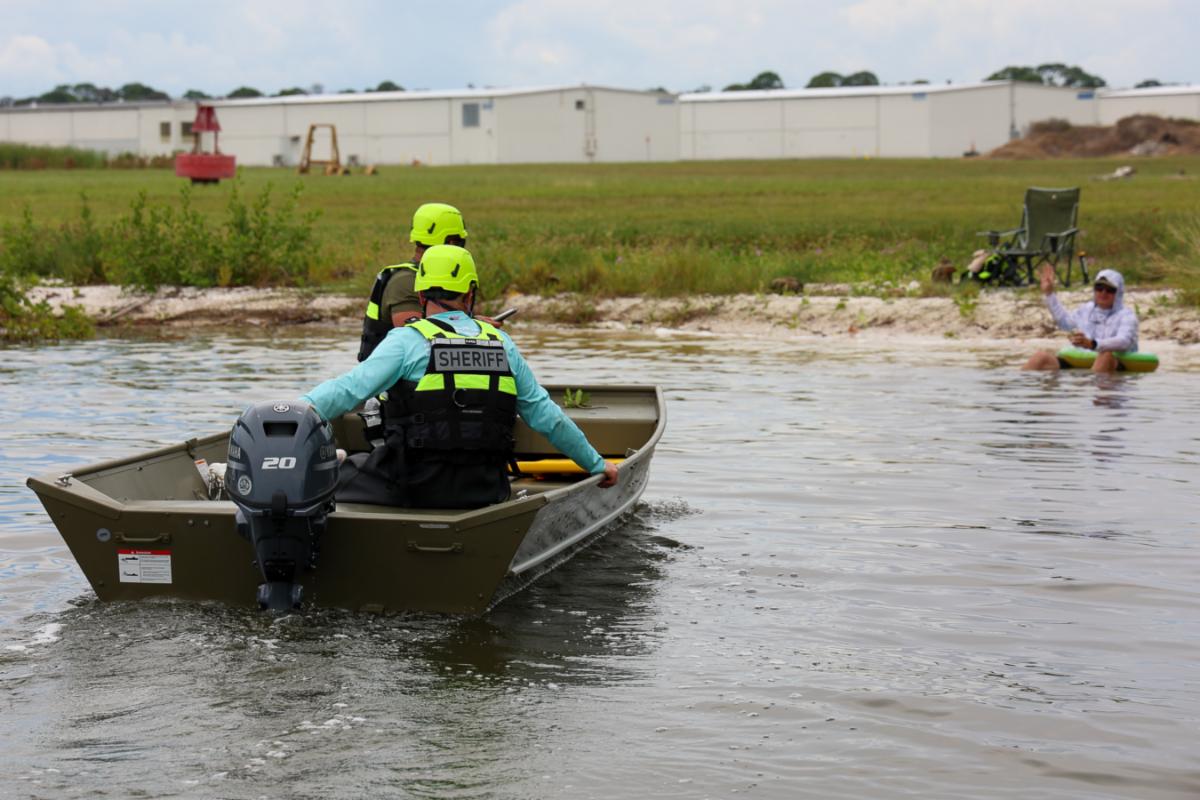
Their most recent training took them out into the shallow bayous around the St. Pete-Clearwater Airport, where the murky water and a shore obstructed with rocks and mangrove roots approximates the conditions they might find in post-hurricane flooding. The team has a fleet of personal watercraft (PWC) and Jon boats that can operate in extremely shallow water. They also have access to Jon boats without motors that can be towed by the PWCs to load people for rescue in even shallower environments. The relatively new team has now been issued all of their personal protective equipment, including chest waders to protect them from water that might be full of contaminants, a helmet, and PFD.
The two-person teams on PWCs practiced getting on and off in both shallow and deep water. It sounds simple, but there’s a trick to it, and soon they were barely rocking the PWC as they climbed back on. They also practiced precision maneuvering that would allow them to get close to a vessel or person in the water to give them aid. Moving through the water after a hurricane is a lot different than a joyride on the Intracoastal. They might be riding in flooded streets with hidden hazards such as mailboxes and landscaping. When a surge sweeps through a house it can strew its contents everywhere, so even in open near-shore water a rescuer might find themselves riding over submerged refrigerators and furniture. Moving vessels through floodwaters is a slow and careful process.
After working on the basics, they practiced rescue scenarios. While volunteers pretended to be caught in high water, rescuers on PWCs tossed them ropes. Then they got to train with a new piece of software designed to coordinate rescue efforts and save lives.
SARCOP – Search and Rescue Common Operating Platform – is a joint project of the DHS Science and Technology Directorate, FEMA, and the National Alliance for Public Safety GIS. It allows multiple agencies to coordinate emergency response by sharing real-time information about victims and damage assessment on a digital mapping system. SARCOP can be used during natural disasters such as hurricanes or wildfires, and also in mass casualty events such as a bridge collapse. As first responders search, the app tracks what they do. After a hurricane, multiple agencies will be working together to save lives, and some of them come from out of the area. With SARCOP, if personnel from another part of the state come here as part of mutual aid, they can easily see what areas or houses local agencies have already searched, and coordinate their assistance accordingly.
The High Water Response Team navigated through five scenarios using SARCOP to get a feel for the software and practice decision-making. Some scenarios were simply about documentation, noting in the system that a house had already been searched, a road was obstructed, or a family had evacuated. Others were more of a challenge. In one, a man floated in a tube, beverage in hand, in front of a destroyed house, but said he didn’t need any assistance. All they could do was warn him about the dangers of staying in a flooded neighborhood, document his presence, and move on.
The final scenario had a person who had survived the storm surge but had fallen and injured their neck afterwards. This is the very reason why people are warned so adamantly that they should evacuate. Even if your house is built to survive a storm, the reality is that emergency services will be interrupted for hours or days. Even if you have food, fresh water, a generator, and a house that is standing, none of that helps if there’s a fire or you have a heart attack. Rescuers will get to everyone eventually, but with downed trees blocking roads and rushing floodwaters covering neighborhoods, help might come too late. In this training scenario, team members loaded the injured person onto a backboard and safely evacuated them.
A strong Pacific El Nino has given us one of the most inactive hurricane seasons in recent memory, but all it takes is one hurricane to devastate a region. We’ll keep our fingers crossed for the rest of this year, but no matter what happens, PCSO and the High Water Response Team will be ready.
|