|
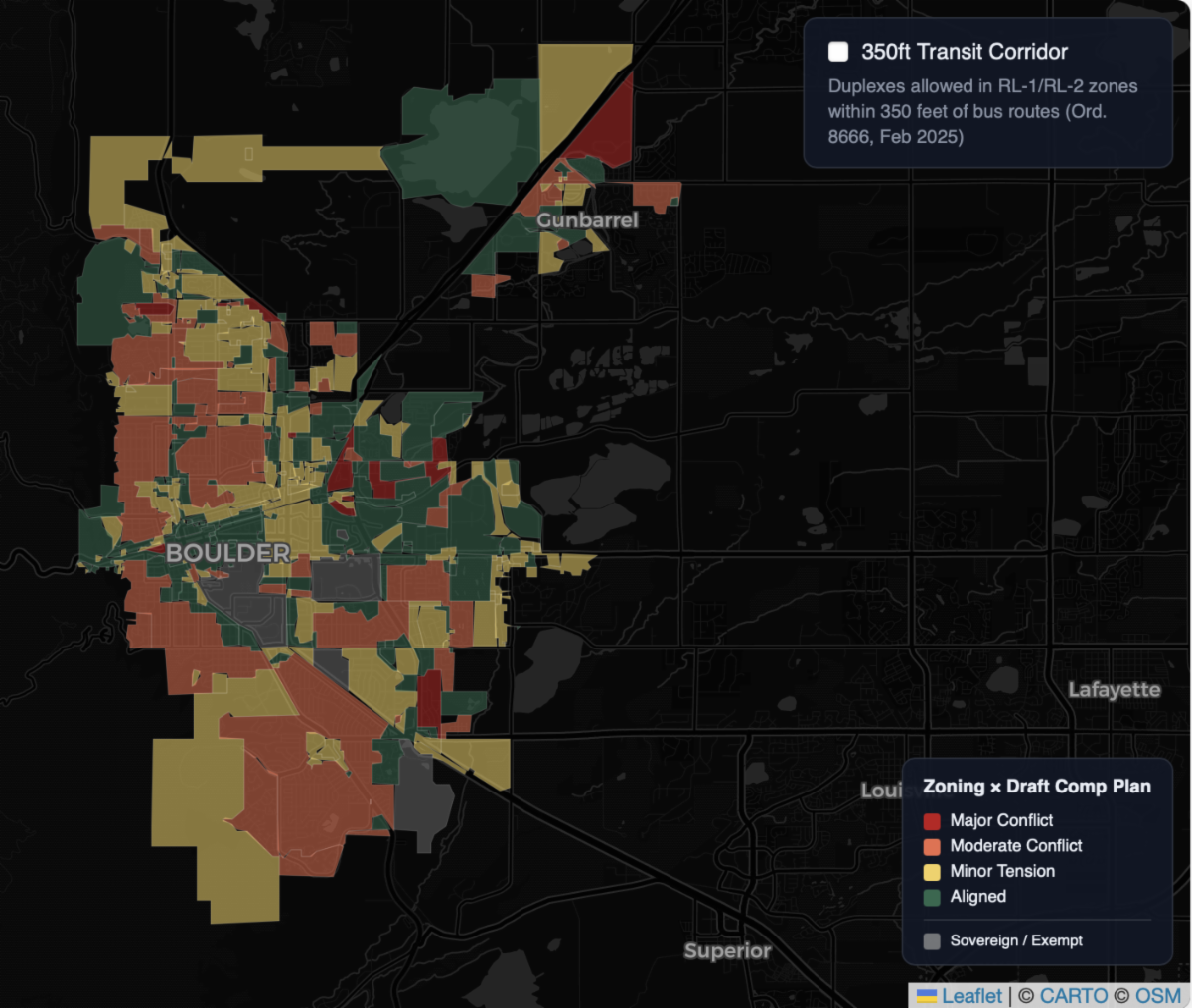
The map tells a clear story: most of Boulder's developable land has at least some tension between where the land use code is today and where the Comprehensive Plan wants to go. The red and orange areas, about 16% of developable land, are places where the current zoning and the BVCP vision are fundamentally misaligned. The yellow areas, roughly 63%, have minor tension. Only about 21% is already well-aligned.
When nearly 80% of developable land doesn't match our community's Comprehensive Plan for future development, we're not looking at an amendment problem. We are looking at a structural one. Policy has advanced faster than the regulatory framework designed to implement it, and that misalignment is being experienced in real time as projects attempt to follow adopted policy and encounter a code that cannot accommodate them.
The three stories below put human faces on what those colors mean.
The Family: A Garage, a Driveway, and an Electric Car
A family in South Boulder wants to convert the rear half of their one-car garage into a home office. It's a common setup in the ranch-style and tri-level homes throughout the area; a single-car garage where the back portion could easily serve a better purpose. They work from home and charge their EV in the driveway. Simple enough, right?
The city's Planning Department told them they'd have to tear out their driveway, replace it with landscaping, park their EV on the street, and give up home charging. Suddenly, their modest interior remodel became a project that could cost $50,000 to $100,000 or more. Driveway demolition, new landscaping to meet code, loss of home EV charging infrastructure, and the permitting and design work to navigate it all. That is what our land use code offers a family that just wanted a desk where their small EV used to sit.
Here's how the code got us here:
Section 9-9-5(a)(2) says that converting a garage "to a use other than use as a parking space" triggers compliance with all of the City of Boulder's site access standards. That one sentence starts a cascade:
9-9-5(c)(8) requires every residential driveway to lead to a conforming off-street parking space. Once the garage no longer qualifies as a conforming parking space (the remaining front half may be too shallow), the driveway no longer leads anywhere legal.
9-9-6(d)(1)(A) says you can only park in your driveway if it serves at least one conforming parking space. No qualifying space? No driveway parking either.
The result: A family that wants a modest interior remodel, no new square footage, no new dwelling unit, no impact on any neighbor, is told to rip out the only place they can charge their electric car.
The irony: In 2025, Boulder eliminated minimum parking requirements (Ordinance 8696). You're no longer required to provide parking. But the site access triggers in Section 9-9-5 are independent of parking standards, they punish you for reducing parking even though the City no longer requires you to provide it. The City sent two contradictory signals: "You don't need parking" and "Don't you dare remove it."
This is what decades of layered amendments look like in practice. One provision says parking isn't required. Another provision, written years earlier, still punishes you for not having it. Neither is wrong on its own. Together, they're absurd, and our planning staff is left to deliver the bad news.
The good news: this specific absurdity was just fixed. The April 2026 omnibus code amendment (Ordinance 8745), once passed by Council (at the upcoming May 7th City Council meeting), will allow existing driveways to remain after a garage conversion. A family in South Boulder can finally build that home office without tearing out their driveway.
But notice what it took to get here. In 2025, we eliminated parking minimums (Ordinance 8696). That reform inadvertently created a new problem: if you converted your garage, the driveway that had been there for decades suddenly had no legal basis. In 2026, we passed an omnibus amendment to fix the unintended consequence of the 2025 reform. Two layers of patches, spanning more than a year, to let a family keep a driveway that was already there.
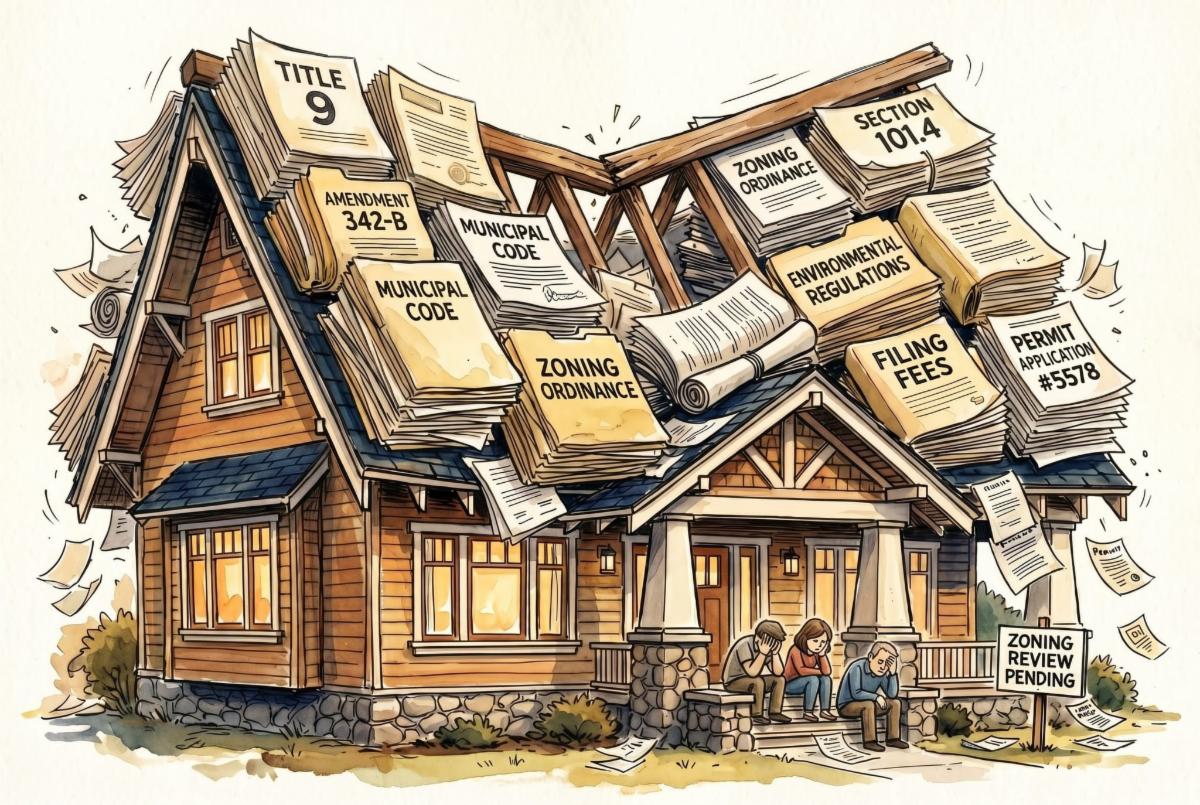
This is the shingles-on-the-roof problem in miniature. Each fix was reasonable. Each was necessary. But when your code requires a multi-year amendment chain to reach an outcome that common sense would have delivered on day one, the structure is telling you something is amiss.
Similarly, the Comprehensive Plan envisions calm, low-speed neighborhoods that support the energy transition and reduce car dependency (Policies 69-75). Clearly, something is wrong when a family is forced to choose between a home office and home EV charging is the opposite of that vision.
The real issue is that the City stumbled upon this very contradiction (in the Fall of 2025) when the owners of this home reached out to me only because we have a mutual friend who heard of their situation and said, "You should call Matt." I reached out to staff, and they admitted that this was a problem and an unintended consequence of our ordinance to eliminate Parking Minimums, but sadly said there was nothing that could be done to help this family. This is just one problem in our code that a family encountered and luckily, through a mutual friend, we're able to daylight this issue to me. Since then, I've been fighting to get this rule fixed, because there are certainly an untold number of families that want to do a similar project. They either get told no or spend tens of thousands of dollars on the absurd. Imagine how many more contradictions and misalignments exist in our code waiting to be discovered, or worse, already have been discovered but have not been raised to staff or council?
The Neighborhood: A Corner That Can't Become a Community
Imagine a property owner at a busy intersection in your Neighborhood 1 area, the kind of corner the Comprehensive Plan envisions as a natural place for a small café, a daycare, or a neighborhood market. The BVCP calls these "15-minute neighborhood" elements (Policy 29) and specifically envisions "small-scale commercial in residential areas" (Policy 67).
The owner applies to open a small coffee shop on the ground floor with two apartments above. The lot is zoned RL-1.
The land use code says no. Multiple times.
First, Table 6-1 (Schedule of Permitted Land Uses) flatly prohibits commercial retail in RL zones. Not conditional. Not by special review. Just prohibited. A coffee shop is no more legal here than a nightclub.
Second, even if you could get the use approved through a variance or rezoning, the form and bulk standards (Table 7-1) are designed for single-unit residential:
- Front setback: 25 feet (a café needs street presence, not a front lawn)
- Maximum building coverage may not accommodate ground-floor commercial plus upper-floor residential
- Parking standards for a commercial use in a residential zone are unclear, the code wasn't written for this combination
Third, there's no transition zone concept in the current code. The Comprehensive Plan envisions 150-foot blending zones at the edges of Neighborhood and Hub designations where standards can flex. Title 9 draws hard zoning lines; you're either in RL-1 or you're not.
The result: An intersection that the community plan specifically identifies as the right place for mixed neighborhood activity literally cannot have it under the current land use code. The owner can't build what the BVCP envisions, and the neighborhood can't get the walkable amenities the BVCP promises.
You could amend the use table to allow cafés in RL zones. But then you'd need to amend the form and bulk standards to accommodate a non-residential ground floor. Then amend the parking standards. Then create a transition zone mechanism. Each amendment is its own multi-month process with its own unintended interactions with other parts of the code.
This is the roof patching treadmill, and it's exactly why a comprehensive rewrite of the land use code is the only path that actually works.
What the Comprehensive Plan says: Policy 67 explicitly calls for small-scale commercial in residential areas. Policy 29 makes 15-minute neighborhoods a core organizing principle. But Title 9's use tables, written when residential meant only residential, make this vision illegal in the very neighborhoods where it matters most.
Is this the neighborhood character we promised each other? We say we want walkable communities where you can grab a coffee and pick up groceries without getting in your car. But when a neighbor tries to make that real, on a corner our own Comprehensive Plan identifies as exactly the right place, the land use code says no.
How long do we keep telling ourselves we want 15-minute neighborhoods while maintaining rules that guarantee 15-minute drives?
The Community: Two Rule Books and No Clear Path
Now zoom out to the community scale and envision the kind of housing project Boulder says it needs most.
A developer proposes a 60-unit mixed-use building in a transit corridor: ground-floor retail, workforce housing above, structured parking shared with the neighborhood. The Comprehensive Plan's vision for Community Hubs and Regional Hubs is exactly this: multi-unit housing, mixed uses, walkable density near transit. The BVCP practically draws a picture of this project.
But when the developer sits down with City planning staff, they discover there's no single path through the land use code, and the paths that do exist aren't doing what they were designed to do. The land use code cannot deliver what the City is asking for at scale.
The dual-track problem
Boulder currently has two different regulatory frameworks operating simultaneously.
The first is form-based code; the approach Boulder has begun piloting in Boulder Junction and East Boulder. Form-based code focuses on what buildings should look like, how they relate to the street, and what physical standards they need to meet. The premise is simple: if you meet the standards, you know where you stand. You don't have to guess how someone might interpret the code. The reward for following this path should be predictability, shorter approval times, rapid turnaround, and, perhaps most importantly, reduced costs passed on to tenants and renters.
The second is Site Review; Boulder's traditional discretionary review process (Section 9-2-14). In theory, site review exists for a valuable purpose: to evaluate the qualities that can't be reduced to measurements. Does the project fit its context? Does it contribute to the streetscape? Is the design thoughtful? Those are the kinds of questions that benefit from human judgment, the kind of judgment that Planning Board members and City Council members are appointed and elected to provide.
But here's what happened over time: site review has evolved into something it was never designed to be. Despite being called "discretionary review," there's very little actual discretion involved. It's become a checklist of criteria, asking if you did or didn't meet standard X? That's an administrative function that staff can handle efficiently on their own. Where Planning Board and City Council should be spending their time is on the genuinely discretionary questions: Does this project feel right for this location? Does the design elevate the neighborhood? Is there something creative happening here that the land use code couldn't have anticipated?
This isn't a criticism of anyone involved. Our planning staff, board members, and fellow council members all work hard within the system we have. The problem is the system itself; it's asked everyone to play the wrong roles.
Two tracks, neither working
Right now, these two systems don't talk to each other. A project in a traditional zone faces one set of rules. A project a few blocks away in the form-based pilot area faces a completely different framework. And in the east Boulder Sub-Community Plan you can choose to either go through FBC or Site-review with no clear understanding of which process is predictable or fastest.
The result: developers roll the dice. They pick a path and hope it leads to a project that pencils out. A developer can design a project that meets every measurable standard in Title 9; height, setbacks, FAR, parking, use, and still face months of additional review under subjective criteria. That's not a safety check. That's an invitation for the goalposts to move.
Time is literally money in development. Every month of delay adds costs, financing, carrying costs, consultant fees, redesign cycles, which ultimately make homes less affordable, businesses face high costs, and projects less feasible. When a 60-unit workforce housing project takes 18-24 months just to get through planning, those costs don't disappear. They get passed on to renters and buyers, or the project dies altogether.
Where this should go
My vision isn't to eliminate either track; it's to make each one do what it's supposed to do. In a well-functioning system, roughly 80% of projects should be able to follow a clear, by-right path (form-based code), and 20% would choose the discretionary route (Site Review) because they're doing something genuinely creative.
The form-based path should be the default for projects that want predictability. Meet the standards, get your approval. No guessing, no extended timeline, no rolling the dice. A new code should focus on the things that matter most, how buildings meet the street, where front doors face, how much usable outdoor space is provided, and leave the rest to good design. This is how you attract the housing production Boulder needs: make it clear that if you build what the community asked for in the comp plan, you won't be penalized.
The site review path should be the lane for projects that want to go beyond the envelope, the architecturally ambitious, the genuinely creative, the projects that push boundaries in ways the code couldn't anticipate. The trade-off is explicit: a longer timeline, higher costs, but the reward is a project that breaks new ground. And this is where real discretionary judgment from the Planning Board and Council belongs. Not checking boxes, but evaluating vision.
Both tracks still require meeting basic code requirements. But the choice should be clear, the trade-offs transparent, and neither path should feel like a gamble.
A cleaner dual-track system doesn't just help developers. It empowers our planning staff to do their best work. Instead of spending time navigating contradictions between overlapping frameworks, they can focus on substantive planning, the work they were trained to do and the work our community actually needs. A simpler, more consistent code intrinsically speeds up planning and permitting, not by cutting corners, but by removing the obstacles that slow everyone down.
This is how you flip Boulder's reputation, from a city where it's hard to do business and hard to create projects, into a place where you can come, be creative, know whether your project will succeed, and build the future this community aspires for.
The missing middle gap
There's one more piece to this puzzle. Perhaps the greatest housing need in our community right now is middle-income housing, homes affordable to teachers, firefighters, nurses, small business owners, and the people who make Boulder work. The Comprehensive Plan recognizes our deficit in this character of housing and why it envisions cottage courts, courtyard housing, fourplexes, and other "missing middle" housing types as core building blocks of our neighborhoods.
But Title 9 has virtually no ability to produce these outcomes:
Cottage courts don't exist in the code. There's no definition, no use category, no form standards. A developer who wants to build six small homes around a shared courtyard, one of the most beloved housing forms in American urbanism, has no regulatory pathway to do it.
Intensity standards still favor single-unit patterns. Even after recent amendments to the land use code that added more flexibility in single-family-only zoning that allowed duplexes and triplexes, the form and bulk standards on most residential lots are physically configured for one house. Fitting a fourplex onto a lot designed for a single-family home often requires variances, even though the use is now permitted.
The inclusionary housing ordinance inadvertently penalizes middle-income projects. The current structure is geared toward producing units below 60% of Area Median Income. Middle-income housing; the 80-120% AMI band where the need is most acute falls into a gap where it's too expensive to qualify for affordable housing incentives but too modest to pencil out under the cost burden of the cost of construction and the current review process.
These aren't gaps you can patch one at a time. Cottage courts need new definitions, new form standards, new intensity allowances, and compatibility with the inclusionary framework, all at once. That's a rewrite, not an amendment.
What the Comprehensive Plan says: The BVCP calls for Community Hubs and Regional Hubs with mixed-use development, housing diversity at every scale. It envisions a land use code that says "yes" to the housing we need, clearly and quickly, rather than subjecting every project to an unpredictable gauntlet.
Is this how we honor our commitment to housing the people who make Boulder work? We told teachers, firefighters, and nurses that this community values them. We adopted a Comprehensive Plan that says we will build homes they can afford. But when a builder actually tries to create those homes, our own rules make the project so expensive and uncertain that it either dies or becomes the luxury housing we said we don't need.
At what point does the gap between what we promise and what we permit become a broken promise?
The Pattern: Shingles on the Roof
In each case:
- The Comprehensive Plan's vision is clear and reasonable
- The land use code blocks or penalizes the exact outcome the plan envisions
- No single provision is "wrong", the problem is how they interact, and how they fail to account for the city's current priorities
- Our planning staff is left to navigate and explain outcomes that nobody, staff included, thinks make sense
This is why a Title 9 rewrite isn't just a technical exercise; it's essential to making the Comprehensive Plan real. Without code reform, the BVCP is not an implementation framework; it is an aspirational document. And more patches won't get us there.
We need a code that was built for the city we're becoming, not the city we were in 1981.
What Comes Next
The good news is that during my first term, Boulder has already started down the path of reform. Recent amendments, eliminating parking minimums, allowing missing middle housing types, reforming occupancy limits, piloting form-based code in Boulder Junction and East Boulder, represent real progress. We've eliminated Use Review for restaurants and streamlined several housing approval processes. And State legislation has accelerated some of these changes.
But the examples above show that incremental amendments can't solve structural problems. Each patch interacts with every other patch. A land use code designed around separated uses, fixed standards, and hard zoning lines will continue generating absurd outcomes when applied to a community that wants mixed neighborhoods, climate action, and gentle evolution. We've been patching for decades. It's time to build something new.
A comprehensive rewrite of Title 9 means:
-
Proportionality: The compliance burden should match the scope of the change. A partial garage conversion shouldn't trigger the same review cascade as a full redevelopment.
-
Use mixing: Residential zones need to accommodate the small-scale commercial uses that make 15-minute neighborhoods possible.
-
Two tracks that work: Form-based code as the default path; predictable, clear, rewarding projects that meet community standards. Site review as the creative path, where genuine discretion evaluates vision, not checkboxes. Each track with a clear purpose and transparent trade-offs. Roughly 80% of projects should be able to follow a clear, by-right path.
-
Missing middle pathways: We need specific code provisions; definitions, form standards, intensity allowances, for cottage courts, courtyard housing, and other middle-income housing types. If the code doesn't name it, we can't build it.
-
Focus on what matters: The code should address the physical elements that shape neighborhoods, how buildings meet the street, where entrances face, how much usable open space is provided, how setbacks create comfortable streetscapes, and leave the rest to good design.
-
Modern realities: The code needs to account for EVs, home offices, aging-in-place ADUs, and solar energy, not treat them as problems to be managed.
-
Empowered staff: A simpler, more consistent land use code lets our planning department focus on the substantive work of shaping our great city, not untangling decades of layered contradictions. Better tools for staff mean better outcomes for everyone.
These aren't radical ideas. They're the logical next step after adopting a comprehensive plan that says we want a city that meets the needs of today and tomorrow. Now we need rules that let us build it.
I've successfully championed making a comprehensive Title 9 rewrite a council priority, and that work will begin in earnest as the BVCP update concludes later this year into early 2027. I intend to keep pushing until the code matches the plan, because without that alignment, everything else is just words on paper.
If you found this helpful, I'd appreciate you forwarding it to friends and neighbors. The more people understand the full picture, the better decisions we'll all make together.
As always, thank you for being engaged, asking hard questions, and caring deeply about Boulder’s future.
Matt Benjamin
Boulder City Council
|