|
Will somebody please give me a shove? Hit me!
Will somebody please tell me I’m not stuck in a time warp.
Condemned, forever to circle in and out of the past. Watching the futile pursuit of people doing the same thing over and over again.
Please allow me to scream.
Aaaaaaaaaaaaaaaaaaaaaaaaah!
Thank you I feel better.
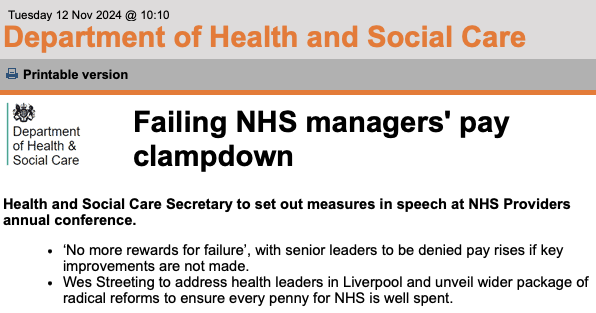
Our great leader Empty-Streeting, has pronounced. In the pursuit of excellence he proposes to introduce league tables of Trust performance and stop ‘failing leaders’ receiving pay rises…
… and give greater financial freedom to good performing Trusts.
Sorry, but;
Aaaaaaaaaaaaaaaaaaaaaaaaah!
Board level pay in Trusts is set by their remuneration committees. They may wish to take into account national pay scales but they don’t have to.
Section 5 of the NHS and Community Care Act 1990: covers the powers and responsibilities given to NHS Trusts, including flexibility in employment terms.
Streeting will have to change the law and take responsibility for paying senior managers into the DH+... or...
... try to somehow bully Boards from the sidelines.
He is talking about giving high performing Trusts greater financial freedom. He seems oblivious to the fact...
... NHS Foundation Trusts, established under the Health and Social Care (Community Health and Standards) Act 2003, are granted significant financial autonomy including…
… the freedom to retain [financial] surpluses and reinvest them into services or facilities as they see fit.
They can borrow capital within certain regulatory limits to support investments, such as upgrading infrastructure or enhancing services and...
... FTs have the discretion to invest funds to improve services, though it is true, investments have more recently been regulated to ensure the financial stability of the system and alignment with healthcare priorities.
He doesn't seem to realise it is the poor performing Trusts that generally need investment.
Nothing new to see here, move on. Nothing that will improve anything... walk away.
How about league tables?
League tables were first introduced in the NHS in 1998 under Tony Blair and Jumping Jack-Flash.
They were part of a broader effort to improve transparency and accountability and were intended to help drive improvements in the quality of care by publicly reporting the performance of hospitals.
They didn't.
They focused on hospital performance metrics, such as waiting times and treatment outcomes. So yer granny could see how long she might wait for her new hip.
League tables caused a row about their impact. They created perverse incentives and oversimplified complex performance data.
Eventually, they were phased out and replaced because of concerns about their effectiveness and unintended consequences…
-
Oversimplification of Performance: The league tables were criticised for oversimplifying complex performance data. By reducing a hospital’s performance to a single ranking, the tables often failed to account for differences in context, resources, patient demographics and case complexity… leading to misleading conclusions.
-
Perverse Incentives: The focus on ranking and performance targets led some NHS trusts to prioritise certain metrics over holistic patient care. For example, hospitals might focus on meeting waiting time targets rather than addressing broader quality issues, potentially sacrificing overall care quality.
-
Hacked off Staff: League tables were also criticised for placing undue pressure on NHS staff, as they could contribute to a culture of blame. Staff in lower-ranked hospitals felt demoralised rather than motivated, impacting morale and job satisfaction.
In plain English...
... count the number of hips done last week but if in three years time half of them have to be revised... measure that. Successful outcomes are dependent on population health, compare and contrast geography and measure that.
Eventually tables were replaced by the CQC and they've failed to improve quality or make the NHS any safer.
This sad list of yesterday’s stuff has got Jumping-Jack’s fingerprints all over it. It didn’t work for him and it won’t work for his apprentice.
What does work?
Sharing best practice, encouraging excellence. Find out why organisations are struggling and investing in them.
The causes of failure are usually three-fold;
-
geography, areas of deprivation, for instance the seaside towns or places with a poor demographic unemployment, disproportionate elderly population and places where, frankly, doctors and other professionals, with families don't want to live.
-
funding, under investment in capital and a balance sheet pushing a bow-wave of debt because Trusts are doing more work than they are funded for.
-
history, of quality issues, staff sickness, vacancies and a high turnover of Board level management.
Streeting can belly-ache from the sidelines until he's blue in the face.
He may think shouting, threatening and bullying from Whitehall makes him look tough...
... it doesn't, it makes him look very silly and inexperienced.
Managers are a soft target, they don't go on strike and organisations like the Confed and Providers, representing them, are useless because if they upset Whitehall, they're out of the tent.
The fact Streeting was given license to unload his abuse at Providers annual thrash, says it all.
When will he stop trying to look busy and do something useful? Start thinking for himself?
Find some decent advice and get on with what Labour was elected for… cutting waiting lists and sorting out social care.
When!
|