|
The Pinellas County Sheriff’s Office (PCSO) has the equipment and training for a robust hurricane response, as we showed after the county was ravaged by Hurricanes Helene and Milton. We also got a lot of help, with law enforcement agencies from around Florida sending people and equipment to assist with lifesaving and recovery. Every year, deputies with the Hurricane Deployment Team train to return the favor if a major storm hits elsewhere in Florida.
They train like they will deploy – arriving in a convoy with everything they need to set up a base camp where they might be living for days or even weeks. The camp is completely self-sufficient so they’re not a drain on the resources of a region stretched thin after a hurricane. Working in teams, they set up the huge inflatable tents consisting of a central quad with multiple wings, all air conditioned, with sleeping and dining quarters.
They have a mobile kitchen and bring all of their own food, feeding team members two hot meals a day. A trailer has three private full bathroom and shower units, two washers and dryers, and an ice maker. Tanks on that trailer can hold 300 gallons of fresh water and 800 gallons of wastewater. They can bring a refrigerated trailer for food and medical supplies, and since communications may be out after a hurricane they have a 100-foot radio communications tower.
All of this is powered by a massive and efficient diesel powered 200 kW generator with a 540 gallon fuel tank set up just outside of the camp. If run at a 150kW load this lasts 30-35 hours, but they generally don’t reach a 150kW load during a deployment so the run time on a single tank can be much longer.
The training was held in an overgrown area with hills and muddy lowlands, ponds where they could test out the limits of their high water vehicles, and plenty of heat and mosquitoes to mimic post-hurricane conditions. Hurricane Deployment Team members practiced driving the Humvee and the LMTV (Light Medium Tactical Vehicle) on uneven wet ground. The vehicles are modified for deep water, with an air intake snorkel and exhaust snorkel installed. Still, there’s a difference between how deep they should go under normal circumstances, and what they will risk in the name of life and safety. For normal travel, water shouldn’t be over the tires of the LMTV, but to save a life they’re prepared to push it to the limits.
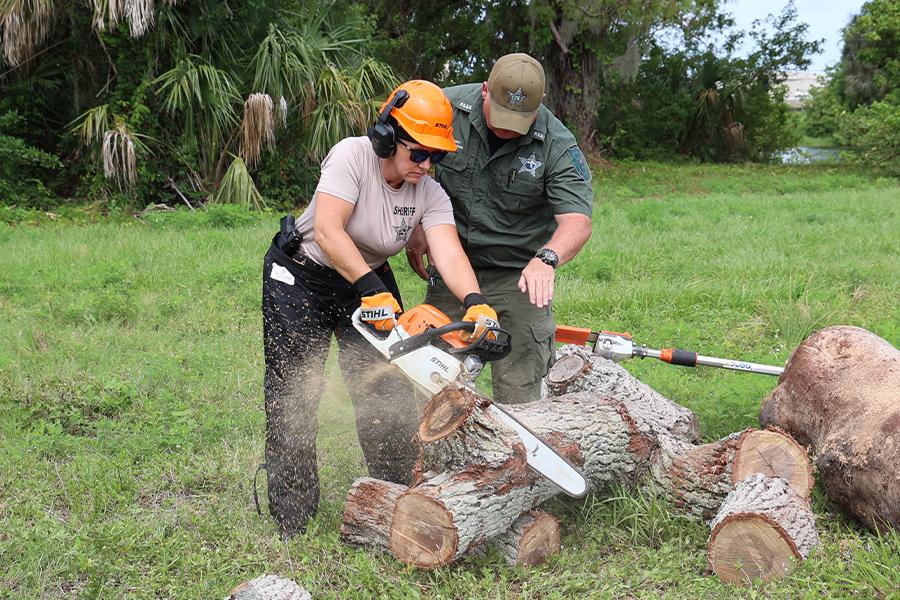
When they respond on the heels of a hurricane, the first priority is clearing the roads for emergency vehicles. The cut team with 20-inch chain saws will move through the county creating passages just wide enough for a firetruck to get through. Most members of the Hurricane Deployment Team have at least some experience with chainsaws, but at their annual training they got instruction from other members who have been certified by the U.S. Forest Service. They learned about safety gear, proper cutting technique, and how to get the attention of someone who is using a chainsaw.
The Hurricane Deployment Team will activate and respond to other counties when either the state or another sheriff’s office requests their assistance. In some recent hurricanes we just deployed equipment. When Hurricane Ian hit Charlotte County, we sent the washer and dryer trailer, the bathroom trailer, and the generator for them to use as they recovered. The team’s last major deployment was after Hurricane Michael hit Mexico Beach in the Panhandle.
Though the members of the Hurricane Deployment Team train specifically to help other counties, taking care of Pinellas is always our first priority. Under PCSO’s Emergency Management Division, the Emergency Preparedness Section and the Emergency Response Unit work full time to be ready to handle any large-scale disaster like a major hurricane. The High Water Response Team prepares to rescue people from storm surge and urban flooding, and when a hurricane hits every deputy is activated to do their part before, during, and after the storm. Just remember that despite all of our planning and training, when the storm is at its fiercest even our high water vehicles can’t respond to help you, so it is vital to evacuate if you’re in a mandatory evacuation zone.
Hurricane Season runs June 1st through November 30th. While we train to do our part, make sure you do yours by knowing your evacuation zone, having a hurricane kit, and getting your house ready for a storm. When a storm strikes, follow trusted sources like PCSO for the most accurate and up to date information.
|