View and share as a webpage.


Friday's Labor Folklore

Who was Fannie Sellins?

(1872-1919)

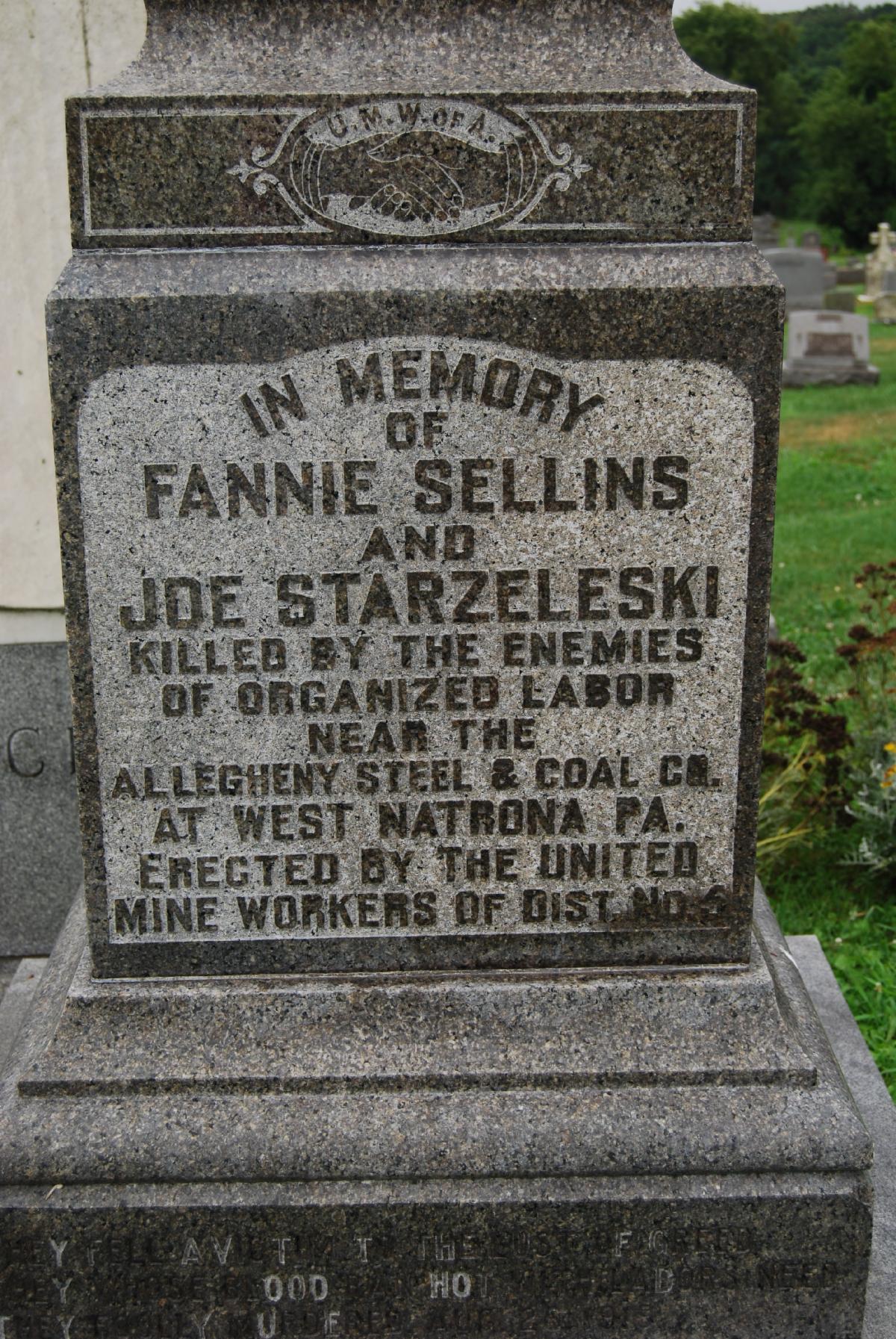
In Pennsylvania's Allegheny Valley, Fannie Sellins lives as a legend which inspires the workers' wives and daughters to steadfastedness in their unionism. A marble monument to her memory and Joe Starzeleski's stands over their graves in Union Cemetery at New Kensington. Annually, on Memorial Day, the women of the valley gather there to hold services and sing the "Fannie Sellins" song in this collection.


We're union women,

We're fighting for our cause. [2 times]

Just like the one who lies here before us,

We're fighting for our cause.


She fought so bravely for us,

We shall not forget. [2 times]

As one of the suffr'ing masses,

We shall not forget.


-- George Korson, Coal Dust on the Fiddle : songs and stories of the bituminous industry, Philadelphia, 1943.

  • Born Fannie Mooney in New Orleans, Louisiana she married Charles Sellers, a garment worker, in St. Louis, Missouri. In 1898, after his death, she started work at Marx & Haas, a St. Louis clothing manufacturer. She was a single mother with four children to support.
  • She helped organize the United Garment Workers Union, Local 67 where she became a union activist and leader. In 1909 workers there went on strike after a man - suffering from tuberculosis - was reprimanded for using the building's elevator, a violation of company policy. Fannie went on to help organize other clothing workers and her reputation became well known outside of St. Louis, especially in the Southern Illinois coal belt where she spoke at miners' rallies. (Rosemary Feurer in "History professor fights to shine light on St. Louis labor martyr." St. Louis Post-Dispatch, 8/19/2022 by Joe Holleman).
  • In 1913 she went to work for the mineworkers' union in West Virginia. She assisted miners' families by distributing food and clothing and assisting poverty-stricken mothers and children. She was arrested in Colliers, WV for violating an anti-union injunction and given a six-month sentence. In handing out the sentence the judge warned her "not to emulate Mother Jones."
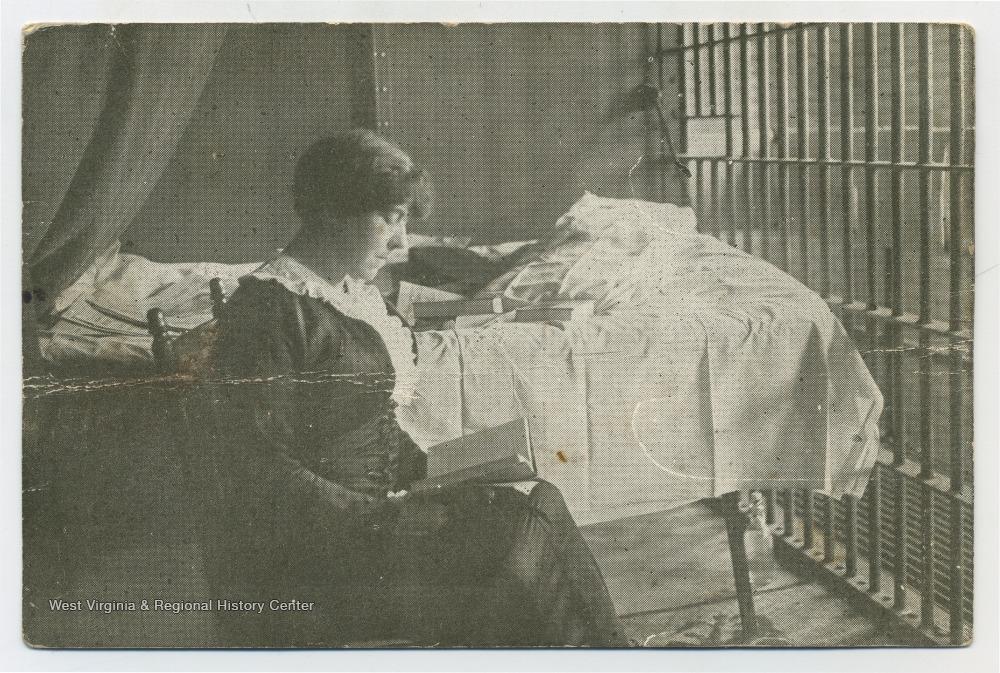
  • Her union - the United Mine Workers of America (UMWA) - launched a campaign to free her from the Marion County Jail. They printed thousands of postcards with a photo of Sellins sitting behind the bars of her cell in Fairmont, WV. On the back side of the card was a plea for her release addressed to the White House.

After a public outcry Fannie Sellins was pardoned by Woodrow Wilson in December, 1916. She moved to Pittsburgh and joined the staff of UMWA District 5 under the leadership of Philip Murray.

  • In 1919 the union assigned her to support the striking miners of the Allegheny Coal and Coke, a subsidiary of Allegheny Steel. She spoke at rallies, recruited steelworkers into the union and worked with the wives of miners and millworkers, many of whom were immigrants. (Charles McCollester, The Point of Pittsburgh : production and struggle at the forks of the Ohio, Battle of Homestead Foundation, Pittsburgh, 2008)
  • Violence broke out between picketers and guards at the entrance of the mine, just as Fannie and a group of women and children approached the picket line. Strikers were protesting the shooting of Joseph Starzeleski, a striker, who was lying on the ground, mortally wounded.
  • Fannie intervened during the confrontation and was struck in the face by a company deputy. When she attempted to flee, the deputies shot and killed her with four bullets. Fannie Sellins was murdered by the company's "coal and iron police" on August 26, 1919 in West Natrona, Pa. Afterwards they mocked her by wearing her hat and doing a little dance before a crowd of mining families.
  • Fannie Sellins' funeral was held in St. Peter's Church in New Kensington, Pa. on August 29, 1919. A crowd estimated at 10,000 marched in the funeral cortege for her and Joe Starzeleski. They both are buried in the Union Cemetery in Arnold, Pa.

Fannie Sellins

by

Tom Breiding


Fannie Sellins

by

Anne Feeney

Friday's Labor Folklore

Saul Schniderman, Editor


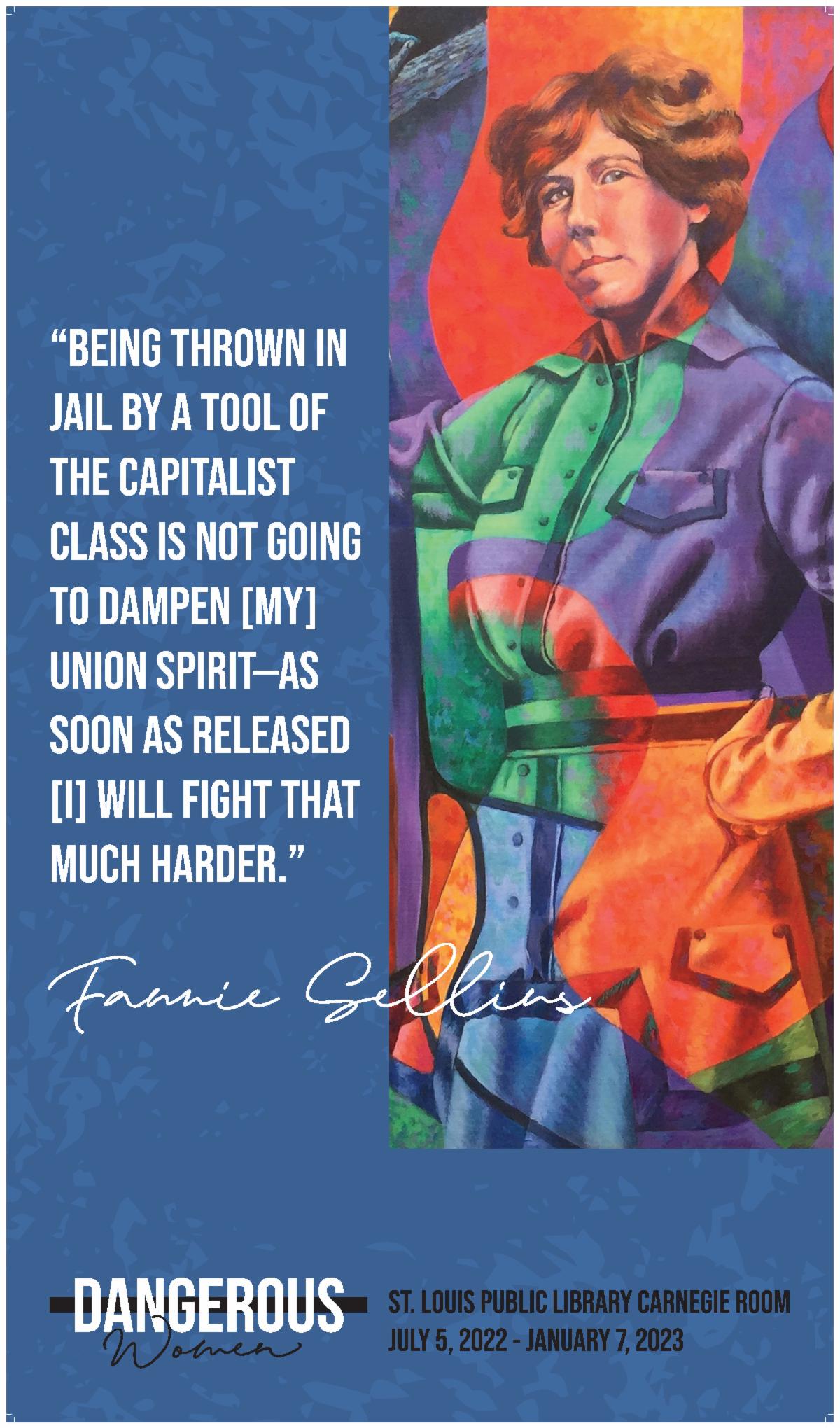
I am grateful to George Korson, Charlie McCollester and Rosemary Feurer (cited above) for their research. Other sources from which I quoted directly, summarized, or paraphrased are: W. L. Iams. "Fannie Sellins, Coal Field Organizer." Industrial Worker, n.d.; Rosemary Trump. "Tragedy in 1919, Fannie Sellins." Battle of Homestead Foundation, 11/30/2018. Bill Yund, "Fannie Sellins in The Black Valley," illustration; James Cassedy, personal letter to the editor, 10/6/86; "Fannie Sellins Historical Marker," explorePAhistory website 2023; Wikipedia. Poster artwork by Kathleen Scarboro.

I will always be on the side of those who have nothing and

who are not even allowed to enjoy the nothing they have in peace. 

-- Federico Garcia Lorca.

Ceasefire Now!