October 2026

Why Word Parts Matter for

Older Students

October is Dyslexia Awareness Month. When we think about dyslexia and reading difficulties, we often think about learning letter sounds, sounding out words, or remembering spelling patterns.


Those skills are certainly important, but as children move into the later elementary and middle school years, the words they encounter become longer and more complex.


At this stage, one skill that can make a significant difference is morphological awareness.

What is Morphological Awareness?


Morphological awareness is the ability to recognize and understand meaningful parts of words.


A morpheme is the smallest meaningful part of a word.


For example:

  • un + happy = unhappy
  • help + ful = helpful
  • teach + er = teacher
  • predict + able = predictable


Some morphemes are whole words or word bases, while others are prefixes or suffixes.


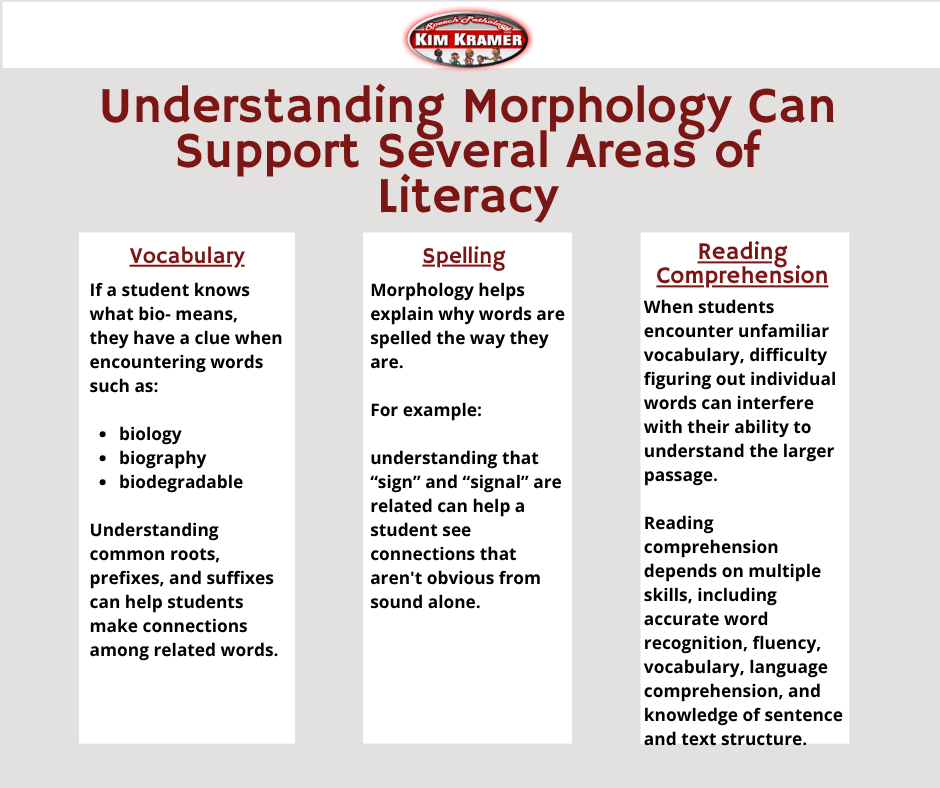
When students understand these word parts, they can begin to see that many seemingly complicated words aren't actually random collections of letters. They contain meaningful patterns that can help them figure out what words mean, how they are spelled, and how they are related to other words.

Why Does This Matter for Reading?


Consider the word "transportation". A student who recognizes transport and understands the suffix -ation has more information to work with than a student who sees the word as one long string of letters.


The same is true for a word like "unpredictable". A student may recognize:


un + predict + able


Now the word has structure and meaning.


For students who struggle with reading, breaking complex words into meaningful parts can provide another way to approach unfamiliar vocabulary.


Morphological knowledge also becomes increasingly useful as students encounter more academic vocabulary in subjects such as science, social studies, and literature.

Dyslexia Doesn't Mean a Student Can't Become a Strong Reader


Dyslexia can make learning to read more difficult, but students with dyslexia can develop strong literacy skills with appropriate instruction and support.


Effective instruction for students with dyslexia is explicit, systematic, and cumulative and addresses both foundational reading skills and the broader language skills needed for reading comprehension.


For older students, that means continuing to build foundational skills when needed while also expanding their ability to understand increasingly sophisticated words, sentences, and texts.

Does Your Child Struggle With Reading?


At Speech Pathology UES, we assess the language and literacy skills that support successful reading, including word recognition, vocabulary, language comprehension, and the ability to understand increasingly complex language.


If you're concerned about your child's reading development, we're here to help determine where they are struggling and what support may be appropriate.


Contact us to learn more about reading and language services.

Have questions or concerns about your child?


Contact Kim at 917-301-3293 or kim@speechpathologyues.com

Like our newsletter? Please feel free to share it with your family and friends!

Check out our new and improved website!


KIM KRAMER

Phone: 917-301-3293

Email: kim@speechpathologyues.com

215 East 79th Street, #1B

New York, NY, 10075


www.speechpathologyues.com/

 
We Are Social:
Facebook  Instagram