|
2130, Wednesday, July 256 2023
Why am I here? People often ask me why I have sailed to these remote regions. These waters are not frequented by cruising sailors. Indeed, in both Makkovik and Hopedale there has only been one other sailboat this season, and, the season ends soon. So, why have I come? It surely is an effort. There are several reasons I have taken this voyage north.
I grew up in a sailing family. My mom and dad and my brother, Bob and sister, Isabel all cruised together when I was young. Those family times were our very best. My dad always liked venturing a bit further, going another distance to explore a new island or bay. My siblings and I treasured those family times spent together, sharing adventures. It sparked my interest in sailing that would become a lifelong passion. It also nurtured my desire for exploration. Today I am a National Fellow of the Explorers Club, a testament to my sailings and my sharing of those expeditions with others through talks and writings.
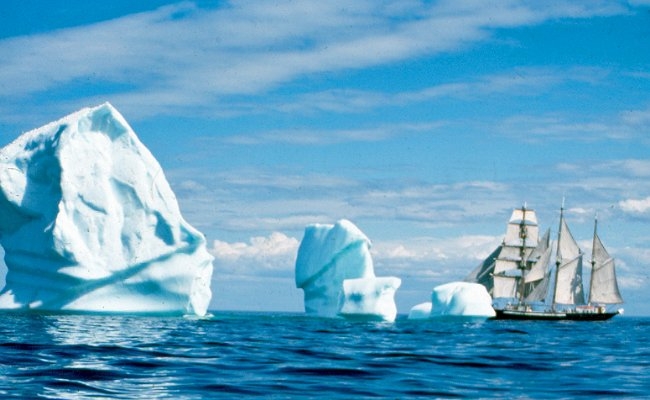
However, this particular voyage has other roots. At age 18 in 1977 I embarked on six months sailing aboard the Regina Maris, a 144-foot square-rigged barkentine built in 1908. With 30 souls aboard we were tracing migration routes of humpback whales, starting in their winter breeding grounds of the Dominican Republic and sailing north with whales to their summer feeding grounds in Newfoundland and Labrador. This fostered my love of nature and a concern for the environment. I experienced a people in Newfoundland and Labrador who lived so closely with their natural world, and who depended upon it intimately and sometimes desperately. The photo at the top of this post is of the Regina Maris that summer of 1977.
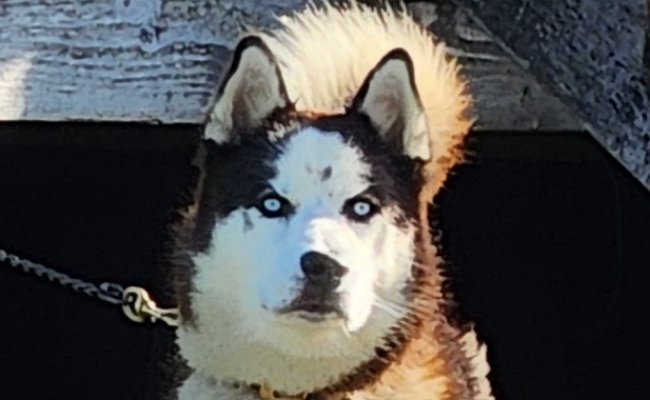
The other seminal thing that happened for me that summer was on a stop, here in Hopedale, my farthest north point for my current voyage. We sailed into port and dropped anchor. Two Inuit men came aboard, one only spoke Inuktitut, the other also spoke English. They invited us to see their community. They also cautioned us that we would see dogs outside homes, on chains. They said they are working dogs and we should not try to approach or pet them. Then, just as they were getting back in their boat, they also warned us not to go ashore on the small island just outside the harbor. The reason was that some people took their dogs out to the island in the spring and left them for the summer, returning in the fall to collect them.
I foolishly commented that it perhaps seemed like harsh treatment of the animals and wondered how they survive. He replied that they scavenge for anything they can, in some cases killing each other and eating each other. Again, I foolishly suggested that it seemd harsh or cruel. In one short sentence, he flipped my mind to his, the Inuit, viewpoint. He said, "Maybe you think so; but, when it is February and I am 25 Mike's from home in a blizzard, I want the dog that will get me home."
Now I understood. This was the way he and his family lived and survived. Make no mistake, they love their dogs. However, it is a question of survival, of not freezing to death on the ice, of brining caribou meat home to his family, of getting firewood to keep them warm. These people understood their place, their world. I just had not seen it through their eyes.
This was my first resounding lesson on how important it can be for all of us to strive to look at the world through other people's eyes. Understanding people's, their heritage their culture matters and makes us better suited to solving issues of the world. An Inuit hunter, dog sled driver, husband, father, fellow human taught me that lesson. I can only hope it resonates with you.
Lastly, these people have seen their natural world change. The cod moratorium of 1992 in Mwwfoundland due to over fishing. The shorter winters that have less frozen sea, limiting travel and hunting. For one reason or another, caribou no longer inhabit the coast around Hopedale. I have mentioned other changes in my emails. These people face these challenges head on, they feel them daily. I am happy to say that the community of Hopedale is now growing; it is now about 700 people. They endure, they adapt. They also know we are one world, one people. That ties to the message of my visit to L'Anse aux Meadows two weeks ago; the place where Vikings traveling west met up with North America's indigenous people of the north, one species, encircling Ling one planet. Actions of one can impact others The Inuit organized a large contingent for the most recent global climate meeting.
I think there are powerful lessons here. There is a richness in the people and a bold reality to the sea and land. I feel it inside me when I am here, when I am sailing a rocky coast, in fog, dancing with icebergs.
The Moravians named this place Hopedale when they arrived in the 1780s. For centuries before the Inuit called it Avertok - it means "Place of the Whales." When I came in 1977 there were many whales here. Today there are far fewer.
I want the dog that will get me home.
Bill
|