|
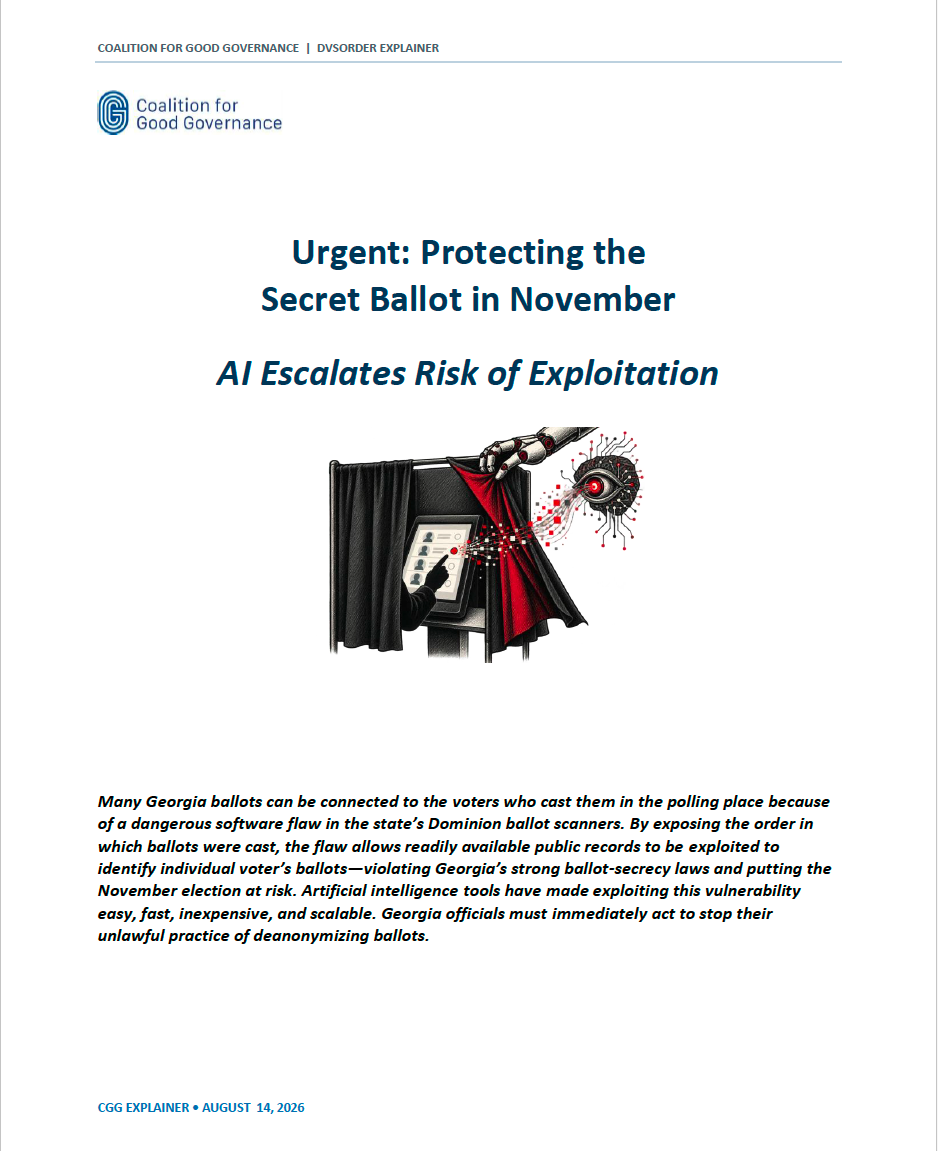
Click on our report above to read or download.
Simply reducing the number of people who may be able to see how a voter voted is not a lawful solution, when the statute mandates that “no one can know” how a voter voted. “No one” includes government officials, contractors, and vendors. Access restrictions cannot make an identifiable ballot secret. Information that should never be recorded cannot be made lawful merely by slapping a “CONFIDENTIAL” sticker on it.
Look no further than the abuses involving Flock camera data to understand why limiting sensitive information to insiders is not an adequate safeguard. No system can assume that every insider will always act properly—particularly when the information is as valuable and exploitable as a voter’s choices. Unlike information lawfully collected by Flock camera systems, identifiers that make ballot records traceable should never be recorded in the first place.
Georgia election administrators should not forget the unlawful release of the statewide system software in Coffee County, and the unauthorized disclosure by five counties of their highly restricted databases which are still published on a website. None of those breaches have been mitigated, more than 5 years after they occurred, and no one has been held accountable. Voters will have no confidence that such highly personal information as their votes will be more secure.
Such information could be extraordinarily valuable to campaigns, employers, vote buyers, or anyone seeking to pressure or retaliate or discriminate against voters. Its existence will also discourage people from voting if they fear that they may someday be called upon to account for their choices, or be quietly discriminated against for a job or position because of how they voted.
Given Secretary Raffensperger’s refusal to update the system software, (and no, he has not informed the legislature of the need, nor asked for money to deploy the patch), the burden of addressing this problem rests heavily on the counties. Counties have an independent legal duty not to use equipment that fails to preserve the required separation between a voter’s identity and the voter’s ballot. The Secretary of State does not have the authority to direct counties to use software that places traceable identifiers on ballot records and then treat restricted insider access as an adequate remedy. The Secretary cannot give counties a permission slip to circumvent the Georgia Constitution, Georgia statutes, or applicable federal requirements regarding ballot secrecy, including HAVA.
Multiple options are available. We urge every county election board to study the governing law and the alternatives thoroughly and to prepare an immediate plan ensuring that voters can cast their ballots lawfully, securely, and without fear that their choices can be traced back to them.
We have prepared a table describing five potential solutions, although other workable approaches may exist. Our strong preference is for a software patch, and we urge counties—individually and through GAVREO—to demand that the Secretary of State install that patch immediately.
If the Secretary refuses to act, or if all equipment cannot be patched in time because of the time required to update the touchscreen units, the alternatives include:
1. Partial update—scanners, server, and limited BMDs --Using hand-marked paper ballots with updated scanners and one updated touchscreen BMD at each polling place for voters who prefer an accessible ballot-marking device.
2. Central Count of Shuffled Early Voting Ballots- Using a central-count method of tabulation (with current software), with sufficiently large collections of ballots physically and thoroughly shuffled at the central facility before scanning.
3. Shuffling Election Day Ballots--Thoroughly shuffling large numbers of Election Day ballots in the precinct before scanning, in order to break the sequence connecting voter scanning sequence with the ordered CVR. Depending on local conditions, this might include shuffling ballots at Election Day polling places every few hours before bipartisan observed poll officials’ scan these groups of ballots.
4. Manual Counting --Manually counting ballots in small counties as a last resort if election officials cannot get comfortable with central counting or sufficiently thorough shuffling. We do not recommend manual counting as a practical approach for most counties, but a lawful alternative to the current process must be selected and deployed.
(See our table summary of alternatives.)
Our analysis indicates that early-voting vote centers process such a wide variety of ballot styles that large numbers of ballots may be required to achieve adequate shuffling to avoid the traceability issue. Each county must carefully evaluate whether its proposed procedures will actually break the recorded sequence between voters and their ballots. Election Day ballots require protection as well, although periodic local shuffling may be sufficient when conducted properly.
It was deeply troubling on Wednesday to see some election officials celebrate the State Election Board’s decision not to require corrective action, apparently on the theory that too little time remains to protect voters’ rights. A compressed time window does not excuse an unlawful election process. There is always time to honor voters’ constitutional rights!
Please ask your county attorney to review this information and the relevant legal authorities without delay. We also ask each county election board to begin developing and approving a concrete compliance plan immediately.
Finally, we urge counties to call upon the State Election Board to promptly reconvene and examine these security and privacy issues with qualified experts and meaningful input from county election officials on feasible lawful alternatives. This is the discussion that Board Member Salleigh Grubbs sought, but she was unable to obtain the support of the other members.
We would be pleased to provide a briefing to any county—or group of counties—wishing to examine the ballot-secrecy issue, how the AI tools work to connect the voter and ballot record, the applicable legal requirements, and the available solutions in greater detail. If you have a question, feel free to post it privately here. We will plan a FAQ public response promptly.
The right to vote by secret ballot is not optional, and protecting it cannot be postponed. Every Georgia county must act now to ensure that no one may know how another person voted.
Sincerely,
Marilyn Marks
Executive Director
Marilyn@uscgg.org
|