THE BENEFITS OF WISDOM
by Lois A. Bowers, McKnights Senior Living
| |
Read recent research on perceptions of wisdom and come away with ideas you can use to change your organization’s culture or programming as well as encourage residents to keep active and contributing in your senior living community, according to leaders at the Mather Institute, which conducted the study.
“It’s important to recognize and appreciate the wealth of experience and insight that residents can contribute,” Catherine O’Brien, PhD, MPH, senior vice president of Mather Institute and community initiatives, and Jennifer Smith, PhD, associate vice president and director of Mather Institute, told me in an email interview. “It could be valuable to provide avenues for residents to share their thoughts and apply their skills within the community if desired, such as leading resident interest groups or planning other events.”
The institute surveyed 745 people aged 55 or more years online in January 2023; 70% were Caucasian, 61% were female, 59% had a bachelor’s degree or higher, and 53% reported having incomes of less than $80,000.
The researchers found that 71% of survey respondents said they believed that wisdom increases with age. But the study also found that age in itself is not perceived as guaranteeing wisdom — only 39% of participants said they believed that age and wisdom are strongly related...
Read more here.
| |
BEYOND NEXT STEPS: Preparing students for their future lives
by Kirsten McHugh, Character.org
| |
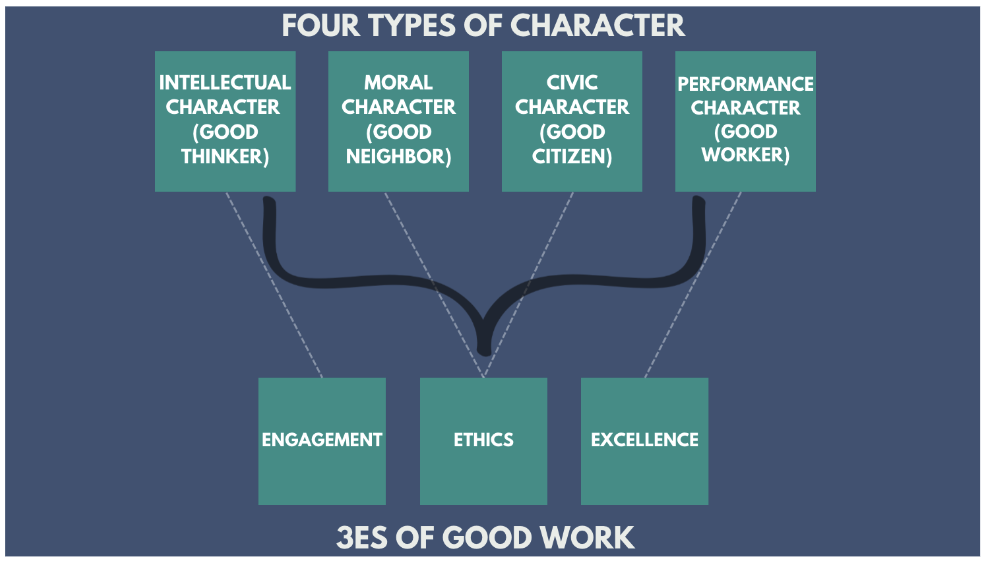
Character education can substantially impact students’ lives and the culture of schools where it is implemented. When students learn to nurture their character strengths and pay mind to the wellness and well-being of others, they can be freed up to attend to the higher-level disciplinary learning necessary for academic success. As just one small example: it’s hard to learn calculus if you have yet to master the self-regulation needed for extended periods of focused study.
While the short-term benefits of character education–and social-emotional learning more generally–are incredibly positive and should not be dismissed, it’s important to remember that we aren’t educating students only for the immediate future. Almost as a counter to the unfortunate politicization of this type of approach, we have seen numerous arguments made to persuade potential critics about how taking time to include this type of learning in the school day leads to “higher test scores,” “better behavior,” or “college success.” In truth, when we allow for investment in students’ character throughout their educational journey, we are planting seeds for them to eventually learn how to tackle the complex problems and difficult decisions that arise in our lives. Taking a step back to consider the entire arc of a person’s education, from primary school through adulthood, can illuminate the longer-term gains that an approach such as character education can bring.
We know that today’s children will be tomorrow’s leaders and citizens. What virtues, character strengths, and values do we hope those future leaders have...
Read more here.
| |
PHILOSOPHY CONCEPTS CAN GUIDE INTERVENTIONS AIMED TO PROMOTE WISDOM IN LATER LIFE
by George S. Alexopoulos
| |
Abstract: Positive Psychiatry has been defined as the science and practice that seeks to understand and promote well-being through assessments and interventions aimed at enhancing positive psychosocial factors (Jeste et al., 2015). It broadens the mandate of Psychiatry from treating psychopathology to enhancing the well-being of patients. Cultivation of wisdom is critical for personal growth because it can offer meaning and purpose to older adults who are forced to live with limitations...
Read more here.
| |
SHADOWS OF WISDOM: Classifying meta-cognitive and morally grounded narrative content via large language models
by Alexander Stravropulous, Damien L. Crone, & Igor Grossman
| |
Abstract: We investigated large language models' (LLMs) efficacy in classifying complex psychological constructs like intellectual humility, perspective-taking, open-mindedness, and search for a compromise in narratives of 347 Canadian and American adults reflecting on a workplace conflict. Using state-of-the-art models like GPT-4 across few-shot and zero-shot paradigms and RoB-ELoC (RoBERTa -fine-tuned-on-Emotion-with-Logistic-Regression-Classifier), we compared their performance with expert human coders...
Read more here.
| |
TEACHING FOR WISDOM IN A CHANGING EDUCATIONAL LANDSCAPE: A learning ecosystem approach
by Samia Henaine
| |
Abstract: Considering the rapid technological progress, the future raises many questions. Artificial intelligence transforms the world, and education is no exception as educators face the challenge of preparing students for an ever-changing future. This chapter presents “teaching for wisdom” as a solution, examining its integration with the learning ecosystem, and introduces practical strategies for embedding wisdom into the classroom experience. One of the central frameworks examined in this chapter is the continuum of understanding, which outlines the four-step process from data to wisdom and demonstrates how these characteristics align with ‘teaching for wisdom'...
Read more here.
| |
THE MEDIATING ROLE OF HEALTH-RELATED BEHAVIOR IN THE RELATIONSHIP BETWEEN WISDOM AND DEPRESSIVE SYMPTOMS IN OLDER POLISH ADULTS
by Magdalena Zadworna & Monika Ardelt
| |
Abstract: Although studies have shown that wisdom is positively related to mental health in older adults, little is known about its possible mechanisms. The current study examines whether health-related behavior can play a mediating role in the relationships between wisdom and geriatric depressive symptoms. Methods The study included 334 Polish older adults aged 60–99 years (M = 71.91; SD = 7.01). The respondents completed the Geriatric Depression Scale, Three-Dimensional Wisdom Scale, Health-Related Questionnaire for Seniors, and a sociodemographic survey. Results Three-dimensional wisdom and its three dimensions correlated negatively with geriatric depressive symptoms but positively with general health-related behavior and its factors. Health-related behavior acted partially as a mediator...
Read more here.
| |
|
THE FLOURISHING STUDENT: International webinar series
The Jubilee Centre for Character & Virtues
| |
Description: In recent years, many universities have expressed their commitment to a holistic, socially-engaged vision of higher education and are increasingly supporting students to develop character and attributes. These are the qualities necessary for students to navigate the fourth industrial revolution, flourish, and make a positive contribution to society.
Following on from the first webinar series, six more world-renowned universities and institutions recognised for their focus on character education share their knowledge and expertise. The international webinar series featured presentations on the role of universities in helping their students to cultivate the character and attributes required for human flourishing.
Series 2 programme dates:
25 Sept
12 Nov
27 Jan
1 April
6 May
TBD June
Read more and register here.
| |
IGNITE PSI CHI RESEARCH CONFERENCE 2024 | |
Description: Undergraduates, graduate students, and faculty: You are invited to attend a special research training/teaching conference funded by a grant from the National Science Foundation (NSF).
Join us to develop critical skills needed to conduct high-quality research and contribute to research projects of global scale that advance psychology as a science. IGNITE 2024 will provide a variety of presentations, workshops, and train-the-trainer sessions to address:
- need for improved research practices
- strategies to reduce barriers to student research involvement
-
cutting-edge open science initiatives (e.g., the Open Science Framework website)
-
benefits and evidence-based practices to implement collaborative, cross-cultural projects (e.g., Psi Chi’s NICE Crowd)
Read more and register here.
| |
If you have any questions, or would like to contribute a blog post, news item, or publication, please contact Jean Matelski Boulware at wisdom@uchicago.edu.
Center for Practical Wisdom
University of Chicago
| | | | |