Strategic Planning Corporation
Weekly Economic Update
| | |
One of the most interesting comments we get from people is the one that begins with the words, "I wish I knew this at age 25 ...." I've said it myself!
You know the things about which this is said. For instance, "I'm 41 and just now taking retirement seriously. I kept saying I'd figure it out later... later came faster than I thought." Sometimes this is due to failure to start saving and investing earlier when you first get a job. Sometimes it is due to saving and investing, but not investing your money prudently and letting it get siphoned off in off-the-wall investment schemes or too good to be true opportunities that are all too ready to come your way!
Another regret that is often expressed goes something like this, "Nobody told me how easy it is to dig a hole with credit cards. Minimum payments felt manageable... until they weren't." The drag of carrying a balance on a credit card at an unreasonable rate of interest eats into your ability to save and invest and just pushes that goal down the road until you have given up years of potential compounding of earnings from your investments for the compounding of interest expense on your credit card balances.
And the person who played it too safe - "I left everything in savings because I was scared to invest. Now I'm realizing inflation quietly ate away at it." We often see lost opportunity for greater potential gains that could have been compounded due to lack of knowledge or information and a fear of losing money. There's nothing wrong in not investing in something you don't understand, but there's really no excuse not to seek out someone who can help you gain the knowledge and confidence to make a better investing decision that could lead to better long term results versus stashing money in the bank. Nothing wrong with having some funds in the bank, but that isn't investing. That's saving. And there is a difference.
This is a big one - Ignoring an employer's 401(k) matching contribution. "My company was literally giving free money and I didn't take it for too many years." Sometimes one of the previous discussed errors contributed to the failure to take advantage of that free money. That's why it is so important to get advice early in your life. Make sure your kids and grandkids are exposed to prudent investing principles - use your financial advisor to provide that.
We present various workshops throughout the year and love to see younger people come with their parents or grandparents to get a head start on good investing principals. That helps them put a plan in place to succeed so they don't waste time on matters that can take them sideways for decades leaving them having to hustle to catch up on the missed time. Hope you will take advantage of these and invite your family or friends to get in on the education.
I'll give you one thing that you will want to make sure your younger family members know about. The Saver's Match that was the result of an early 2026 presidential executive order. It provides for a matching contribution to a traditional IRA for people earning under $35,000 per year who do not have available an employer-sponsored retirement plan. The Saver's Match provides for a government contribution match of up to $1,000 per year for these workers and it takes effect in January 2027 - just around the corner. The matching contribution is equal to 50% of what the worker invests in the IRA up to $2,000 from the worker. So you get that maximum government matching contribution of $1,000 if you invest at least the $2,000 required amount to max out the match. That would put $3,000 into your IRA each year you continue to earn less than $35,000. The first money would come in upon filing your 2027 tax return in early 2028, but you have to have invested your own money in the IRA during 2027. There are still details to be worked out and we are keeping tabs on the rollout of those details, but anyone you know who may be earning less than $35,000 per year should be made aware of the opportunity and get with us to be ready to get the maximum matching contribution.
Hey, additionally, we may find out that us older folks may also qualify if we are still working, maybe a part time job, without benefits and earning under that $35,000 threshold per year. We'll let you know as we find out more so you too might be able to take advantage of the Saver's Match.
Enjoy the rest of this week's read.
| | Want to access our Podcast for current and past episodes? You can use this QR Code to go to the website where you can find the full archive of all podcasts beginning with the most recent to oldest. Enjoy! | | |
Weekly Economic Update
for the Week of
January 5, 2026
Quote of the Week:
“You can’t go back and change the beginning, but you can start where you are and change the ending.”
~ C.S. Lewis
| | |
The Week in Brief
Stocks ended last week mixed as a tug-of-war between strong economic data, cooler job growth, and decades-high Treasury yields played out.
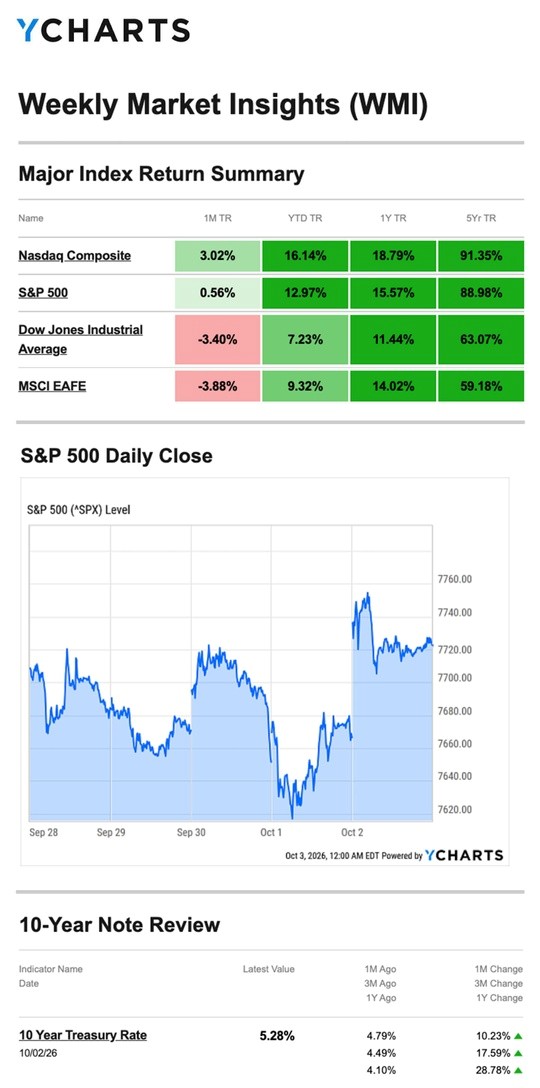
The Standard & Poor’s 500 Index edged down 0.27 percent, while the Nasdaq Composite Index rose 0.45 percent. The Dow Jones Industrial Average slid 1.26 percent. The MSCI EAFE Index, which tracks developed overseas stock markets, fell 1.81 percent.1,2
A Mixed Week
Stocks fell at the start of the week as Treasury yields continued to rise. They steadied over the next session with Treasury yields still in the spotlight. The benchmark 10-year Treasury yield topped 5.29 percent, up 133 basis points from its year-to-date low in late February.3,4
Markets perked up midweek after a revision to Q2 GDP showed the economy grew faster than originally estimated. Quarterly earnings results for a large semiconductor also supported markets, while rising oil prices kept enthusiasm in check.5,6
After a soft jobs report, stocks opened higher on Friday, with investors wondering whether the Fed would adjust rates at the end of the month. The AI trade roused once again to lead the Nasdaq to a fresh intraday record and end the week on a high note.7
| | Source: YCharts.com, October 3, 2026. Weekly performance is measured from Monday, September 28 to Friday, October 2. TR = total return for the index, which includes any dividends as well as any other cash distributions during the period. Treasury note yield is expressed in basis points. | |
Contrasting Economic Data
Q2 GDP was revised upward from 1.5 percent to 2.2 percent, flipping the economy’s trajectory over the first half of the year from slowing to growing.8
On the other hand, the latest jobs report showed job growth slowed in September to 29,000 jobs added, a falloff from August’s downwardly revised 133,000 job gain (from 162,000). Jobs added in July were also revised down, reflecting a total well under 200,000 for Q3.9
Also in the mix was last week’s Personal Consumption Expenditures (PCE) Index report, which showed inflation held steady in August at 3.4 percent over the prior 12 months. The Fed’s long-standing target has been 2 percent inflation.8
This Week: Key Economic Data
Monday: Purchasing Managers Index (PMI)—Services.
Tuesday: Trade Balance. Dallas Fed President Lorie Logan speaks.
Wednesday: Federal Open Market Committee (FOMC) Meeting Minutes. Consumer Credit.
Thursday: Weekly Jobless Claims. Monthly Wholesale Trade.
Friday: Consumer Sentiment (U. Michigan Survey). Kansas City Fed President Jeffrey Schmid speaks.
Source: Investor’s Business Daily - Econoday economic calendar: October 2, 2026.
The Econoday economic calendar lists upcoming U.S. economic data releases (including key economic indicators), Federal Reserve policy meetings, and speaking engagements of Federal Reserve officials. The content is developed from sources believed to provide accurate information. The forecasts or forward-looking statements are based on assumptions and may not materialize. The forecasts are also subject to revision.
This Week: Companies Reporting Earnings
Thursday: PepsiCo, Inc. (PEP)
Friday: Delta Air Lines, Inc. (DAL)
Source: Zacks, October 2, 2026 Companies mentioned are for informational purposes only. It should not be considered a solicitation for the purchase or sale of the securities. Investing involves risks, and investment decisions should be based on your goals, time horizon, and risk tolerance. The return and principal value of investments will fluctuate as market conditions change. When sold, investments may be worth more or less than their original cost. Companies may reschedule their earnings reports without notice.
| | |
FEATURE ARTICLE
The Real Danger of a Market Bubble Comes When You Think You Can Predict It
Investor Minute
| | |
Many people believe that the stock market is due for a major “correction.” The term is commonly used to label a short-term market decline of 10-20%.
Earlier this month, Jason Ma, weekend editor for Fortune, wrote, “Investors should enjoy the final months of 2026 while they can as the AI-led stock market boom is soon to bust, according to analysts.”1 He then cites a senior market economist who forecasts a 7.7% gain for the S&P 500 from now through December, followed by a 21% drop in 2027.
And it’s not just credentialed analysts who think we’re headed for a crash.
Wall Street Journal columnist Jason Zweig asked his newsletter readers if they thought we were currently in a stock market bubble. Many in this presumably financially astute group answered yes.2
One way to predict an event in the future is to look at the major factors leading to its occurrence in the past. Many are looking at the dramatic dot-com collapse of 1999 as the model for an AI-led collapse today. Several factors back then seem to be present today: stock prices were high, volatility and trading volume were way up, and many people believed that a huge correction was imminent.
However, Zweig points out that while our current stock market may have these attributes, it’s missing other key factors present in 1999. For example, we don’t see a large number of new stock offerings. Also, instead of chasing performance (“buying the rip”), which characterizes behavior in a bubble, today’s investors have been purchasing stocks based on bad news (“buying the dip”).
But, says Zweig, the real danger in trying to spot a bubble comes when you believe you can actually do it. And in anticipation of the predicted crash, you sell your stocks or change your long-term strategy, most likely incurring unnecessary costs and missing out on potential future market gains.
Since nobody can know for sure if we’re in a bubble or just an unusual phase of market growth, the prudent investor will accept that uncertainty, holding a broadly diverse portfolio and not trying to overload on “winners” or supposedly safe alternatives.
Working closely with their trusted advisor, they know that periodic corrections should be expected but cannot be predicted. This risk is simply the cost of participating in a wealth-creating market.
Whatever forecasters are saying, your best chance for successfully saving for retirement will come from following a long-term plan with patience and discipline.
Sources:
1. https://fortune.com/2026/09/13/stock-market-outlook-late-stage-bubble-crash-2027-treasury-yields-5-percent/
2. https://www.wsj.com/finance/stocks/why-its-so-hard-to-spot-a-stock-market-bubble-63f40a1c
| | |
Weekly Tip
A thought to consider!
Wrap Your Sandwiches Before You Eat Them
Here's a simple trick that might change your sandwich game forever. After making a burger, sub, or breakfast sandwich at home, wrap it in food wrapping paper, just like a deli would, and let it sit for 10 minutes before eating. This resting step lets the ingredients come together, soften, and reach a cohesive temperature. It's often the missing step when a homemade sandwich just doesn't hit the way your favorite spot's does.
Tip adapted from BuzzFeed10
| | |
Riddle of the Week:
Simply talk about it, and you will break it. What is it?
Last Week's Riddle:
There is a 7-letter word that starts with BR and ends in G, and if you put an E in it, you get an 8-letter word that sounds the same yet has a different meaning. Name these two words.
Last Week's Answer:
Braking and Breaking.
| | |
Thank you for reading this newsletter. We want to be the financial partner you need . . . the financial partner you can trust. Call on us at (336) 668.4338 for anything we can do to help you.
Please feel free to forward this article to family, friends, or colleagues. You may use the "Forward email" link at the bottom of this page. If you would like us to add them to the list, please reply to us with their address and we will contact them and ask for their permission to be added. Thank you.
Sincerely,
R. Michael Flanders, CLU, CFP®
Certified Financial Planner™professional
Strategic Planning Corporation
mike@SPCinvesting.com
www.SPCinvesting.com
(336) 668-4338
| | |
Blueprint Financial Advisors (“Blueprint”) d/b/a Strategic Planning Corporation is an investment adviser registered under the Investment Advisers Act of 1940. Please note any trade orders received via email or voicemail cannot be honored. Any disclosed data was obtained from third parties deemed by us to be reliable. Nonetheless, we have not verified the results and cannot be assured of their accuracy. This message (including any attachments) is confidential and may be privileged. If you have received it by mistake please notify the sender by return email and delete this message from your system immediately. Any unauthorized use or dissemination of this message in whole or in part is strictly prohibited. Please note that emails are susceptible to change. Electronic communications through Blueprint Financial Advisors systems are the property of Blueprint Financial Advisors. Blueprint Financial Advisors LLC reserves the right to monitor, audit, record or otherwise retain electronic communications at any time for appropriate business usage, standards and compliance with applicable laws and regulations. Anything in this email should not be viewed as investment advice.
All expressions of opinion reflect the judgment of the authors as of the date of publication and are subject to change. Past performance is not indicative of future results. Investment return will fluctuate so that an investment may be worth more or less than the original cost at the time of withdrawal.
Past performance is not indicative of future results. The material above has been provided for informational and educational purposes only and is not intended as legal, tax, or investment advice or a recommendation of any particular security or strategy or of any particular strategy or investment product. The investment strategy and themes discussed herein may be unsuitable for investors depending on their specific investment objectives and financial situation.
Information obtained from third-party sources is believed to be reliable though its accuracy is not guaranteed.
Information contained on third party websites that Strategic Planning Corporation may link to is not reviewed in their entirety for accuracy and Strategic Planning Corporation assumes no liability for the information contained on these websites.
An index is an unmanaged portfolio of specific securities. The performance of which is often used as a benchmark in judging the relative performance of certain asset classes. It should not be assumed that past performance in any way relates to future results. An investment cannot be made directly in an index. An index does not charge management fees or brokerage expenses, and no such fees or expenses were deducted from the performance shown.
Investing Risk: Investing involves risk, including possible loss of principle.
Dow Jones Industrial Average: A stock market index composed of 30 of the largest companies in the United States.
MSCI EAFE Index: Serves as a benchmark of the performance of major international equity markets, as represented by 21 major MSCI indexes from Europe, Australia, and Southeast Asia.
Nasdaq Composite Index: A market capitalization-weighted index of more than 2,500 stocks listed on the Nasdaq stock exchange. It is a broad index that is heavily weighted toward the important technology sector.
S&P 500 Index: A widely used U.S. equity benchmark. It contains 500 U.S. stocks chosen for market size, liquidity, and industry group representation.
| | |
CITATIONS:
1. WSJ.com, October 2, 2026
2. Investing.com, October 2, 2026
3. CNBC.com, September 28, 2026
4. CNBC.com, September 29, 2026
5. WSJ.com, September 30, 2026
6. CNBC.com, October 1, 2026
7. WSJ.com, October 2, 2026
8. WSJ.com, September 30, 2026
9. WSJ.com, October 2, 2026
10. BuzzFeed, October 15, 2025
| | | | |