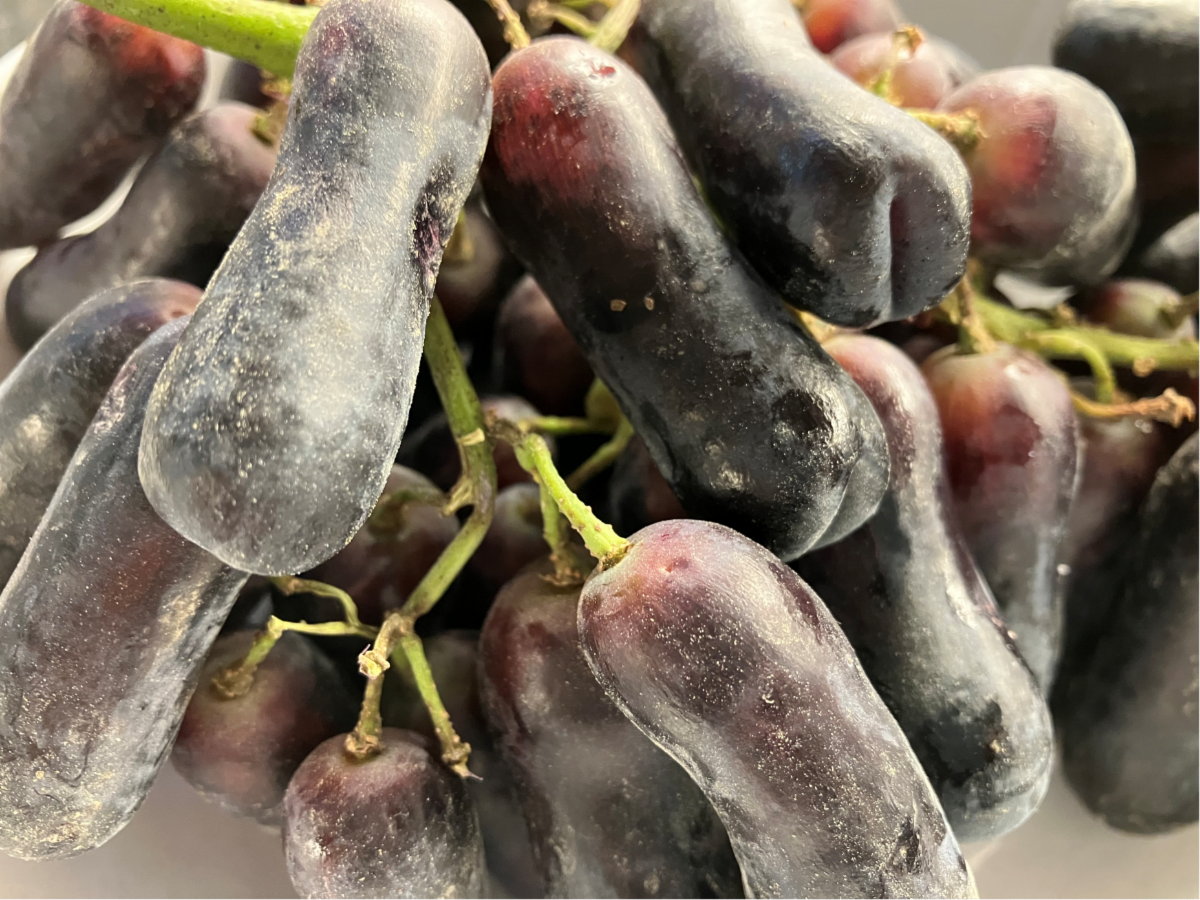
WITCH FINGERS AND MOON DROPS | |
|
Today is Halloween, and yes, I have some Witch Fingers in my fridge. Well, technically, they're Moon Drops. I'm talking about grapes, of course.
These spooky-themed table grapes have long, tubular, seedless berries with snappy skin and a flavor some compare to Welch’s grape concentrate. Their skins may be dark red (Witch Fingers, which taper to a pointy end), dark blue (Sweet Sapphire, a.k.a., Moon Drops, as they’re marketed by Grapery) or green (Tear Drops). The elongated shape was an innovation from University of Arkansas and further crosses at International Fruit Genetics led to Witch Fingers, a name trademarked by Grapery. To my mind, these were some of the first varieties that went beyond more utilitarian traits like yield, texture, sweetness, seedlessness and postharvest hardiness to push the boundaries of reality. I mean, grapes are round (more or less). Aren’t they?
As I was thinking about (and snacking on) these oblong oddities, a news item dropped into my inbox titled, “Could Salt Water Be the Solution to Future Irrigation Woes?” Recognizing the dwindling supply and declining quality of water, the article explains this existential issue for farmers. “You can’t water plants with salt water because it’s too dense; plants [can’t] absorb it through the soil. Instead, higher salt levels leech water out” and eventually kill them. However, scientists in Saudi Arabia have successfully integrated salinity tolerance from crop wild relatives into cherry tomato plants that can be watered with salt water, which the world has in abundance. The plants produce more sugar to counteract the higher levels of salt, so the super-sweet fruits are a commercial hit. Of course, these are greenhouse plants, grown hydroponically. Obviously, with a permanent crop like grape, open-field irrigation using salt water poses soil health and root zone issues. But the point is, scientists are bending the rules of plant biology to adapt to the reality of water scarcity.
None of these grape or tomato varieties were gene-edited or even genetically modified. The DNA of other species were not mixed in to create some crazy frankenfruit. To be sure, with their elongated shape and dimpled ends, Moon Drops could appear to be grapes from outer space. But no, they’re the product of traditional breeding.
Yet traditional breeding itself has changed. The understanding of gene expression and the identification and application of markers (regions of DNA) for traits of interest has improved and accelerated breeders’ ability to improve beloved varieties and make innovative new ones. Varieties that once took decades to develop now come to market in 10 to 12 years. Further discoveries in grape genomics will enable breeders to zero in on specific genes to work a kind of scientific magic. Faster, more precise breeding may help to head off to grim realities we can’t even fully anticipate or imagine.
Just think of grapes that are adapted to a chaotic climate and “born digital” vineyards that are adapted to mechanization and precision farming. Imagine viticulture free of pests and diseases, grapes that can do more with less. If we can transform table grapes into Witch Fingers, there’s no telling what we can do!
| |
Learn MyEV: An Open-Access Vineyard Visualization Tool | |
|
Calling all extension faculty, educators, viticulturists, growers, crop consultants and crop advisors! The Efficient Vineyard project team is providing a free, online introduction to this open-access vineyard visualization platform and training on how to use its precision management applications on November 28, 2023.
MyEV is a web-based tool developed as part of the NGRA-initiated, SCRI-funded Efficient Vineyard project and is used to integrate vineyard data spatially based on vineyard maps. It was created to make data management and visualization easy and straightforward so that everyone can use it! Now, it’s your chance to see how to apply it to your vineyard operations.
Participants will learn how to obtain spatial data from their farms/research plots, see how to upload and manage the data in the platform, and use it to make decisions and farm more efficiently. Learn more and register.
| |
Help Crown the Rich Smith Award Winner | |
|
Nominations are now closed for the Rich Smith Award of Excellence, so named to honor the legacy of an icon in the US grape and wine industry. But you can be there the moment the winner is announced!
Rich was the co-founder, along with his wife Claudia, of Valley Farm Management, Paraiso Vineyards and Smith Family Wines in California’s Santa Lucia Highlands wine region. He also was integral to the founding of NGRA, WineAmerica and Winegrape Growers of America (WGA). The three organizations join with the Smith Family annually to confer the Rich Smith Award at the WGA Leadership Luncheon, to be held on January 24, 2024, in Sacramento, CA. Get tickets now!
| |
Joseph E. Gallo Recognized for Lifetime Achievement | |
Joseph E. Gallo served as president and chief executive officer of E. & J. Gallo Winery, an NGRA member-organization, from 2000 to 2020, “calmly chart(ing) a course for the world’s largest wine producer,” writes Wine Enthusiast’s Jim Gordon. “Under his leadership, the privately held wine company welcomed a third and fourth generation of Gallo family members into the business and virtually reinvented it in the process.” For a lifetime of stellar accomplishments benefiting the wine and spirits trade, and three generations of consumers, Wine Enthusiast will bestow on Joe Gallo its Lifetime Achievement Award. He’ll be honored at the magazine’s Wine Star Awards on February 5, 2024, in Miami. | |
Nat DiBuduo Honored with Inaugural Whole Vine Festival | |
The inaugural Whole Vine Festival, held October 21-22, 2023, in Fresno, CA, was dedicated to Nat DiBuduo, a longtime grape industry leader and advocate. Nat grew up on his family’s table grape vineyard in California’s San Joaquin Valley and graduated with a Plant Science degree from Fresno State, focusing on viticulture. He served on various Boards of Directors, including NGRA’s, until his retirement after 18 years as President of Allied Grape Growers, an NGRA member-organization. Nat is credited with helping to found the Whole Vine Festival, which was conceived to celebrate the table grapes, raisins and wines produced in the San Joaquin Valley, and launched this year. He was honored on the event’s opening day. | |
Walt Mahaffee Is Acting Research Leader in Corvallis | |
|
On October 1, Walt Mahaffee began a one-year detail as Acting Research Leader at the USDA-ARS Horticultural Crops Disease and Pest Management Research Unit (HCDPMRU) in Corvallis, OR. A plant pathology researcher by training, Walt’s research spans epidemiology, microbial ecology, fluid mechanics, genomics and mechanical engineering to develop sustainable production systems for wine grapes and other small fruit. His team’s research has resulted in the commercial implementation of several biological control agents, inoculum monitoring tools, disease forecasting models and cultural practices for disease management.
Walt succeeds Inga Zasada as Research Leader. Inga will refocus her career on her strong, highly collaborative and impactful scientific program within the unit, and other leadership roles and partnerships.
| |
Irrigation Expert Leads UC Kearney and West Side RECs | |
|
Atef Swelam, an irrigation engineer known for improving water-use efficiency, started on August 10, 2023, as director of the Kearney Agricultural Research and Extension Center (REC) in Parlier, CA, and West Side REC in Five Points, CA. Both facilities are part of a network of centers operated by University of California Agriculture and Natural Resources (UC ANR).
During the World Food Forum this month, Atef was recognized by the United Nations’ Food and Agriculture Organization as a “Water and Food Hero” for his work on irrigation techniques that save water and boost yields across the Nile Delta and beyond. The long-term mechanized raised-bed (MRB) irrigation program he developed for wheat is a prominent example of the technology for which he has garnered international honors. It has been found to help growers reduce applied water by 25% and cut farming costs by 25%, while boosting fertilizer use efficiency by 30% and increasing yield by 25%. MRB is applied by more than 2 million farmers in the Middle East and North Africa to a variety of crops.
| |
CLEREL Welcomes New Grape IPM Specialist | |
Cornell Cooperative Extension of Chautauqua County’s Lake Erie Regional Grape Program this month welcomed German Vargas as the new statewide Grape Integrated Pest Management (IPM) Specialist and Extension Associate at the Cornell Lake Erie Research and Extension Laboratory (CLEREL) in Portland, NY. In this new role, German will help grow and sustain the wine and grape industry in New York State and Erie County, PA, by developing, demonstrating and guiding IPM efforts, and generating and advancing knowledge in sustainable pest management in grape agroecosystems. A native of Colombia, German is an award-winning entomologist with more than 40 peer-reviewed and extension publications. He cites grape berry moth and spotted lanternfly as his two top pest priorities as he gets started. | |
New Farm Manager Named at MSU SWMREC | |
A new farm manager started this month at the Michigan State University (MSU) Southwest Michigan Research and Extension Center (SWMREC) in Benton Harbor, MI. Michael de Schaaf was previously the owner of a vineyard management company, a viticulture and enology educator and winemaker for nearly three decades. He now oversees research and extension projects involving grapes and other specialty crops at the SWMREC. He also will partner with the center coordinator and staff to draw up budgets, oversee maintenance of buildings and equipment, and develop and maintain relationships with growers and industries throughout the region. The SWMREC is known for its viticulture research and annual Viticulture Day each summer for growers and wine industry representatives, making Michael a natural fit. | |
AFRI Funds Study on Economics of Climate Change for Specialty Crops | |
|
The USDA’s National Institute of Food and Agriculture (NIFA) announced this month an investment of nearly $22 million in agricultural economics research, under the Agriculture and Food Research Initiative’s (AFRI) Foundational and Applied Science program. Of the 41 projects funded this year, one relates to viticulture.
Over the next three years, UC Davis scientists will analyze the effects of weather, climate change, adaptation and natural resource scarcity through the lens of California irrigated agriculture. Specifically, the research will quantify the effect of weather and climate change on the revenue of specialty crop growers. It focuses on the quantity and quality of production, including post-harvest losses, considering climate change impacts and potential of mitigating effects of climate-smart agricultural practices.
| |
OWB Funds More Than $350K in Grape Research | |
In fiscal year 2022-2023, the Oregon Wine Board (OWB) committed $359,409 to seven viticulture and enology projects that were reviewed and recommended to the Oregon Wine Board by its Research Committee. Viticulture projects included the study of common vineyard threats and diseases in the state, grapevine irrigation and rootstock performance. Enology projects focused on understanding the role of wine microorganisms and the effects of smoke taint. See pages 26-27 of the OWB’s annual report for an overview of the Board’s research accomplishments and links to summary reports for funded projects. | |
UC Davis Seeks an Assistant Professor of Wine Chemistry | |
The College of Agricultural and Environmental Sciences at the University of California announces an Assistant Professor of Wine Chemistry faculty position in the Department of Viticulture and Enology on the Davis, CA, campus. Applications are encouraged from candidates with a strong background in any current or emerging area related to wine chemistry. This academic year (9-month), tenure-track position has teaching, research, outreach/engagement and service responsibilities. It will remain open until filled but to ensure consideration, apply by December 1, 2023. | |
|
IT’S NOT JUST YOUR NEIGHBOR’S VINEYARD—
PATHOGENS CAN TRAVEL THE WORLD ON DUST
By Krishna Ramanujan, Cornell Chronicle
| |
|
Plant pathogens can hitch rides on dust and remain viable, potentially traveling across the planet to infect areas far afield, according to new NASA-funded research led by Cornell AgriTech’s Kaitlin (Katie) Gold. The findings, co-authored by Katie, published last month in the journal Environmental Research Letters, are the first to provide computer modeling evidence to support the idea that massive dust storms can transport viable pathogenic spores across continents and oceans.
Step one of the project was to modify an existing Earth system model to simulate a major, global dust storm. Nicknamed “Godzilla,” the simulated storm brought some 24 million tons of dust from North Africa across the Atlantic Ocean to the Caribbean and southeastern United States in summer 2022. In its aftermath, the researchers found that viable spores of the deadly soilborne fungal plant pathogen Fusarium oxysporum (F. oxy) could be transported across the ocean and likely deposited across a range of regions that include agricultural production zones, most significantly in southeastern Louisiana, Mexico, Haiti and the Dominican Republic, with particularly high risk in Cuba.
“We found that this Godzilla dust event could have potentially brought over 13,000 viable live spores, which is not a lot, but it’s never been shown before, by any means, that viable soilborne pathogens could be transported trans-oceanically with dust,” Katie said.
Previous research of F. oxy viability showed that 99% of all spores are killed off within three days of being airborne due to ultraviolet radiation exposure—a factor included in the model.
“For long-distance transport, when we just look at total spores, including ones that maybe deactivated while they’re in the atmosphere, we see there are many that are traveling very long distances,” said Hannah Brodsky, the paper’s first author, who conducted the work as an undergraduate in the lab of Cornell Engineering’s Natalie Mahowald. “What really limits potential disease spread via long-distance transport is whether they're still viable by the time they land in an agricultural region,” Hannah said. Accordingly, areas which are closer to the pathogen’s source and grow common crops are at greater risk, but may still be continents away.
Soil-adapted F. oxy is found on all six crop-producing continents and can infect more than 100 crops and other plants, including grapevines, leading to losses of up to 60% of crops and hundreds of millions of dollars in some areas. Though F. oxy is not equipped to survive well when airborne, the team found that the pathogens could attach to soil particles in dust clouds. The research offers a “novel danger index” for modeled viable spore deposition in agricultural zones and a view to understanding how and how far fungal diseases may spread.
The researchers note that the study is preliminary. Future work will focus on gathering observational data for corroborating the model’s results—including creating remote sensing maps of real-life (not just simulated) dust storms and genomic comparisons of F. oxy between dust sources and areas of disease outbreaks.Further work as part of the NGRA-supported NASA Acres project will expand and translate these findings to assess powdery mildew dispersal risk in grapes and other specialty crops at national and regional scales.
Sharifa Crandall, a plant pathologist at Pennsylvania State University, and Ryan Pavlick, a research technologist at NASA Jet Propulsion Lab, are co-authors. Hannah Brodsky is now a researcher at the National Renewable Energy Lab in Golden, CO.
This article was adapted from the original, entitled “Live Plant Pathogens Can Travel on Dust across Oceans,” published in the Cornell Chronicle on October 10, 2023.
| |
|
Washington State Wine Commission
The Washington State Wine Commission (WSWC), an NGRA member-organization, has launched a new web portal to receive and track all viticulture and enology research proposals. The Washington Wine Research Grant Portal opened October 1, 2023, and is accepting research grant applications for Fiscal Year 2025 (July 1, 2024 through June 30, 2025). A preproposal application is now required for all new grant applications. The deadline for preproposals is November 10, 2023. Invited submissions will be due on January 19, 2024.
| |
|
Specialty Crop Research Initiative
USDA-NIFA’s Specialty Crop Research Initiative (SCRI) awards grants to support critical research and extension efforts on behalf of the specialty crop industry. Projects must address at least one of five focus areas:
- Plant breeding, genetics, genomics and other methods to improve crop characteristics
- Efforts to identify and address threats from pests and diseases, and to pollinators
- Efforts to improve production efficiency, handling and processing, productivity and profitability, including policy and marketing
- New innovations and technology, including improved mechanization and technologies that delay or inhibit ripening
- Methods to prevent, detect, monitor, control and respond to potential food safety hazards
The deadline to apply is December 8, 2023. Applicants are invited to attend a technical webinar on November 8, 2023. Register here.
| |
|
Applying for a grant? Request a letter of support!
NGRA is pleased to provide letters of support for research projects that directly address our industry research priorities. Request a letter via our online request form at least two weeks prior to the grant deadline (or any internal deadline you may have). Requests are reviewed and approved by NGRA Research Committee leadership, so processing times may vary.
| |
|
Students Hope to Help NYS Wine Industry Reuse Bottles
October 23, 2023 | Cornell Chronicle
As wineries in New York and other states prepare to meet possible (or passed) legislation requiring them to develop and implement strategies to promote recycling, reuse and recovery of product packaging, undergraduate students at the Cornell SC Johnson College of Business are exploring ways to help wineries reuse their bottles. The regulatory and sustainability challenge is significant, but “we all need to do better [for the environment],” says one of the students’ winery clients.
When to Expect the First Fall Freeze
October 23, 2023 | National Centers for Environmental Information (NOAA)
Using data from the 1991-2020 U.S. climate normals, the National Oceanic and Atmospheric Administration (NOAA) produced maps of the median dates for the first freeze, as well as the earliest and latest freezes of the last 10 years. They also include regional expectations for the first freeze of the season, which, depending on where you are, may have already happened!
Research Is a Two-Way Street
October 18, 2023 | HiRes Vineyard Nutrition Podcast
In this podcast of the NGRA-initiated HiRes Vineyard Nutrition Project, Oregon State University’s Patty Skinkis, project co-director, speaks about her path to viticulture research and Extension, and about some unique industry-impacting aspects of this precision nutrition project. “This is the first project I’ve been involved with where we’ve had a more active role in generating information for stakeholders as we go along. We’re not just waiting to the very end and having this nice package tied up with a bow to deliver in a report.”
Dissecting the Genetic Architecture of Root‑Related Traits in a Grafted Wild Vitis berlandieri Population for Grapevine Rootstock Breeding
October 14, 2023 | Theoretical and Applied Genetics
Genome-wide association studies (GWAS) have never before been performed for wild Vitis populations or grafted grapevines, and previous genetics studies have not targeted rooting traits. A new study analyzes the genetic architecture of the root-related traits of grafted V. berlandieri rootstocks, finding three genotypes with better root-related trait performance than commercial rootstocks, and therefore, could be considered candidates for use in grapevine rootstock breeding programs.
NASA Satellites Detect Grapevine Diseases from Space
October 5, 2023 | Sustainable Winegrowing with Vineyard Team
This podcast features Cornell AgriTech’s Katie Gold, talking about her trailblazing work on remote detection of grapevine diseases using hyperspectral imaging (a technology developed by NASA to determine the composition of Mars). Plants are designed to interact with light, she explains, and these satellite-based hyperspectral sensors can measure—from space—the light plants reflect to detect viral and foliar diseases before they’re visible to the human eye.
Digital Viticulture: Cornell Lab Detecting Diseases in Grapevines Using Robots, Satellites
October 4, 2023 | The Cornell Daily Sun
Cornell AgriTech’s Katie Gold and Ph.D. student Fernando Romero Galvan are using NASA sensor and satellite technologies to detect grapevine diseases before symptoms are visible to the human eye (if ever). Here, they explain the “yin and yang” of remote and proximal sensing, and the vagaries of data collection to train machine learning models to distinguish healthy and diseased grapevines based on the data these hyperspectral sensors capture.
How Tastry ‘Taught a Computer How to Taste’
October 2, 2023 | Unite.AI
Sensory science company Tastry set out to answer a basic research question: “Can we decode the unique flavor matrices of sensory-based products and the unique biological preferences of consumers to accurately predict likability?” Using novel chemistry and AI to assess palatability against a combination of actual and virtual palates, the short answer is yes. The Tastry app is 92.8% accurate in predicting the aggregate U.S. consumer rating for a wine. In other words, they write, “the AI can predict the average 5-star rating for a wine within +/- 1/10th of a star.”
It’s Official: Dreaded Spotted Lanternfly Pops up in Middle Tennessee
October 2, 2023 | Growing Produce
The Tennessee Department of Agriculture has confirmed the detection of spotted lanternfly in Davidson County, in the Nashville area. Tennessee is the 16th state to detect SLF since it was first discovered in Pennsylvania in 2014.
New Technology to Quickly Assess Nitrogen Status of Grapevines
September 29, 2023 | American Vineyard Magazine
In this short video, UC Davis’ Alireza Pourreza shares his lab’s work on assessing whole-vineyard nitrogen. Using images collected via drones, satellites or airplanes, they can correlate nitrogen content with other vineyard variables to “gain spatial insight into the canopy” and define management zones for appropriately fertilizing the “hungriest vines” to the most vigorous. He acknowledges that most nitrogen is applied via irrigation, a challenge for variable rate application.
Inside Scientists’ Mission to Save America’s Wine Industry from Climate Change
September 28, 2023 | Associated Press
The team of scientists, led by Washington State’s Tom Collins, UC Davis’ Anita Oberholster and Oregon State’s Elizabeth Tomasino, researching smoke impacts on West Coast wine grapes have discovered previously unknown compounds that create the ashy character in smoke-affected grapes and wine, and have installed dozens of smoke sensors in vineyards in the three states, all funded in part by a $7.65 million SCRI grant. “I think it’s increasingly clear that we’re not likely to find a magic bullet,” Tom said. “But we will find a set of strategies.”
Spotted Lanternfly: A New Invasive Insect in Illinois
September 27, 2023 | University of Illinois Urbana-Champaign
The Illinois Department of Agriculture confirmed last month the state’s first detection of spotted lanternfly. A report of a live adult led to identification of a moderately populated area of SLF. Based on USDA modeling, most of Illinois has a highly suitable environment for the pest.
Pathogens Sneaking Around Your Vines!? Act Now And Protect The Wine! (Part 1)
September 27, 2023 | I See Dead Plants (Crop Protection Network podcast)
In this interview with WSU Professor and Viticulture Extension Specialist Michelle Moyer, she discusses some history of grapegrowing (Vitis vinifera, in particular), including the migration of grapevines from Europe, the pests and diseases that hitchhiked with them or attacked them on arrival, and the early efforts at managing them. Modern grape production is evolving, and with it, Michelle says, are growers’ views on the inputs that pest and disease management requires.
You're Living on an Ant Planet
September 26, 2023 | PBS Eons
Ants number in the quadrillions and inhabit almost every habitat on earth (including vineyards). Evolutionary biologists believe that flowering plants (like grapevines) helped them evolve and spread, achieving the “world domination” they enjoy today.
Time to Shine: A Second Honeymoon for Hybrid Grapes
September 26, 2023 | Wine Industry Advisor
As climate impacts bedevil vinifera-driven wine regions like France, which lost an estimated $2 billion in wine sales in 2022 due to a historically low harvest blamed on extreme weather, more grape growers look to hybrids as a hedge. Developed to resist or mitigate extremes such as sudden frosts, intense heat, and pests and diseases, they can help reduce risk, including when farmed alongside more classic varieties. “Cornell has done research on the subject, and our own observations also show that hybrids cost about 50% less to farm than vinifera,” says John Wagner of the Finger Lakes’ Wagner Vineyards Estate Winery. True, they garner lower prices per ton, but with lower inputs and a lot lower risk.
Nanoparticles Made from Plant Viruses Could Be Farmers’ New Ally in Pest Control
September 21, 2023 | UC San Diego Today
Engineers at UC San Diego are using nanoparticles to deliver nematicide to soil depths previously considered unreachable. They altered the RNA of the tobacco mild green mosaic virus to make it noninfectious, mixed it with pesticide and water, and heated the solution. The resulting virus-like nanoparticles are packed with pesticides, have soil mobility and can reach the root level where nematodes live.
Tips for Managing Vine Nutrition in Vineyards
September 20, 2023 | Grape & Wine Magazine
This time of year, Tian Tian, UCCE Viticulture Farm Advisor in Kern County, CA, advises grape growers on replacing nutrients in their vineyards. She estimates that roughly three pounds of nitrogen (N), a half-pound of phosphorous (P) and five pounds of potassium (K) are removed with each ton of harvested fruit. Although it’s tempting to use those numbers to calculate how much fertilizer is needed to compensate for the loss, in reality, she says, it may not be sufficient. For instance, data from western Oregon showed that young Pinot noir vines took up 12.5 lbs of N, 3 lbs of P and 25 lbs of K per acre after two tons per acre were harvested.
An Exploration of Consumer Perceptions of Sustainable Wine
September 10, 2023 | Journal of Wine Research
In an online survey of Canadian wine consumers, researchers at Brock University assessed whether sustainability-related cues on wine packaging play into purchasing decisions. Overall, their results show that, while these cues are “somewhat valued,” they have low importance relative to the other label information. However, consumers with more knowledge of sustainability concepts spend more per bottle.
Alliance for Science Study Shows Gene Editing Achieves Higher Favorability in Social and Traditional Media Than GMOs
July 3, 2023 | Alliance for Science
A five-year study from the Alliance for Science shows largely positive public sentiment toward one aspect of agricultural biotechnology—gene editing, especially compared to gene modification. “It may be that gene editing, which largely involves DNA alterations that could possibly happen in nature, is less ‘scary’ than transgenic techniques, transferring DNA sequences between unrelated species,” says the study’s lead author.
California Goodness: Creating a Brighter Future
May 22, 2023 | California Table Grape Commission
This video from the California Table Grape Commission shows that technology deployed in vineyards isn’t just about improving efficiency and lowering costs. It also helps improve the worker experience, provides a safer work environment and opportunities for employees to learn new skills and advance their careers.
| |
Find these stories and more, published every weekday, on our Facebook and X (formerly Twitter) feeds. You can also find us on LinkedIn. Use #graperesearch to join and grow the conversation! | |
|
November 3, 2023
ASEV Webinar
Remote Sensing, Yield, Physical Characteristics and Fruit Composition Variability in Cabernet Sauvignon Vineyards
Virtual event
November 6, 2023
New York Wine & Grape Foundation Webinar
Biochar: Observed Vineyard Impact & Practical Insights for Application
Virtual event
November 7, 2023
Tree & Vine Expo
Turlock, CA
November 9, 2023
NGRA Year-End Board Meeting
Beltsville, MD
November 10, 2023
Grape, Nut & Tree Fruit Expo
Fresno, CA
November 13, 2023
New York Wine & Grape Foundation Webinar
Agrichemical Remote Sensing to Improve Sustainable Grape Disease Management
Virtual event
November 13-15, 2023
Northwest Center for Small Fruits Research Annual Conference
Corvallis, OR
November 14-15, 2023
Sustainable Ag Expo
San Luis Obispo, CA
November 16, 2023
UC Davis Grape Day
Davis, CA
November 16-17, 2023
Washington State Grape Society Annual Meeting
Grandview, WA
November 28, 2023
Learn MyEV: An Open-Access Vineyard Visualization Tool
Virtual event
November 28-30, 2023
SITEVI
Montpellier, France
November 30, 2023
North Coast Wine Industry Expo
Santa Rosa, CA
December 6, 2023
Washington Advancements in Viticulture and Enology
Spotted Lanternfly Webinar
Virtual event
December 8, 2023
Texas A&M AgriLife Viticulture and Enology Research Symposium
College Station, TX
December 11, 2023
New York Wine & Grape Foundation Webinar
Tracking Grapevine Cold Hardiness Across New York in 2022-2023
Virtual event
January 22, 2024
NGRA Annual Meeting & First-of-Year Board Meeting
Sacramento, CA
January 23, 2024
New York Wine & Grape Foundation Webinar
Update on New Wine Grapes with Improved Cold Tolerance & Disease Resistance
Virtual event
January 23-25, 2024
Unified Wine & Grape Symposium
Sacramento, CA
January 24, 2024
WGA Leadership Luncheon
Includes the Rich Smith Award of Excellence ceremony
Sacramento, CA
| |
The monthly NGRA Update is provided as a service to the U.S. grape and wine industry.
| | | | |