|
It’s a tricky topic.
Giving it a miss is the easy thing.
So, let’s do the hard thing.
Antisemitism; the longest hatred… existed since the European, Christian Catholic hierarchy developed a doctrine that all Jews were responsible for the crucifixion of Jesus.
The Nazis took hatred of Jews to a genocide. It’s been an ugly, painful history.
Geopolitical events in Israel and Gaza have shaped public attitudes… of which 10% of the public of working age are employed in health and social care… so it’s important to frame this carefully.
Organisations such as the Community Security Trust and Tell MAMA both report worrying increase in racial incidents.
We are all exposed to daily reports, social media posts and graphic imagery. People carry strong emotions; fear, anger and grief into workplaces.
Emotions influence perceptions.
In some cases; trigger bias, discriminatory comments, especially if they conflate individuals with wider groups.
Research on prejudice shows that conflicts involving an ethnic, religious, or national group abroad can increase negative stereotyping or micro-aggressions at home.
Even among people who normally behave respectfully.
Health and social care are a salami slice of the UK. What happens in the clinics, wards and carer visits to front-rooms will be no different to what happens in supermarkets, bus-shelters and late night takeaways.
But, it should be different…
… different because the NHS is our national safe-place. Neutral, humanitarian and thoughtful.
There are 200 nationalities working side-by-side in the NHS, including Russians and Ukrainians. We know how to get along. We share each others grief and celebrate good times… there for each other.
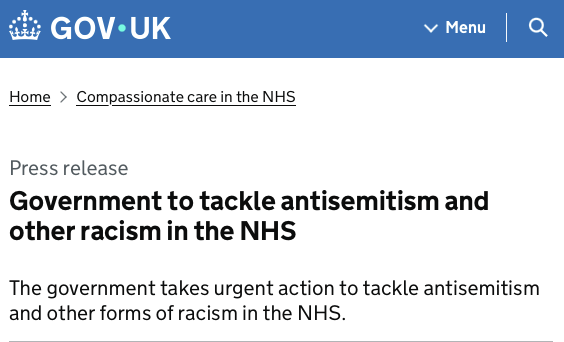
Streeting thinks there’s a ‘scourge’ of antisemitism in the NHS… and has said as much. He also said the NHS was ‘broken’.
We've learned to accept the fact, he lacks maturity. Reaching for florid language like ‘broken’ or ‘scourge’ creates noise. Makes him look busy but…
… his bellicose distracts from measured, evidence-based action. He’ll alienate staff who feel unfairly blamed or caught in moral panic and encourages tokenism… like training, tick-boxes and press statements.
Managers unsure what they're to do, in a panic to find structural fixes.
Staff and the public they come into contact with, have become more sensitive to discrimination… reporting incidents more frequently.
In parallel, some incidents go unreported because people fear a backlash in an already charged environment.
These dynamics can create the impression of a spike in incidents, which may reflect heightened tension rather than a change in the underlying behaviour across the workforce.
Hard data is hard to come by.
There are reports of 78 anti-semitic incidents in the health sector over the past 14 months.
The British Islamic Medical Association and the NHS Muslim Women’s Network called for healthcare institutions to specifically acknowledge the increase in Islamophobic abuse.
Leadership in complex organisations needs… mature, steady, fact-grounded communication, fostering trust, engagement and sustained change.
Emotional, exaggerated statements from politicians, may feel decisive but they reduce the space for nuanced discussion and careful implementation.
For sensitive issues like racism people need;
- A clear policy,
- fair processes,
- supportive leadership
- accountability
… not hyperbole.
The Office of HMG’s Independent Adviser on Antisemitism review and recommendations in July last year made the observation;
‘… UK politicians should be more ready to assert that British Jews should not be asked to justify the actions of the Israel government.’
We have to be mindful of the special place the NHS occupies in our nation’s life.
NHS uniforms and badges confer an ‘official status’. When the public are angry or polarised about geopolitical events, they may project their feelings onto our colleagues…
… especially if they associate them wrongly, with particular groups or institutions. Visible symbols, a Star of David, a Hijab, or other signifiers of identity.
Tackling any prejudice in the NHS, isn’t only about training. We've known for years, unconscious bias training is of little use.
Streeting's proposed on-line, mandatory training... click and forget it.
Instead, think about culture within teams, frontline protection, confidence in reporting and visible managerial backing.
The NHS, as the nation’s largest workforce, reflects society… and society inevitably brings its prejudices into hospitals, care homes and surgeries.
Streeting’s training might help raise awareness… but only of him. It won't erase deeply held beliefs or the weight of people’s lived experiences.
Winning hearts and minds is much more important if we want lasting change...
... and it looks like we'll have to do that without him.
|