Methodist Federation for Social Action
Oregon-Idaho Chapter
| |
|
|
I’ve been thinking about free speech a lot lately. What constitutes free speech? Who gets to decide what is free speech? It seems that free speech has become pretty haphazard in the United States in the past few years.
The First Amendment of the US Constitution provides that Congress make no law respecting an establishment of religion or prohibiting its free exercise. It protects freedom of speech, the press, assembly, and the right to petition the Government for a redress of grievances. A few narrow categories of speech are not protected from government restrictions. The categories are incitement, defamation, fraud, obscenity, child pornography, fighting words, and threats.
Some of those categories are fairly clear. Others not so much. And when there isn’t clarity, it is up to a court of law to determine if the speech falls into one of these categories.
So how come anti-gay speech, including a law that says “Don’t say gay” can get passed in one state and speaking out for Palestinian rights is considered antisemitic speech in many places around the country? When does an employer get to decide what employees can speak out about and when does it cross a line that prohibits free speech?
Those are all complex questions without easy answers. It seems to me that we have to be willing to look at the questions if we don’t want to continue to see speech restricted by a fairly small group of people. Free speech means all of our ideas are acceptable unless they fall into one of the restrictive categories. And those categories listed in the amendment all fall within the instruction of John Wesley to “Do No Harm”. At what point does one’s speech cause harm to another? It’s a complicated question – a question that we need to consider over and over again.
If we are to love as Jesus calls us to love, how do we exercise our right of free speech? When is it important to speak out and what are the right words to use and places in which to speak? Jesus certainly spoke out when he encountered injustice. We are not asked to be silent. It is by speaking out that we can begin to change our world to be a place that better reflects God’s love. When is our speech, or the speech of another, helping to create a world that is more just and loving? How are you using your voice to speak out for justice? And what causes you to hesitate to speak out? Is this a conversation you can have in your own church or faith group?
Working Together for Justice,
Karen Nelson
| | | |
NEWS, OPPORTUNITIES AND ACTION | | |
|
Greg Nelson
Are you looking for a way to do more to support justice and inclusion?
Each of us work within our local church and ministry context to seek justice and show God’s love. But how can we strengthen that commitment to have a wider impact?
Serving as a leader in Methodist Federation for Social Action is one way. The Oregon-
Idaho MFSA is part of an international connection working for justice in the world and the church.
By being a board member of MFSA you can learn more and offer your gifts and talents to the larger connection.
The Oregon-Idaho MFSA board meets monthly via zoom to help sharpen our region’s focus on justice. Consider being a leader in the organization by serving on the board. For more information, contact Rev. Karen Nelson and learn more on the Oregon-Idaho MFSA website and the National Organization site.
| | |
GENERAL CONFERENCE
Charlotte NC
| |
| | |
REFLECTIONS OF A GENERAL CONFERENCE DELEGATE | |
Jan Nelson
It was good to be a delegate at General Conference! This is the first time I can truthfully say that without qualification. As many have said, this year was SO different. The Big News was that all the major progressive priorities passed: regionalization, revised Social Principles, and removal of anti-LGBT language from the Discipline. There were other good things accomplished, and some things were left undone. I could go on and on about it, but I’ll share a few stories as briefly as possible.
Most of the hard work happened in committees. I was elected a subcommittee chair; I had a diverse group of 21 people and a big pile of petitions. We sat in a circle and had very respectful conversations with people from the US, Europe, and Africa. No one was allowed to totally dominate the conversation, but some liked to talk a lot. Charles is a long-time delegate from Michigan, originally from Liberia; by his own admission, he loves to argue. We all laughed at that and made sure everyone who wanted to had a chance to speak. I was a little sad about one woman from the US who voted against the majority on almost everything, and never spoke.
Meanwhile in the plenary sessions, most things we thought were controversial were sailing through with large majorities, many on the consent calendar. Most of the Social Principles sections were never debated, but then we came to the section with the language on sexuality and marriage. Many of us held our breath as a delegate from Zimbabwe got up to propose an amendment. She wanted to add the words “man and woman”, but she did not propose to put that in place of “two persons of faith” to the sentence on marriage, but to have both. At first it was hard to understand her, but the bishop was patient and the room was quiet as he helped the delegate sort out what she was really trying to say. The most miraculous to me was that the queer delegate chat group did not blow up in protest or snarky comments. The amendment was clarified and passed. That was the only amendment to the whole document.
On the last day, there were still a lot of matters to settle, and some awkward attempts to save time that ended up doing just the opposite. But Bishop Malone set the tone in worship, and at the end of that time, the band started to play “people all over the world, join hands, start a love train”, and people really did it. Holding hands, dancing in the aisles, it went on and on. It was like no general conference I’ve ever seen.
Not everyone left Charlotte equally joyous. On the shuttle to the airport, I talked with Harriet, who had been on my subcommittee. She is a pastor in Kentucky or Tennessee, personally supportive of the things that passed. But she wondered what she would say to her “purple” congregation, and she knew some people would leave. One of them will be her husband. I can’t even imagine what that would be like. There is much work left to do.
The outcomes we celebrate did not happen miraculously. All the major changes were the product of many years of work, especially intense after the terrible 2019 conference. Credit goes to leaders, some new and some long-time veterans of the struggle, that rose to huge challenges and never lost hope. MFSA has been there from the beginning of all these challenges. As part of Love Your Neighbor Coalition (LYNC), we have done major work on policy but also on building bridges across this extremely diverse denomination. The future is very hopeful, and we are ready to get to work.
| | |
WE BELIEVE IN A GREATER OREGON | |
Karen Nelson
As we prepared to leave for General Conference, Greg Nelson, LYNC communications coordinator, wrote these words in a LYNC newsletter:
He removes any of my branches that don’t produce fruit, and he trims any branch that produces fruit so that it will produce even more fruit.
(John 15:2)
Why LYNC?
Some may wonder why we need LYNC – a coalition of progressive groups working to change The United Methodist Church. Aren’t the delegates to the General Conference, bishops, and general agency staff capable of deciding things for the church?
It’s because the vine can’t prune itself. The institutional church needs outside voices to hold it accountable to its own stated purpose, and the higher purpose of God.
That’s what the LYNC partners do. MFSA was instrumental in creating the social creed and the original social principles. Affirmation and Reconciling Ministries Network are there helping create a groundswell telling the church that inclusion matters. BMCR, MARCHA, and NIAC are there with other ethnic and indigenous groups reminding the church of its history and responsibilities for making things right. Those advocating for justice for the differently abled and the earth itself are also at the General Conference to raise their voices, watch the conference, and inspect the fruit that it bears.
So, LYNC and its coalition members will be there – standing outside the conference – to say, “Don’t forget about the people Jesus called us to love. Don’t put all your energy into maintaining and protecting the institution of the church and forget to BE the church.”
Not that there aren’t voices for change within the structure – there are many – but they need our support from the edges to say Yes – Love Wins. And you are not alone.
So as LYNC volunteers pack their bags this week – we pause to say thank you. Thank you for your financial support. Thank you for your prayers. Thank You for not giving up on making the United Methodist Church a better institution.
MFSA has been a part of the Love Your Neighbor Coalition since its inception in 2012. Today LYNC is a coalition of 15 organizations working together to create a more just UMC. That isn’t an easy task because sometimes the goals of one organization conflict with the goals of another organization. It takes lots of communicating, listening, some compromise, and supporting one another to have the work of the coalition be successful.
Not only is MFSA a partner in LYNC; it is also the fiscal agent for LYNC. So the MFSA treasurer was at General Conference, helping to make sure we had the funds for the things we wanted to do each day. Some of the key tasks of LYNC included providing translators for all those conversations and gatherings that happened in multiple languages outside of the plenary sessions; providing cultural competency training for all of the volunteers to help us better serve and understand the diverse group of people at GC; sponsoring an international craft market for Central Conference delegates to bring craft items to sell with the entire proceeds going back to their own mission projects at home. LYNC also rented several large meeting rooms in two hotels and made them available to a variety of groups to gather throughout the conference. And of course, there was the daily task of keeping track of what was happening with legislation and figuring out what the next best steps were for the entire coalition.
MFSA also created a What’s App group that updated all of us in real time about what was happening on the floor and beyond at GC. MFSA was present at the coalition table in the exhibit hall and had an opportunity to interact with many of the delegates, guests, and volunteers who attended GC.
What’s next for LYNC? That’s the conversation of the next several zoom meetings as we evaluate the work that was done by the coalition and look ahead to what comes next.
| | |
REFLECTION ON GENERAL CONFERENCE | |
Dee Stickley-Miner
Dee Stickley-Miner is a General Conference delegate from the West Ohio Annual Conference. She has been a member of the Standing Committee on Central Conference Matters.
This General Conference was different from other ones. I am bold enough to say that one of the differences may be that our Central Conference delegates shared their own voice and perspective. We always benefit when that happens.
The Worldwide Regionalization petitions submitted by the Standing Committee on Central Conference Matters were envisioned and created primarily by lay and clergy from our Central Conferences (for those who are not United Methodist, people from outside of the United States). They wanted to counter the predominant narrative from within the US committed to dividing the denomination. Instead, the Christmas Covenant envisioned a regionalized denomination that gave agency and maintained the connectional identity so we could focus upon relationships and mission. They imagined a denomination where the US was not the center of the church. They provided a gift to the whole church that now has the power to reshape how we see ourselves. This happened because they trusted their own perspective and risked partnering with other people.
The petition that amended the constitution passed with 78% of the vote. That is a HUGE margin of support. There has been much discussion regarding the numbers of delegates not able to attend due to visas and other issues of certifying elections. If everyone had been present, and if everyone had voted no, we still would have had more than the required 2/3rd vote. Why? Because it was leaders in Africa, Philippines, and Europe who had been organizing and providing a narrative of what regionalization provides the UMC. The people were involved--it was not just identified leaders of the denomination...but unlikely people committed to the heart of what it means to be United Methodist. The vote represented the will of United Methodists around the world.
So...what does this mean? For me, this is what I HOPE...
1. We will ratify the constitutional amendments. This will take place over the next 12 months in every annual conference session of the UMC.
2. We in the United States will have an opportunity to authentically share power, voice, and leadership. We can learn so much from our siblings around the world. May our pride and arrogance of thinking we know best transform into a spirit of humility committed to being in mutual relationship with the church around the world. We have much to learn in knowledge, spirit, and heart.
3. Our muscles for trust have atrophied for too long. It is time for us to risk trusting that the leaders in other parts of the world know best what is required for the Gospel to flourish. We can build trust with each other because God has dared to trust us with the heart of the Gospel. If God can trust us, certainly, we can learn to trust each other.
4. We will see the beauty of our diversity and how it allows the Gospel to flourish, without any one place or culture dictating how things should be. The first book of the Bible clearly shows how much God values diversity.
5. Instead of focusing on legislative legalities to "keep us together" we will return to seeing relationships, mission, and the heart of Jesus Christ that holds us together in unity. Differences can and do co-exist when we are grounded in the heart of Jesus.
6. We will mess this regionalization thing up...Change always requires us to practice confession, forgiveness, reconciliation, and kindness with each other. What a powerful witness this will have in a world intent on dividing itself!
7. For us in the United States, I think this gives us an opportunity to confess our legacy that comes from colonization and neo-colonialism. I will be honest and say that I continue to learn what all of this means...I know that this is a redemptive journey that God calls us to embark. Hopefully, it will end with us having "right relationships" with our siblings in other parts of the world. I believe the Bible when it says that all things are possible with God. It just requires us to trust the moving of God's spirit over the certainty of our own thinking. I'm hoping I will be humble enough to embark on this journey. It's a long journey that requires the practice of grace, confession, forgiveness, healing, restoration, and confident humility.
8. My greatest hope is that people in our communities who wonder if they matter will actually experience that they do through a UMC faith expression. When we stop fighting with each other, maybe there will be enough energy, time, and desire to authentically relate with the neighbors God has given us.
9. Is this easy? By no means...we have been called to be healing agents of change in this world. I'm not sure where this journey will take me or us...I'm fairly confident, however, that we will find ourselves more deeply rooted in God's heart with a greater ability to live in community and unity with our neighbors. Don't get me wrong...being healing agents of change in this world does not mean going along to get along. It means seeing value in those who we have marginalized and building community where their voices and perspectives shape who we are. I don't really dance in life, but this is a dance and rhythm I am willing to try, because I believe it will be an imperfect way to do justice, love mercy, and walk humbly with God.
| | |
2024 MFSA LEGISLATIVE RECOMMENDATIONS | |
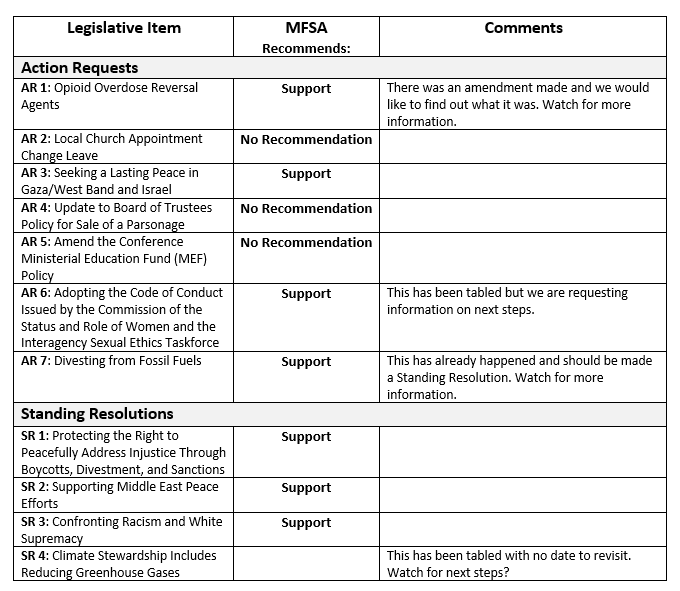
Each year the MFSA Board looks at the legislation coming before Annual Conference and makes recommendations about the legislation that addresses social justice issues. We have completed the recommendation chart for all legislation that was presented to Legislative Assembly in April. However, the Legislative Assembly will convene again in late May to further consider tabled items (noted below) and again on June 18 to consider any late-breaking petitions.
It is possible that the body will be asked for ratification of legislation passed at the General Conference 2020/2024 in May. We endorse legislation that may be presented at Annual Conference that upholds our conference and MFSA values of inclusivity and non-discrimination. Watch for an Occasional Memo shortly before Annual Conference with any updates.
By speaking out and taking a stand through legislation, we take one more tiny step toward bringing God’s kin-dom to life on earth. If you are not a voting member of Annual Conference, you are urged to share your thoughts with your church’s member(s) before Annual Conference.
You can find the full text of legislation here.
| | |
BOOK STUDY: OUR HEARTS WERE STRANGELY LUKEWARM | |
Claudia Roberts
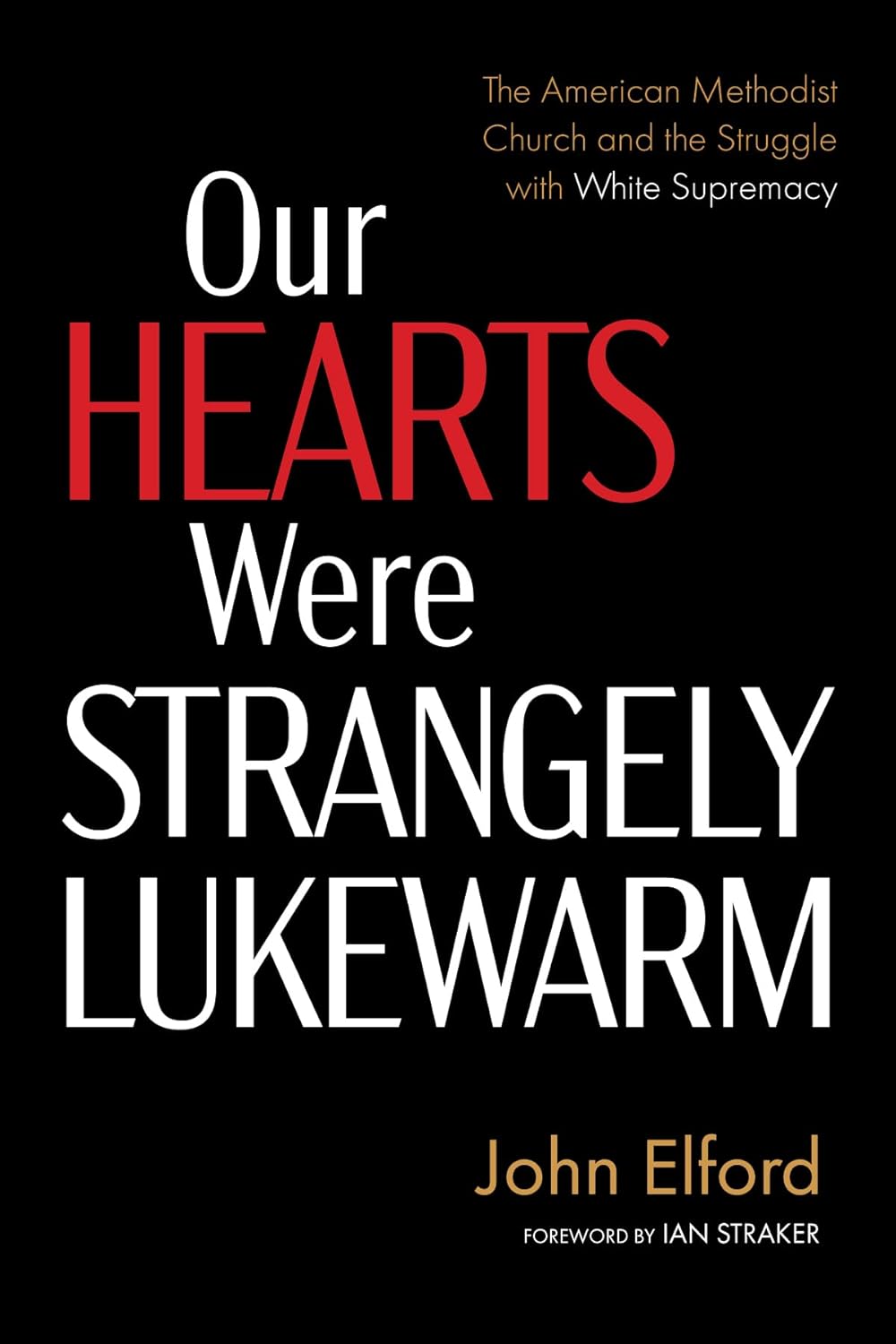
This book was recommended to all the churches in the Pacific Northwest by Bishop Cedric Bridgeforth. It is a history of the systemic racism which has been practiced by the Methodists since their formation in the United States. As I grew up in the church, I had learned that African American people were required to sit in the balcony in New England churches, that the churches were segregated in the south and that the Ku Klux Klan handed out Bibles to children in southern white churches. But that is just the very tip of the iceberg.
John Elfred provides an extensive and well documented history of how the white Methodist Episcopal church has oppressed people of color for over 200 years. Only in the last 50 years has there been some movement toward reconciliation and inclusion.
I recommend that you find a few other people around you to read this book and discuss the information together. Reading it alone you may be shocked and saddened, but reading it with a group may move you to take to look around your local church area and see if there is work to be done.
OR-ID MFSA offered a weekly class on zoom that was well attended and included participants from other conferences as well. MFSA continues to seek ways that we can help our churches dismantle racism. Watch for announcements about other studies or events.
| | |
NOW'S THE TIME FOR ACTION | | |
Now is the time to continue to push for broad systemic change. Besides the calls to action found in the articles above, here are a few other ways you can take action to seek justice: | |
[ ]AIDNW continues to serve 50+ newly release guests outside Tacoma’s NW ICE Processing Center at the RV Welcome Center each day. They are in desperate need of volunteers and supplies. Find out how you can help!
[ ]Support studying and developing a system of reparations to make up for our many sins as a nation.
[ ]The Americans of Conscience Checklist features clear, well-researched actions for Americans who value democracy, equality, voting, and decency. We are a big tent for all people who want a kinder, flourishing nation.
Human Rights and Economic Justice
[ ]Protect Native Families in your state by pressing your state legislature to pass a statewide Indian Child Welfare Act (ICWA) law.
[ ]Help buy up medical debts through RIP Medical Debt. Learn about churches who have had successful medical bill forgiveness campaigns.
[ ]Sign ICHRP-US's open letter to President Biden on human rights in the Philippines.
[ ]Join a National Nonviolent Moral Direct Action Call-In in calling the offices of Senator Manchin, Senator Sinema, Senator McConnell, and Senator Schumer.
[ ]Sign up for Coalition of Immokalee Workers Fair Food mailing list to learn more about what you can do to advocate for farmworker rights.
[ ]In solidarity, join workers demanding $15/hr and tell McDonald’s to raise wages now.
[ ]Call your legislators (202-224-3121) and advocate for permanent federal paid sick leave, expanded unemployment benefits, SNAP increases, and a moratorium on evictions, utility shut-offs, and payments.
[ ]Tell Congress to protect children in agriculture through co-sponsoring the Children's Act for Responsible Employment and Farm Safety (CARE Act).
[ ]Tell your Senator to pass the Equality Act so that all people have comprehensive, nationwide protection against discrimination.
Gender Justice
[ ]Join the fight against anti-trans discrimination by learning what anti-trans legislation is proposed in your state and access information to contact your state legislator.
[ ] Write your senators to urge them to prioritize the needs of pregnant and postpartum workers by passing the Pregnant Workers Fairness Act without delay!
[ ]Contact your Senators and demand they vote yes on the Women's Health Protection Act.
[ ]Donate to local abortion funds and providers.
Racial Justice
[ ]Take the pledge to bring racial justice into our education system. From curriculum to student life, there is so much we can do to make schools a safe and equitable place for all children.
[ ]Tell your Member of Congress to support the Accessible, Affordable Internet for All (AAIA) Act, an act that can help bridge the digital divide that disproportionately impacts Black, Latinx, Indigenous, rural, or low-income people.
[ ]Grow in your personal learning or as a community with a group study by taking advantage of free online university courses on systemic racism.
Immigration and Refugee Rights
[ ]Support and protect families who face emotional, financial, and legal strains after being forcibly separated at the border.[ ]Tell Congress to reduce funding for ICE detention capacity and shrink the cruel immigration detention system.
[ ]Tell Congress to reduce funding for ICE detention capacity and shrink the cruel immigration detention system.
[ ]Join the #WelcomeWithDignity movement by signing the pledge to reimagine the way our country and our communities treat people seeking safety.
[ ]Host a virtual Card Writing Party to write and mail letters to immigrants in detention via The Casa Mariposa Detention Visitation Program.
[ ]Contact your elected officials and demand Congress cut funding for ICE and CBP and defund hate.
[ ]The Interfaith Movement for Immigrant Justice (IMIrJ) hosts IMIrJ Advocacy Nights on the 2nd Monday of each month from 6:00-7:30pm. RSVP here and invite your friends to join you!
[ ]United We Dream advocate for immigrants. Find ways to take action.
Justice in the Holy Land
[ ]As the violence and loss of life in the Holy Land unfolds before us, people of faith and all people of conscience must do what we can to reverse the course that Israel and the United States are following. Call for a ceasefire now.
[ ]Help protect land and life in Wadi Foquin and the West Bank, and sign the petition to stop Israeli Settlement Expansion.
[ ]Discover more campaigns targeting companies making a negative impact on Palestinians lives and human rights, from the The Palestinian BDS National Committee (BNC) and use Investigate! to discover corporations involved in incarceration and immigrant detention, the Israeli occupation, and the border industries.
[ ]Hold Siemens and Chevron accountable for fueling Israeli apartheid and climate disaster.
[ ]Send a message to your legislators in Congress to speak out publicly and also urge the Biden administration to press Israel not to fulfill its plan for ethnic cleansing and destruction in Masafer Yatta.
[ ]Tell President Biden and Vice President Harris to hold Israel accountable to its obligations as an occupying power and insist that Israel provide COVID-19 vaccines equally and fairly to Palestinians living under its occupation.
[ ]Check out the BDS Toolkit and learn what economic actions you can take to fight along the side of Palestinians and their struggle.
Gun Violence
[ ]Take action to support gun safety legislation that will help end gun violence.
Peace and Justice
[ ]Join a National Nonviolent Moral Direct Action Call-In in calling the offices of Senator Manchin, Senator Sinema, Senator McConnell, and Senator Schumer.
[ ]Reject U.S. support of the Marcos Dynasty in the Philippines and sign the Unity Statement.
[ ]Has your country signed on to the UN Treaty on the Prohibition of Nuclear Weapons? Contact your elected officials to support the end of nuclear weapons in the world.
Climate Justice
[ ]Sign the Fossil Free UMC Petition.
[ ]America’s largest asset manager must stop fueling the climate crisis. Take action to tell the CEOs of BlackRock, Vanguard State Street, and fidelity to put our future and our long-term saving over short-term fossil fuel profits.
[ ]Contact your Senators and ask them to prioritize climate provisions in upcoming bills.
[ ]Learn more about the United Methodist Creation Justice Movement in their May newsletter.
Voting Rights
[ ]Join the Poor People's Campaign effort. to educate and mobilize poor and low-wealth eligible voters for the Midterm Elections
[ ]This election season, pledge to vote your values and fight for your rights and encourage your friends and family to do the same.
Death Penalty Abolition
[ ]Sign the petition and tell Congress to abolish the federal death penalty.
Justice for those with Disabilities
[ ]Learn how you and your ministry can truly embody open hospitality by enrolling in Be A Disciple's courses and getting a Certification in Ministry with People with Disabilities.
| |
OREGON-IDAHO CHAPTER EXECUTIVE COMMITTEE | | | | | |