REMOTE WORK
The new resentment
The return-to-office tug of war is playing out not only between bosses and employees, but between partners, too
| |
|
MUCH HAS BEEN made about the way that remote and hybrid work has affected domestic life, giving workers extra time for all sorts of things ― exercise, time outdoors, cooking time, laundry, napping, you name it.
For many two-career couples with white-collar jobs, the last few years have meant a whole new routine, a whole new dynamic and ― for some ― a new kind of domestic bliss. There were, experts said, major benefits, especially for women who have historically carried more weight at home.
“Women reached new highs in labour force participation, and men a new level of unpaid household work,” writes Sarah Green Carmichael in Bloomberg. “It was nowhere near equality, but we were heading in the right direction.”
But then came the return-to-office mandates and the strict hybrid schedules and suddenly, remote work became a perk ― and one that has the capacity to inspire jealousy within couples, as it turns out.
“Insanely jealous of the amount of time they have to work out, travel do housework ― how much happier they seem to be in general,” wrote one in-person employee, musing about their partner’s schedule in Fortune magazine. “Super petty. I’m happy for them, but it’s kind of starting a rift with my boyfriend.”
“There’s definitely some envy just because I have to get dressed and put on business clothes, and my husband doesn’t even have to turn his camera on,” another non-profit worker told Fortune. “It’s definitely made me consider looking for another job.”
For couples where one partner has gone back into the office and one hasn’t, the nature of their work-life balances has started to diverge. One might be back to juggling dinners, cleaning and kids on top of the daily office commute; the other might still be enjoying a nice afternoon stroll while they’re technically on the clock. It’s hard not to see how envy and jealousy would result from vastly different experiences of going back ― or not ― to the office.
It's often the women who are losing out here, if only because it was women ― especially those with kids ― who tended to benefit from the equalization remote work provided.
“Evidence suggests that the increase in companies enforcing return-to-office mandates may drive mothers out of the workforce at a crucial moment,” writes working mom Alana Semuels in Time. The stats show that remote work saves one around 72 minutes a day, she writes. “Those 72 minutes matter…For many people, remote work meant the difference between chaos and sanity.” Kieran Delamont
| |
WORKFORCE
Denied the chance
Why is the employment gap for people with disabilities so consistently wide?
| |
|
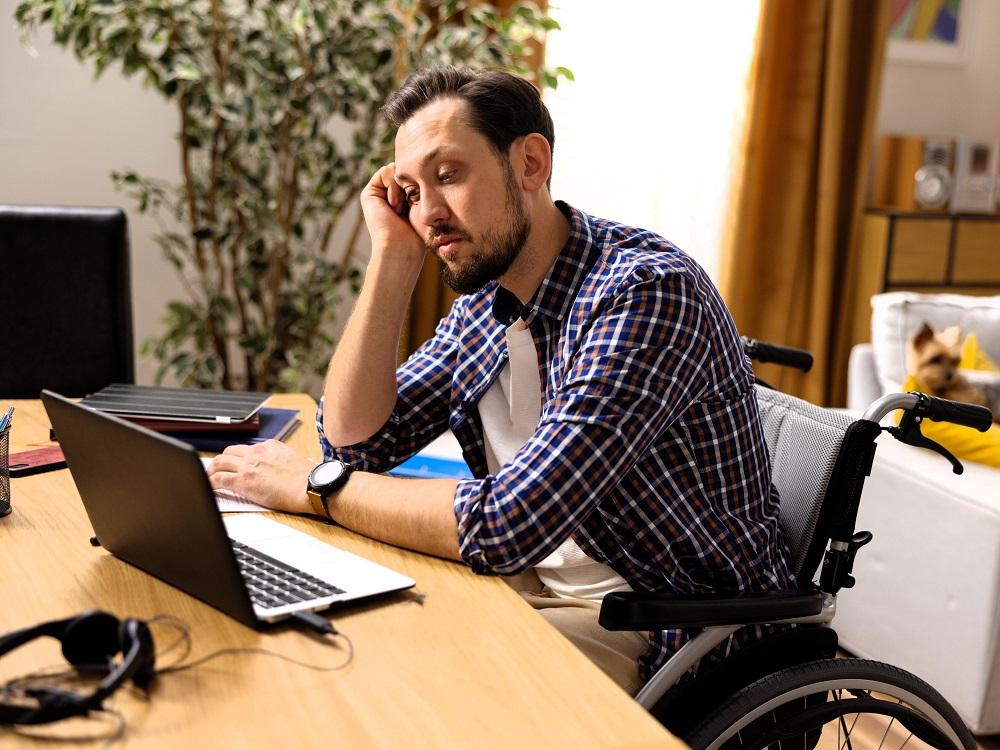
OVER THE YEARS, many of the efforts to improve workplace diversity have resulted in tangible gains for many groups ― women, people of colour, queer communities and others. But for disabled workers, new statistics show that there’s still a long way to go in terms of opportunities and advancement in the workplace.
Recently released data from Statistics Canada showed that the employment rate in 2022 for disabled workers was only 65 per cent, compared to 80 per cent for the general population. Disabled workers were also nearly twice as likely to be unemployed and remain that way for longer periods of time. And those that do work are more often doing so on part-time hours.
Another recent report from Canadian recruiter Robert Walters noted that one quarter of professions with a disability note that they feel underpaid, and that many report lacking advancement opportunities.
All of this, many argue, represents a serious gap in opportunity for people living with disabilities.
“People with mental and physical disabilities are laying the groundwork for successful careers, but they can’t seem to find an on-ramp,” writes London’s Glen Pearson, co-director of the London Food Bank.
Some big corporations are making an effort to change this. DIsability:IN is a global nonprofit organization that has tracked disability equality since 2015 and has been pushing to get high-profile CEOs to make their organizations more inclusive to those with disabilities. Arguing that disabled workers represent a huge untapped talent pool, to date more than 170 CEOs have signed on, according to the organization.
“We stand to boost the American GDP by up to $25 billion if we hire just one per cent of the untapped talent with disabilities,” they write. “Research reveals that leading disability-inclusive companies stand to gain as much as 28 per cent higher revenue, double the net income and 30 per cent higher economic profit margins than their peers.”
But the fact is that the gap in opportunities has remained stubborn and hard to close, even as progress has been made.
“Though professionally capable citizens, the employment game seems rigged against them,” writes Pearson. “We need a more dedicated effort ― privately, socially, governmentally and corporately ― to generate the kind of structural change that has been promised the disabled for decades but never arrived.” Kieran Delamont
| |
|
|
Terry Talks: Finding talent in the age of ChatGPT
| An array of online tools such as resume-boosting software and generative AI platforms that draft cover letters is complicating the hiring process and making it increasingly difficult for companies to weed out unqualified applicants (and identify the great ones!). That’s why it is more critical than ever to invest in thorough candidate assessments. The process of evaluating candidates extends far beyond technical competencies; it encompasses understanding their potential, cultural alignment and long-term value to the organization. | | | |
PRODUCTIVITY
Going monk mode
Some young professionals are switching to ‘monk mode’ to get things done. Now what on earth is that?
| |
|
IN THE PROOF that all that is old becomes new again category, a late-aughts productivity hack has started to gain traction again, especially among young male professionals looking to their ascetic brethren and going “monk mode.”
What is monk mode, you might be asking? Writer David Cain, a proponent of monk mode, puts it thusly: “During the late 2000s, there was a trend among young male entrepreneurs called ‘Monk Mode.’ Everyone had a different idea of what that term meant, but generally it referred to taking a definite period of time ― a week to three months or more ― to focus with unusual intensity on certain important and fruitful pursuits, while abstaining from certain distracting or self-defeating activities,” he wrote on his blog last year.
In a work capacity, monk mode looks more like creating a period of time where you focus on one, single thing. No interruptions, no deviations, phone and email shut down, Internet off, just pure focus on one single thing ― like a monk.
The big question: Does it do any good?
One writer at The Guardian, Emma Beddington, gave it the ol’ monastic try earlier this year. “I wrench myself offline and try to write longhand. It’s fast, but I can’t tell if what I’m producing and hate not seeing my word count,” she noted. “Then I want a break, but don’t know what to do. Without Instagram to stare at, I practice a 16th-century mass we’re singing in choir ― it seems appropriate ― and illuminate my article with some monastic marginalia.” She doesn’t like multitasking, she concludes, but nor does she feel capable of monotasking.
Okay, so maybe it’s not the easiest thing to do. But it has its followers. Josh Wood, CEO of tech hospitality company Bloc, wrote a piece in Business Insider about his own flirtations with monk mode earlier this year.
“I would say my productivity in monk mode is five times better than when I’m working normally,” he writes. “I complete more tasks throughout the day and complete them at a much higher level of quality…I don’t have to work insane 80-hour weeks anymore. I can get the same amount of work done in less time, which frees up time for other important things like a social life and family.”
Of course, social life and family are two things that monks famously eschew ― but you get the point. Kieran Delamont
| |
TECHNOLOGY
ChatRIP?
AI probably won’t kill you, but it can definitely write your obituary
| | |
|
BY NOW, PLENTY of us have played around with AI tools like ChatGPT, whether to pump out a few paragraphs for fun or to quickly whip up some professional prose for your job. But at least one industry that has taken to the tech extremely quickly and successfully might surprise you: the funeral industry.
In particular, funeral directors have been making increasing use of tools like ChatGPT in the work of writing obituaries, according to the Ontario Funeral Service Association (OSFA).
Strathroy funeral home owner and OFSA president Brett Denning called the tool, “like an extra person in the room that is able to provide creativity,” and said that it’s become increasingly commonplace for funeral homes to rely on the tools to help quickly write standard obituaries. (In cases where the family doesn’t want to write the obituary themselves, it’s common for the funeral home to write one for them.) Long-term, many expect to see dedicated technology for this purpose, Denning told the CBC.
In fact, those tools are already very much in development. One such tool, provided by a company called Obituare, is already available. “Writing an obituary is one of the most gut-wrenching parts of planning a funeral, Obituare’s founder Steven Arevalo said. “This new AI function is an important tool that can help make the process less stressful.”
Another startup, called Empathy, covers similar ground, allowing families to provide some basic info, keywords and so on to generate an obit. Sure, it’s not prose that sets the world on fire ― but for a grieving family struggling to meet all the administrative duties a death demands, it may be more than suitable.
But naturally, funeral directors are aware that the robot obit writer lacks the human touch, and that while the tool is useful, it’s not about to completely take obit writing out of a human’s hands. (There are plenty of risks, too: earlier this month an obit that called a former NBA player “useless” sparked a media firestorm). Like so many AI tools, industry insiders say its usefulness is about augmenting human labour, not replacing it.
Paul Needham, owner of London’s Westview and Northview Funeral Chapels, told the CBC that the tech is far from perfect and still requires human oversight. “It has to be personalized as much as possible,” he said. “That means using proper terms of endearment…They’ve all got different terms or even pet names, and that has to be explored. I don’t know that you’ll achieve that through an AI-generated obituary.” Kieran Delamont
|
| | | | |