|
If there is one thing that our great leader is good at, it is 'announceables'.
He’s a master of the art of looking busy, while staying roughly where he is.
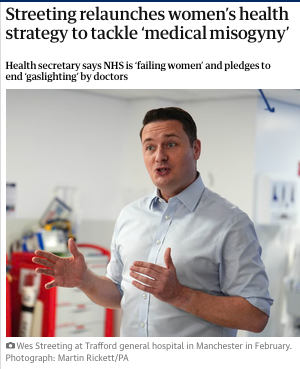
The latest example is his rehash, a second go, a reprise of the Women’s Health Strategy launched in 2022… that promised…
‘… to listen more carefully to women, close gaps in care, improve research and tackle inequalities.’
A health system largely staffed by women, serving a population where women as patients and carers are predominant users… still struggles to meet women’s needs... really!
You can’t fix this by saying ‘we need more women in the system'. They’re already there.
Here we are, three years on, the problems remain stubbornly in place.
- Long waits for gynaecology.
- Patchy access to services.
- Women reporting they are not listened to.
- Pain not taken seriously,
- conditions diagnosed too late.
Around half a million women are still waiting for gynaecology treatment. That’s not a niche issue...
... that’s a system issue.
This time the language is a bit sharper. The tone more urgent. There’s a nice sound-bite; tackling ‘medical misogyny’. Faster diagnosis for conditions like endometriosis. Better pain management and expanding women’s health hubs.
There’s also a nod to creating a single point of referral and…
… perhaps most interestingly, linking patient feedback more directly to funding decisions, but…
… step back, do that thing that artist do, squint, look at the whole landscape… and it is the same picture;
-
Same ambitions.
-
Same delivery model.
-
Same reliance on local systems to make it happen.
In other words, the strategy hasn’t been redesigned. It’s been re-announced.
Special advisors always like ‘announceables’… things you can announce to look busy, whether or not they change anything.
Policy-PR people reach for phrases like; 'war on…’, ‘tackling…’ and ‘ending injustice…’
All classic policy-wonking. Repackaging with stronger language and a moral edge. More urgency. More emphasis. More adjectives, but…
… the original strategy didn’t fail for lack of insight.
We already knew the problems:
- fragmented care pathways
- workforce shortages
- inconsistent access
- and a system that too often makes patients navigate complexity rather than smoothing the path for them…
… none of that solved by better words.
The uncomfortable truth; this isn’t just about women’s health. It’s about our health system.
- Gynaecology waits are part of the wider elective backlog.
- Delayed diagnosis reflects pressure in primary care and
- limited specialist capacity.
- Poor experiences are often the by-product of overstretched services and clunky pathways.
Put bluntly… this is a system problem, wearing a women’s health badge.
The danger with themed strategies is they can isolate issues that are, in reality, deeply interconnected. You can build hubs, create programmes, even mandate standards, but …
… if the underlying system remains constrained, the gains will be marginal.
There is, perhaps, one glimmer of something different…
… linking patient experience to funding.
If… if… it’s done seriously, that could begin to shift behaviour.
Organisations respond to incentives, but…
… it will be hard to measure, harder to implement, and very easy to dilute.
We’ve been here before with targets that look good on paper but fold under operational pressure.
This ‘renewal' also sits neatly within the wider vacuous narrative;
- neighbourhood care,
- prevention,
- services closer to home.
Yes, we could put gynaecologists in every GP practice. How about a geriatrician for old geezers? Why not, add a paediatrician…
… the problem is, we don’t have enough of any of them, so we put them all in one place, called a hospital.
This is not a standalone fix; it’s a chapter in a much bigger story about reform.
Is this about improving women’s health… or refreshing the optics of delivery?
We tackle the NHS in stovepipes: women’s health today; mental health tomorrow; children somewhere in between… as if fixing each in-turn, will fix the whole.
It won’t.
Patients don’t live in policy compartments; they move across a system and trip over the joins.
Improving one slice, while the rest struggles is not reform, it’s called displacement.
In his book; Introduction to Operations Research, the systems thinker, Russell L. Ackoff said...
‘… improving one part of a system in isolation can make the overall system worse.’
You don’t fix the NHS piece by piece, you fix the connections that hold it together.
The NHS lacks grip. Someone to take hold of delivery… workforce, pathways, accountability.
Women don’t need another strategy.
We all need a strategy that works.
|