|
It was back in the 1830’s in the US…
… that the word first appears in the vocabulum of newspaper literature.
It’s a zero-derivation or conversion word. Meaning, it’s capable of being used as a noun, a verb, and occasionally and adjective.
The word?
Leak…
... as in…
The Watergate disclosures or the parliamentary expenses scandal. They were more than ‘leaks’. They were gushing torrents. Great bow-waves sweeping all before them.
There was another ‘leak’, yesterday… more of a dribble, a sort of plop, plop… in the £walled Times, that might foretell of a torrent. It revealed the NHS is about to quietly float across an important line.
Until now, artificial intelligence has been sold as an assistant. A tool to help doctors diagnose faster, reduce paperwork, improve scans, summarise clinic notes and free-up more time for patients.
Reasonable enough… welcome, even, but …
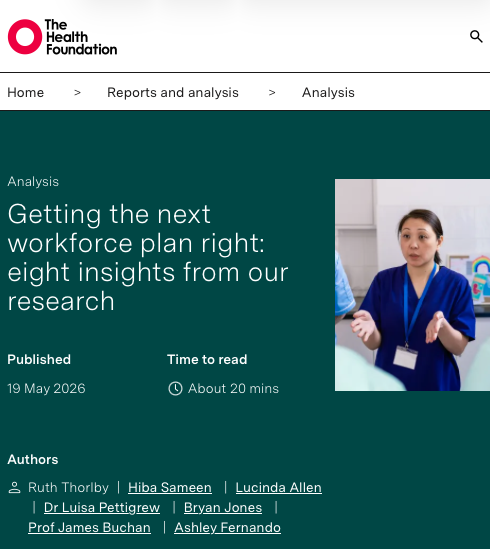
…buried in the Times’ leak of a chunk of the proposed NHS workforce plan is something very different. A sentence that changes the whole argument.
The plan, apparently, envisages circumstances where technology can...
‘completely substitute for a role’.
Substitute. Not support. Not assist. Replace.
That all matters because AI is no longer being discussed simply as innovation policy. It’s becoming workforce policy and, more importantly, Treasury policy.
The old workforce plan, launched under the Sunak government, assumed the NHS needed a vast expansion in staff numbers.
By the mid-2030s the NHS workforce was expected to rise from around 1.4 million to as many as 2.3 million people. The last man standing would be employed by the NHS.
The new thinking is radically different.
Fewer nurses. Little significant expansion in doctor numbers. More care shifted into communities. AI helping close the gap.
The Treasury will love it, as will the Biscuit Boy (he’s ex-treasury).
Staff costs account for around half the NHS revenue budget. If technology can reduce the growth by hundreds of thousands, the savings look enormous on paper…
… on paper… because this is where the conversation becomes dangerously simplistic.
The real question is not whether AI works.
The real question is whether the NHS can reorganise itself around it.
That’s a much harder problem. The NHS has never struggled to buy technology. It struggles to redesign work.
We all know the reality...
...some organisations are digitally sophisticated. Others still wrestle with antiquated systems, fragmented records, clunky workflows… computers that belong in a museum.
Digital maturity across the NHS is wildly uneven. Leadership capability varies. Infrastructure varies. Data quality varies. Interoperability remains patchy, and…
… this matters because AI is not like buying a new MRI scanner and plugging it in.
AI changes workflow, staffing models, decision-making, accountability and the division of labour itself, all of which requires …
…organisational competence.
The NHS is a federation of organisations, not a single machine with one management structure and one operating system.
Innovation in the NHS has always spread unevenly. Roger’s diffusion theory works reasonably well in coherent organisations. The NHS is not coherent. It’s fragmented, semi-autonomous and operationally inconsistent.
Some trusts will race ahead. Others will barely move.
The danger is obvious; the organisations most in need of productivity improvements may be the least capable of implementing them safely.
A two-speed NHS.
Meanwhile, there is another contradiction at the heart of this debate.
We know waiting lists remain stubbornly high, productivity is disappointing and patients struggle to access care.
At the same time, we are apparently concluding fewer doctors and nurses will be needed…
… perhaps, but…
… what if workforce numbers are not the primary constraint? What if the bottlenecks are elsewhere; discharge delays, diagnostics, estates, theatres, social care, fragmented pathways and cumbersome administration?
In the NHS, solving one bottleneck often simply shifts pressure somewhere else.
Goldratt would recognise it instantly… you can’t just fix components, you must fix the flow through the system.
There is another uncomfortable truth that politicians rarely acknowledge.
Productivity gains are not always cash-releasing savings.
If AI saves clinician’s time, demand will expand to consume it...
-
More patients are seen.
-
More conditions identified.
-
More follow-up generated.
-
More costs…
… expectations rise.
The NHS is a demand sponge. Technology rarely reduces demand. It reveals more of it.
Technological possibility is not the same as organisational capability. That’s the lesson policymakers keep missing.
The challenge is not whether AI works.
The challenge is whether the NHS knows how to make it work.
|