Weekly update from the National Housing Conference | | News from Washington | By Brittany Webb | | |
Affordability takes center stage at elections
Housing affordability proved to be a key issue in the 2025 elections, influencing both ballot measures and candidate platforms across the country. In New York City, voters approved several housing-related ballot measures designed to accelerate development by streamlining approvals and limiting the City Council’s ability to block new projects. The city’s newly elected mayor, Zohran Mamdani, ran on a platform centered on affordability, pledging to expand housing supply and implement a citywide rent freeze affecting rent-stabilized apartments.
The proposal quickly became one of the most discussed policies of the campaign, with supporters arguing that freezing rents would provide immediate relief for tenants struggling with rising housing costs, but many economists and real estate groups warning that such policies have historically backfired and discourage housing production that provides long term cost relief.
Nationally, costs were a central theme in campaigns at multiple levels of government. In New Jersey, newly elected governor Mikie Sherrill focused her messaging on driving down utility costs with promises to freeze utility rates. For Virginia, newly elected governor Abigail Spanberger noted what mattered most to voters was lowering costs and strengthening the economy. Kaohly Her was voted in as mayor of St. Paul, Minn., after campaigning as a champion for affordable housing. Ballot measures centered on addressing housing affordability also proved successful. In Texas, measures to provide property tax relief passed with broad support of voters, and new renter protection were approved in Bellingham, Wash.
| |
Shutdown reaches new record; housing assistance stretches through December
As of November 5, the ongoing government shutdown reached 36 days, officially becoming the longest in U.S. history. The sobering milestone brings new concerns about funding critical government assistance programs that risk running out of available money to deliver payments to households that rely on supplemental income to make ends meet. The U.S. Department of Housing and Urban Development (HUD) has reported that it will be able to fulfill the necessary funding to Public Housing Authorities for December, alleviating some uncertainty for families who rely on housing assistance through the end of the year. The funding will maintain operations for public housing and tenant-based rental assistance; however, January payments remain at risk.
|
| | |
Don’t Miss Out — Reserve Your Spot Before It’s Too Late!
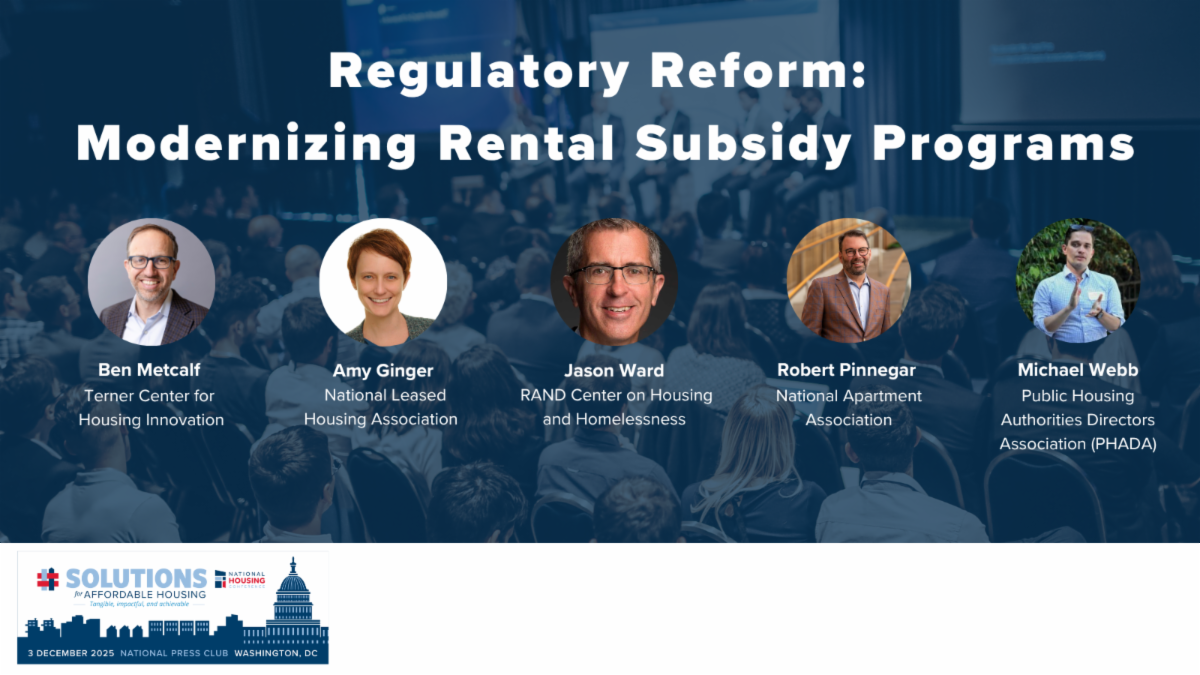
This year's sessions will focus on key housing challenges, including affordability, supply, access, and policy reforms that shape the future of rental, ownership, and subsidy programs. Experts will also explore innovative solutions such as new housing models, rural and middle-income strategies, homelessness prevention, and resilience in the property insurance market.
Sponsorships Still Available
Elevate your organization's profile and actively participate in the conversations that are shaping the future of housing by sponsoring NHC’s Solutions for Affordable Housing convening. We offer sponsorship levels tailored to fit every organization’s needs, starting at $1,000. Click here to learn more.
| | |
In-Person Tickets
$200*
(Non member rate $250)
*Use Code: Member2025
| |  | |
Virtual Tickets
$150*
(Non member rate $175)
*Use Code: MemberVirtual2025
| | |
Legislation introduced to raise PWI cap
A bipartisan group of House members introduced legislation to raise the cap on Public Welfare Investments (PWI) that determine how much banks are allowed to invest in affordable housing and community development projects. House Financial Services Committee members Mike Lawler (R-N.Y.), Joyce Beatty (D-Ohio), and Young Kim (R-Calif.) introduced the Community Investment and Prosperity Act which would increase the PWI limit for banks from 15% to 20% of a bank’s capital surplus. The provision is included in the comprehensive Senate housing legislation package, the ROAD to Housing Act. A week prior to the introduction, stakeholders sent a letter supporting raising the cap, citing a survey showing among the 22 banks surveyed, 42% of Low-Income Housing Tax Credit (LIHTC) investment in 2024 came from banks nearing the current 15% PWI cap.
The higher cap would unlock billions of dollars in potential financing for housing and infrastructure projects that benefit low- and moderate-income communities, particularly in light of increased LIHTC availability passed through legislation earlier this year.
| | | |
Fannie Mae removes minimum credit score requirement
Fannie Mae announced that it will remove the minimum credit score requirement of 620 for new loans beginning on November 16. According to the Enterprise’s latest Selling Guide, loans processed through its Desktop Underwriter (DU) system will begin considering loan eligibility using DU’s own analysis. Instead of relying on a hard cutoff, DU will use its automated risk assessment to determine eligibility based on a borrower’s overall financial profile. The change aims to expand access to mortgage credit, especially for borrowers with thin or nontraditional credit histories. Research shows that reliance on traditional credit score models can also have discriminatory impacts on communities of color, potentially locking out qualified purchasers from the homeownership market. While some reactions to the news expressed a need for clearer guidance of the change, a spokesperson from the Federal Housing Finance Agency (FHFA) noted that nothing in the Enterprise underwriting standards has changed.
The move is the latest in a series of changes for how Fannie Mae and its counterpart Freddie Mac consider creditworthiness. Earlier this year, the Enterprises also allowed use of the VantageScore 4.0 credit score.
| |
Stakeholders comment on Enterprise affordable housing goals
Housing stakeholders submitted commentary on the new affordable housing goals for Fannie Mae and Freddie Mac proposed by FHFA in an off-cycle notice of proposed rulemaking. The 2026-2028 Enterprise Housing Goals would reduce the current homeownership goals for low- and very low-income households, eliminate the minority census tract subgoal and combines it with a single low-income area subgoal, and leave the multifamily goals unchanged.
Many consumer and affordable housing groups, including the Underserved Mortgage Markets Coalition (UMMC), Center for Responsible Lending (CRL), National Urban League (NUL), and a group organized by the Consumer Federation of America argued the reduced benchmarks will significantly curtail financing for low- and very-low-income borrowers and exacerbate lack of access to affordable housing credit for minority borrowers and communities. These groups generally supported or were neutral on the other changes, including that the single-family low-income refinance goal and multifamily housing goals were maintained.
“The proposed reductions would shrink Fannie Mae and Freddie Mac’s home purchase goals to the lowest levels in FHFA’s history and far below their performance in any year since 2010,” noted groups in a letter led by UMMC, also signed by the National Housing Conference. The letter continued that “Current market conditions and the Enterprises’ performance do not support a reduction in these goals.”
Caution in reducing affordable housing goals was also expressed by some industry stakeholders, including the National Association of REALTORS® which noted the changes were premature without stronger data and analysis and could risk distorting pricing. The Mortgage Bankers Association (MBA) noted that the proposed single-family low- and very low-income home purchase goals are lower than before and at the bottom of forecasted ranges. While meant to reduce market distortions, MBA urged FHFA to monitor the goals to ensure they still support affordable housing. MBA also recommended lowering the single-family low-income refinance goal and keeping measurement buffers to manage market and forecasting challenges.
Regarding the elimination of the minority census tract subgoal, the National Urban League wrote, “This consolidation would erase the ability to evaluate how effectively Fannie Mae and Freddie Mac serve communities of color— particularly Black households.” They continued, “Moreover, it is important to note that minorities are not synonymous with low-income populations. Disaggregating these subgoals is essential for evaluating both racial equity and economic inclusion.” They also expressed concerns that having a combined low-income area subgoal could mask gentrification and the displacement of minority households.
| |
FHFA Inspector General role vacant
FHFA is without an inspector general following the reported ouster of Joe Allen, who had served in the acting role since April and previously as the agency’s chief counsel. It remains unclear when Allen departed or whether he continues in his counsel position. Allen’s exit comes amid heightened scrutiny of FHFA Director Bill Pulte’s aggressive fraud enforcement push, which has included high-profile referrals to the Department of Justice and prompted questions from lawmakers about the agency’s independence. Several members of Congress have warned that bypassing the inspector general’s office in such investigations undermines statutory procedures and could politicize the FHFA’s oversight functions. Just a week prior, Director Pulte fired ethics staff at Fannie Mae.
| |
IRS corrects 2026 ceiling for 9% tax credit
The Internal Revenue Service (IRS) has issued a correction to the 2026 state allocation ceiling for the 9% LIHTC after an initial rollout omitted a newly mandated increase. Under the One Big Beautiful Bill Act, each state’s 9% LIHTC ceiling will be permanently increased by 12% beginning in calendar year 2026, a change long requested by housing advocates. The original revenue procedure published did not include this update.
The corrected formula sets the 2026 state ceiling for 9% LIHTC allocations at the greater of $3.416 multiplied by the state population or $3,953,600.
|
| | |
Rental data provides more robust credit scoring
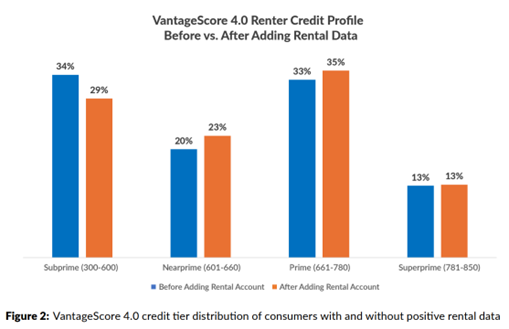
VantageScore Solutions released a new report evaluating data from over 600,000 renters with verified on-time renal payments, illustrating how including positive rental payments into the VantageScore 4.0 model expands opportunity for previously credit-invisible customers. The comprehensive study illustrates the challenge of rent payments historically being excluded from credit scoring models, limiting credit-building opportunities for millions of renters in the U.S. The data shows that including this information improves credit score predictive power by 11% and identifies more defaults. By including rental payment data, the share of consumers in the lower subprime and near-prime tiers decreases, while the proportion in prime and super-prime tiers increases. This uplift corresponds to real creditworthiness as measured by comparable default rates, meaning that positive rental payments can help lenders identify creditworthiness to renters who might otherwise be overlooked.
| | |
The National Fair Housing Alliance published its 2025 Fair Housing Trends report that analyzes housing discrimination complaints filed in 2024, revealing persistent and widespread discrimination across the United States. The report highlights key issues such as the predominance of disability-related complaints, a significant rise in national origin and retaliation complaints, and the ongoing challenges of federal funding cuts and staffing shortages on enforcement capacity.
The National Association of REALTORS® Profile of Home Buyers and Sellers reports an alarming decline in first-time homebuyers, who now make up only 21% of the market, with the average age rising to 40, reflecting growing challenges in housing affordability that threaten economic mobility and wealth building opportunities. This affordability crisis is exacerbated by the disparity between rising costs of living and stagnant wages, as U.S. workers have seen a significant gap between income and expenses such as housing. NAR’s advocacy for solutions includes zoning reforms, tax incentives, and legislative initiatives, such as the ROAD to Housing Act, to increase homeownership access and address affordability challenges.
An article from The Wall Street Journal discusses that rising housing costs are prompting more buyers to turn to adjustable-rate mortgages (ARMs); a loan type often linked to the previous subprime mortgage crisis for its potential risk as payments may rise in the future, though importantly the toxic ARM products that led to the crisis are no longer legal. Currently representing over 10% of mortgage applications, this recent resurgence in ARMs reflects the struggle to afford homes in the current market as borrowers seek lower initial rates at the cost of greater long-term uncertainty. This rise brings renewed debate over the safety of these loans, even as today’s options carry more consumer protections compared to those leading up to the 2008 crisis.
| | |
Monday, November 10
Assembly of Delegates | National Apartment Association, November 10-12
Tuesday, November 11
Veteran’s Day
Wednesday, November 12
Building inclusive economies | Brookings, 2:00 - 3:15 PM ET
2025 NAREB Black Homeownership Summit, November 12-14
Thursday, November 13
Virtual Workshop: Building and Strengthening Local Coalitions to Advance Upward Mobility in Your Community | Urban Institute | Upward Mobility Initiative, 1:00 - 2:15 PM ET
Friday, November 14
Last House on the Block: Black Homeowners, White Homesteaders, and Failed Gentrification in Detroit | Joint Center for Housing Studies, 12:15 PM ET
NAR NXT, The REALTOR® Experience | Real Estate Conference, November 14-16
| | The National Housing Conference is a diverse continuum of affordable housing stakeholders that convene and collaborate through dialogue, advocacy, research, and education, to develop equitable solutions that serve our common interest. | | Defending Our American Home since 1931 | | Copyright © 2024. All Rights Reserved. | | | | |