 |
TUESDAY, JULY 10, 2018
Click
HERE for yesterday's quote from Scott Paul on the 232 tariffs.
from a GBD Event Sponsored by
|
RISKS OF THE NATIONAL SECURITY GAMBIT
"Here's the U.S. developing these exotic theories about protecting your national security by closing all your biggest markets ... (now even potentially withdrawing from the larger multilateral framework) - in other words, creating circumstances in which the rest of the world may just pass us by as we close."
Rufus Yerxa
National Foreign Trade Council
June 29, 2018
|
|
|
|
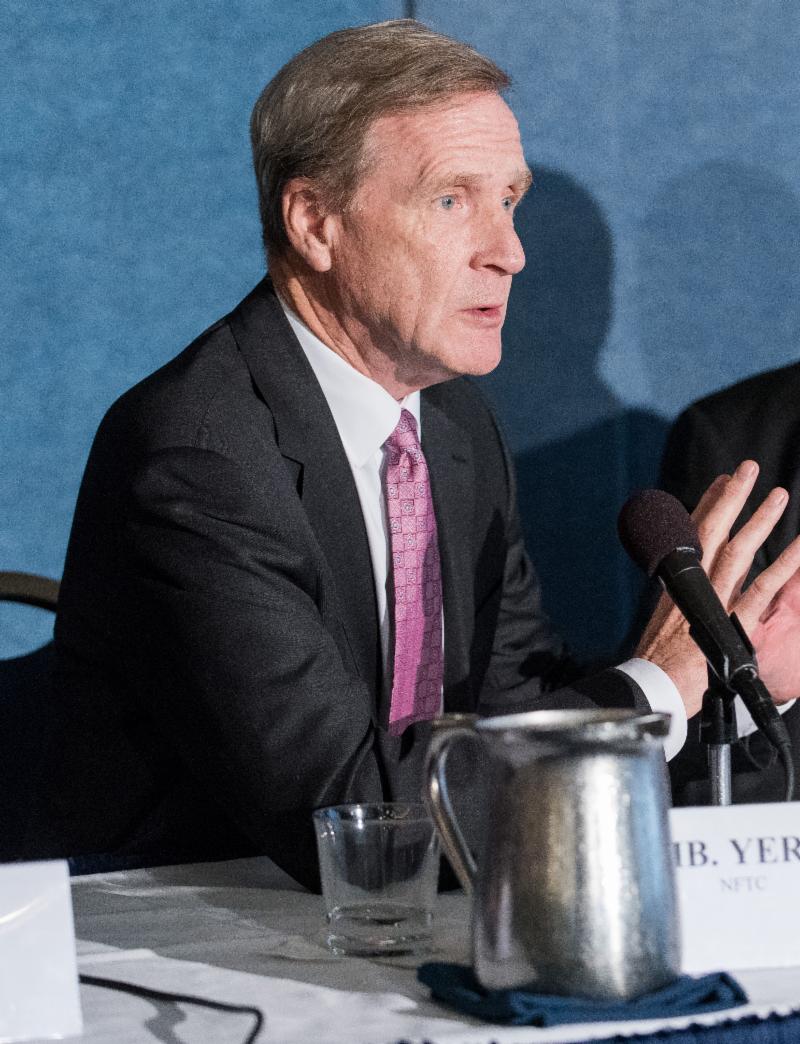
Amb. Yerxa Fields a Question
|
|
A former U.S. ambassador to the GATT and former Deputy Director General of the WTO, Rufus Yerxa today is the President of the National Foreign Trade Council (NFTC). In that role he led off the discussion at GBD's June 29 event on the national security tariffs on steel and aluminum. Today's featured quote was taken from that presentation. Clearly the NFTC is concerned about the direction of U.S. trade policy generally and particularly by the new Section 232 tariffs on steel and aluminum.
|
As we mentioned yesterday, those tariffs - 25 percent on steel imports and 10 percent on aluminum - went into effect for most imports on March 23 and for imports from Canada, Mexico, and the EU on June 1, 2018.
Even before the 23rd of March, it was clear that these contentious tariffs were coming, and on March 6, the NFTC announced the formation of a new group. This is the Alliance for Competitive Steel and Aluminum Trade. Its approximately 45 members include associations whose members use steel and aluminum, including the Motor and Equipment Manufacturers Association and the Beer Institute, as well as associations doomed to be hurt by retaliation, such as the U.S. Wheat Association and the National Pork Producers Council.
As Ambassador Yerxa explained in his remarks at GBD, "If you take all the manufacturing that depends on steel and aluminum, you're talking about 40 to 50 times the size of the steel and aluminum sector." The automobile sector by itself is ten times that size.
STEPPING BACK
Where current U.S. trade policy is concerned, the bridge of understanding is very much under construction. It has a number of supporting cables, some of them questions, and several of them were mentioned by Ambassador Yerxa. Here are a few.
The Role of American Manufacturing. "Eighty percent of Americans think that our manufacturing output is declining," Ambassador Yerxa said. "Actually, it's increasing quite dramatically and has been increasing consistently since the downturn in 2008." Earlier that week, Ambassador Yerxa had seen some of that vibrancy first-hand, when he visited a Toyota plant in Indiana. He said:
Toyota's a member of mine-producing about 410,000 autos a year [in that plant]. Almost 20 percent of their production is exported. I watched right-hand drive Toyota Highlanders come off the line, due for the Australian market. It's consuming 600 metric tons of steel a day, seventeen hundred trucks coming into the plant. Actually, over 80 percent of what they produce is from domestic content, or North American content. ...
And that's a reflection of the U.S. auto industry today. Two million exports last year -- 17 million unit production in an industry that's experiencing tremendous resurgence all over the country. By the way, it's no longer just centered in the industrial Midwest or upper Midwest, but in places like Texas, and Alabama, and South Carolina. We're exporting, Mercedes Benz from Alabama to China-at least we were; we'll have to see what happens once retaliation hits.
The Turning Point. Ambassador Yerxa said the country is facing a fundamental choice about the direction of U.S. trade policy, a that choice is likely to be made definitively "over the next six to eighteen months." He described the choice as between "a more mercantile trade policy," based on instruments like tariffs and bilateral, country-by-country trade deals on the one hand versus reliance on "the basic [trade policy] framework that's evolved over the last seventy years" on the other.
The fact that every action the Trump Administration can be seen as a negotiating tactic as well as a commitment to a certain path makes the analysis more difficult. But taking these two approaches on their own, the NFTC clearly sees more risk than reward in the newer approach. In that context, Ambassador Yerxa shared this anecdote:
I heard one member of my board describe it this way. They [the Trump Administration] fundamentally believe that you can fix the problems of the 21st century economy and 21st century industries by using 19th century policy instruments like tariffs and a 17th century philosophy like mercantilism.
Part of a Negotiation. Back to the 21st century, if the 232 tariffs [and, we might add, others] are part of a negotiating strategy, Ambassador Yerxa said, then let us hope that we see some results, some agreements, soon. "Because from a business point of view, what we're experiencing now is just tremendous uncertainty." He added:
Are we going to be getting new agreements to open world markets? ... Or are we actually going to start to face a world where tariffs go up everywhere, particularly against U.S. exports, and we begin to see higher costs and higher prices and the consequences of protectionism in our own economy?
We have left out a great deal here, including Ambassador Yerxa's acknowledgement of the serious problems America faces in its dealings with China and his suggestions for better ways to deal with them. For those, we suggest you listen to (or read) his full presentation.
|
|
As we have noted, there were four speakers at GBD's June 29 session on the 232 tariffs - five if you include the insightful comments of the moderator,
John Magnus of TradeWins. All of the presentations were excellent, and we expect to take note of each of them in the pages of the TTALK Quotes. In doing so, we shall keep our own comments to a minimum.
|
From the Transcript is a link to our transcription of Ambassador Yerxa's presentation on June 29. This was the source for today's featured quote and others in the above entry. The audio recording from which it was taken is available on the Events page of the GBD website, www.gbdinc.org.
About the Event takes you to the page of the GBD website that focuses on the June 29 GBD event What's in a Name? The Tariffs, National Security, and the WTO. Here you will find links to biographies of all of the speakers, an MP3 recording of each of their remarks, and a link to the C-Span video of the full event.
|
| TO GET THE TTALK QUOTES IN YOUR INBOX
Or Other GBD Notices, click below.
|
|
©2018 The Global Business Dialogue, Inc.
1717 Pennsylvania Ave., NW, Suite 1025
Washington, DC 20006
Tel: (202) 463-5074
R. K. Morris, Editor
Joanne Thornton, Associate Editor
|
|
|
|
|
|