|
“Darkness…this [refers to] the exile of the Greeks” (Bereshis Rabbah 2:4).
Reish Lakish, the great Talmudic scholar, explains that in the opening chapter of the Chumash, the Torah already hints to the various exiles the Jews will ultimately endure. Each word in the verse (Bereshit 1:2) corresponds to a different period of time when the Jews find themselves in exile. Reish Lakish first pairs the words in the verse with the exile of Bavel, moves on to the exile of Persia, then the Greeks, and concludes with the exile of the Romans. But why is the term darkness specifically used to describe the story of the Greeks?
Sruly Bornstein, of Daf Yomi fame, points out that of the four exiles referenced in our verse, three share a common theme: The exile of the Babylonians, the Persians, and the Romans are all storylines that take place outside the land of Israel. The Babylonians destroyed our first Beit Hamikdash, the Romans destroyed our second Beit Hamikdash, and both nations expelled the Jews from Israel. The story of Purim, from beginning to end, occurred exclusively in the land of Persia, modern-day Iran.
Unlike the others, though, the story of Chanukah took place entirely in the Jewish homeland. We were not on foreign soil. We were not strangers in unfamiliar territory. We were in the land promised to our forefathers, Avraham, Yitzchak, and Yaakov. We were in Israel. We were home. In fact, it’s a little difficult to understand why it’s referred to as an exile at all.
The Greeks were able to take what was so familiar to us and make it feel foreign. To take the values that we cherished and cause us to question them. To take the mitzvot that comprised the fabric of our lives and routines and slowly render them passé. That was the power and threat they wielded. Despite the Jews celebrating a period of light, the Greeks succeeded in casting an imposing shadow of darkness.
Today, Jews, for the most part, have attained religious freedom and light, yet there are times and there are people that try to assault us with darkness. And once again, we are faced with the task of fighting that darkness. When we do, we should remember, as Martin Luther King, Jr. declared, “[d]arkness cannot drive out darkness; only light can do that.” We must search for the light within ourselves and within each other to eradicate the darkness that abounds. May this year’s Festival of Lights shine the ultimate light onto all those who need it and fervently seek it.
Shabbat Shalom,
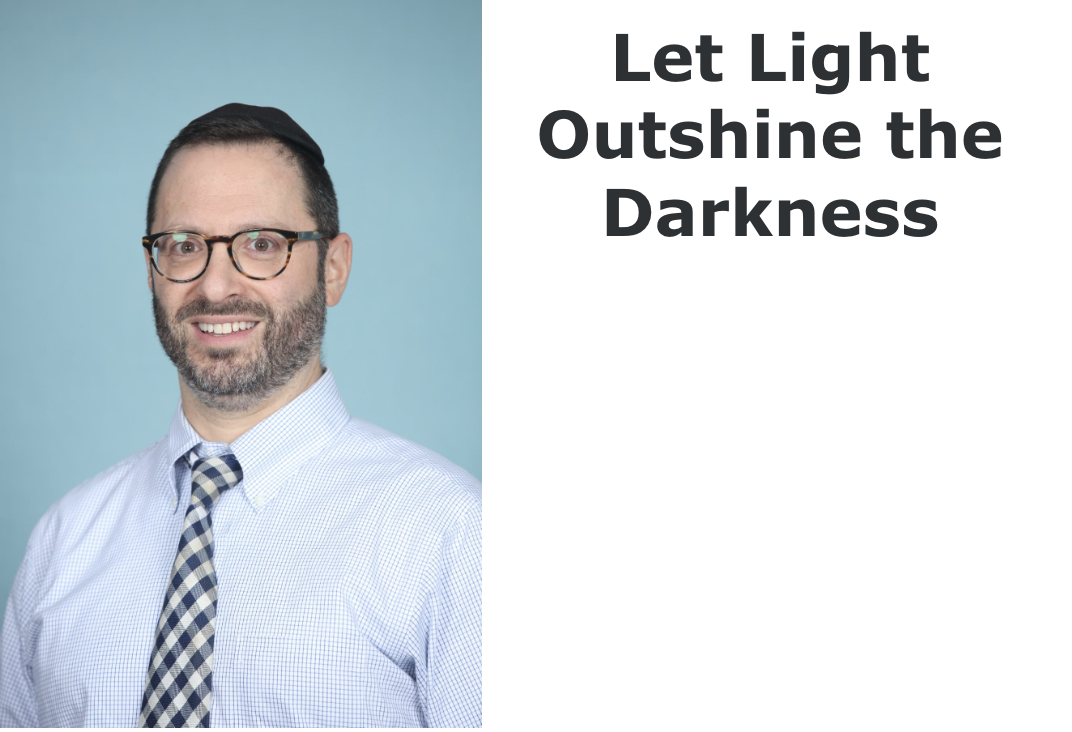
Rabbi Lanner
|