|
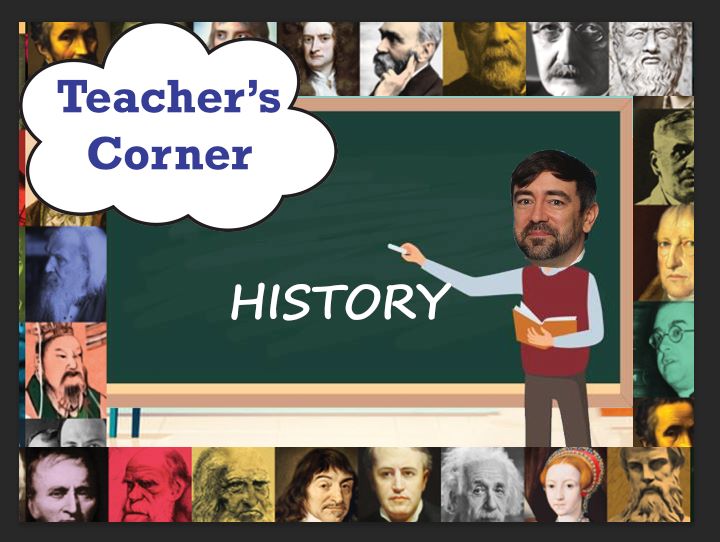
Graphic by Dan Himelstein ('24)
Amira: When did you start teaching?
Mr. Sulzener: I've been teaching since 2010, although primarily at the university level for a good chunk of that first decade. I've been happily ensconced here at KYHS since 2020.
Amira: What made you decide to teach?
Mr. Sulzener: The decision was initially happenstantial -- a necessary byproduct of pursuing a doctorate in history. With the benefit of some research grants, I was able to live in Germany from 2017-2020, during which I was mostly away from teaching and holed up alone doing research or working on my book. What dawned on me over that time, however, was the realization that I found much greater enjoyment, satisfaction, and purpose in the classroom than in the archive. And I haven't doubted that impulse since.
Amira: What is something you love about teaching?
Mr. Sulzener: My greatest joy in teaching comes in witnessing a true blue bit of student-led revelation, or that moment when I am but a conduit to a student pulling all the threads together on their own and "discovering" connections across otherwise disparate themes and periods. Critics of science fiction literature call this the moment of "conceptual breakthrough" -- when the curtain is pulled back and we are made privy to the gears at play -- although "light switch flip" works just as well.
Amira: What is your favorite class (subject) to teach and why?
Mr. Sulzener: There is no greater subject than history; and surely everyone feels the same, n'est ce pas? I enjoy teaching all history, although European especially, given my academic background. History is a disciplinary bridge, as it straddles the methodological divide. It is both an art and a science. Like poetry, historians have their own meter: verifiability. And the skills required to craft effective arguments about the past are the very ones required to do the same about the present. In short, what I love about teaching history is that history is always about much more than just "history".
Amira: How do your students inspire you?
Mr. Sulzener: It is easy for teachers and parents alike to dismiss the grind of a high school schedule. But that grind is real, and it is wearing. I'm confronted every day with students slogging through precisely that mix of big tests, big games, big commitments, and big growing up. And, by and large, my students do it with a smile and an easy diligence that inspires me to mimic the same as much as possible.
Amira: Why do you enjoy teaching at KYHS specifically?
Mr. Sulzener: To answer this, I think back to my start in the middle of the ‘20-‘21 school year. From the beginning, the whole school community was warm and more than welcoming, which turned what could have been a rather jolting start into an enjoyable and smooth transition. The longer I'm here, I realize that attitude is just as much the rule as the exception.
Amira: What do you think could benefit your teaching experience at our school?
Mr. Sulzener: My history classes would benefit immensely from a souped-up, flux-capacitor-equipped DeLorean.
Amira: How do you feel about the relationships you have formed with your students?
Mr. Sulzener: It is just as nice to see a student mature and grow over the course of four months as it is four years, and especially so when even a smidge of that growth is attributable to the positive relationships they've developed with any of their teachers.
Amira: What did you think you would be when you grew up/what would you be if you weren’t a teacher?
Mr. Sulzener: If you know anyone hiring people to kind of just hang out at Powell's in Portland, Oregon for 8 hours a day, roaming blindly through the stacks, reading 50 pages here, spilling coffee on 40 pages there, please do let me know.
Amira: What is your favorite food?
Mr. Sulzener: Ambrosia.
Article by Amira Kahn ('25)
|