Graphic by Esti Distenfeld ('26)

Upcoming Events:


End of Quarter 1 (9th-11th Grade) 

Nov. 11th


Parent Student Teacher Conferences

Nov. 18th - 19th

Doing Our Part


As the war in Eretz Yisrael continues, this week’s parsha gives each and every one of us a personal perspective on how we can contribute our part and the chizuk we need to accomplish this goal. 


In this week’s Parashat Lech Lecha, Avraham Avinu goes out to war against the four kings to save his nephew Lot. He successfully frees Lot from captivity, overpowering three of the four kings. Avraham then divides the spoils of war equally among the soldiers who fought the battle and those who manned the base. As our kids would say, “that’s not fair!”. It would seem only fair to us that those in the battle should receive a greater portion than those on base. We see the same situation many years later in sefer Shmuel Alef, when David Hamelech fights a war with Amalek and then, just as Avraham did, he divides the spoils evenly among the soldiers in various positions. When individuals respond that they should get a larger portion in proportion to the efforts they expended in the war, David disagrees and the Malbim explains his response:


 ״אמר להם דעו כי מה שאמרתם היה נכון אם היה ההצלה בכח ידינו, ואם ידינו עשו לנו את החיל, אבל לא כן אחי אנחנו לא עשינו מאומה, רק ה' הוא הלוחם והמנצח והמציל והנותן לנו״,

“He said to them, what you said would be correct if success was in our hands, and if it was our strength that made us successful, but it's not so, we didn’t do anything, only Hashem who fights and wins on our behalf.”


What Avraham understood and what David taught Bnei Yisrael years later was that, when the Jewish nation engages in war, it is Hashem who is fighting the battle. It doesn't make a difference what position you are in as long as every person is doing their part. From those manning the base, to the soldiers on the battlefield, as long as you are showing up and taking responsibility for your part, we are all one army led by HaKadosh Baruch Hu into success. 


This applies to those of us who are neither on the battlefield nor on the base but are far far away and may feel helpless and useless where we are. “The soldiers may be out on the battlefield, wielding the weapons, but it is we who have the ability to bring them home safely each night, through the protective power of our Torah and tefillah. If our emunah would be unshakeable, and we would genuinely believe that the outcome is decided not by guns, but by our Torah and Tefillah, then our learning and prayers would be with an intensity that rivals the intensity of a soldier in battle” (Rav Wolbe on Chumash) .


This concept has been shared multiple times over the past year of tragedy in Eretz Yisrael, but it’s a concept many of us may have a hard time truly internalizing. We may feel that it's the men and women on the front lines who truly fight this battle and that our Torah and tefillah cannot even be considered as such a significant contribution in comparison with them giving up their lives. As Rav Wolbe said, it is then our emunah that needs strengthening – the emunah that Hashem placed each and every one of us exactly where we are needed and are supposed to be and it is exactly in that place that we are tasked with doing our part. For some that is waiting at home for their husbands or wives to return from war, for some it is collecting necessary items the soldiers are lacking, and for others it is dedicating their learning as a zechus for the safety of our nation. 


May we be able to strengthen our emunah in Hashem’s love and protection of us, so we may be inspired and empowered to contribute our personal role in the army of Hashem. 


Shabbat Shalom,

Mrs. Hadar Essebag


Passing the Torch

Dr. Shane bids farewell as Dr. Roni Raab becomes the new Head of KYHS

Graphic by Serena Fialkoff ('27)


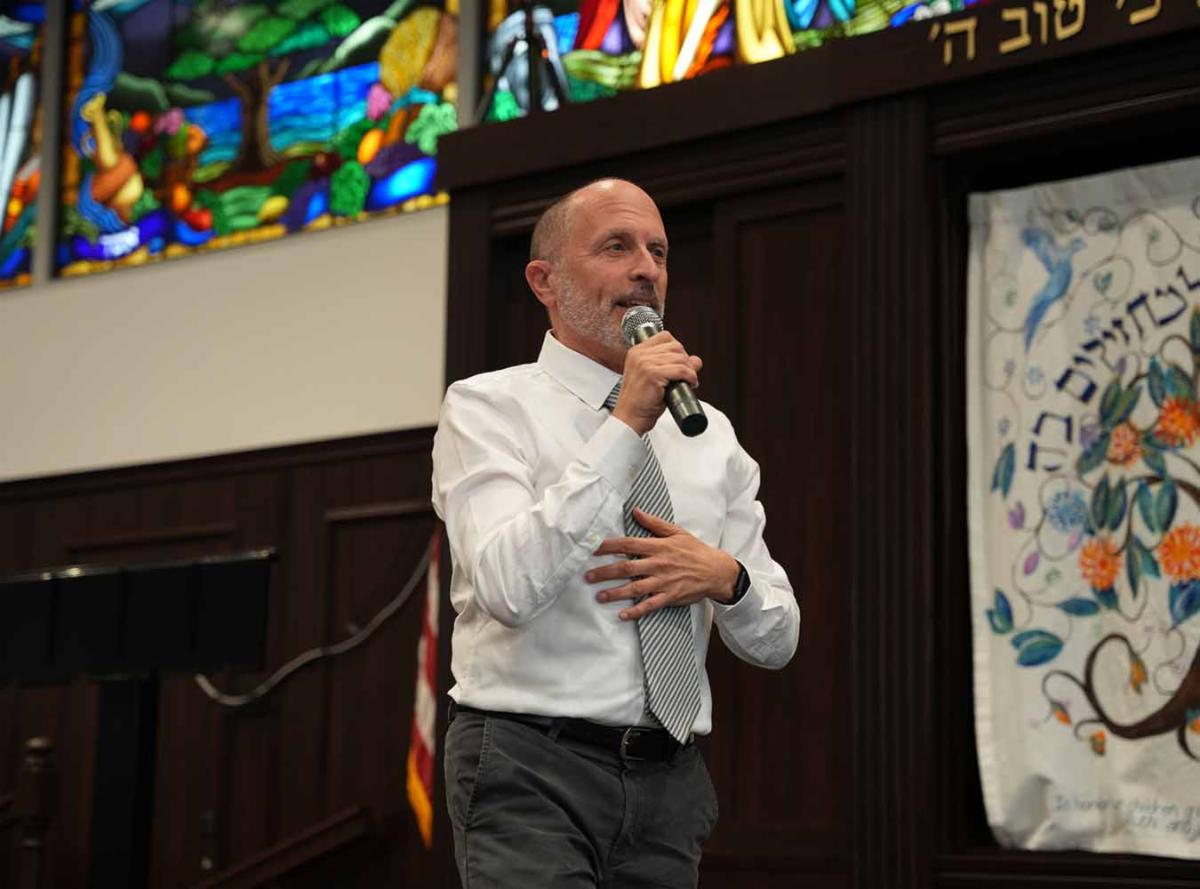
As we approach the end of the first quarter and begin the second quarter, a new Head of School has arrived. It is unique for the Head of School to change once the school year has already begun. For the past two years, Dr. Shane has been traveling back and forth from Eretz Yisrael to Florida to serve as the interim Head of School. In her goodbye speech to the students this week, Dr. Shane explained that, if it were any other school, she wouldn’t do this, but she believes that Katz Yeshiva High School is the best school in the United States! She expressed her thanks, said farewell to all of the students and faculty, and then handed the microphone over to Dr. Roni Raab, signifying the transition and that she was giving over her role and responsibilities to our new leader. 


Students were cheering for Dr. Raab because they were, and still are, excited to see what’s in store. “A Head of School has to be someone who is uplifting and shows a great sense of leadership. I believe that Dr. Roni Raab deeply cares for the student body and will help to further improve the school,” said Rebecca Slesinger (‘25). 


Dr. Raab has worked at many different schools around Florida, including Hebrew Academy, Donna Klein, and Katz Hillel Day School. He is a very experienced teacher and administrator, and he expressed that his first concern is for the safety of the students and faculty. Once everyone is safe and secure, he can then focus on making a warm environment for students to learn and grow. It’s crucial that a school is filled with a lot of opportunities to help guide students through their next steps in life. High school students are in their formative years during which they get to shape their future selves. Dr. Raab will surely do a phenomenal job at setting the students of KYHS up for success in their future.


Article by Miriam Marcus ('25)

 Why Are Ballots Not Online?

Graphic by Ezra Dimont ('25)


Everyone in the world is chronically on their phones. The media has been spreading propaganda videos everywhere on the internet. Federal election campaign ads popped up in almost everyone’s social media feeds, and registered voters were bombarded with text messages such as, “Election two days away! Go vote!” or simply, “Vote for Harris/Trump!”. It seems that, in today’s society, we receive all of our information for our presidential candidates on our devices. American citizens, for the most part, form so many of their personal beliefs from what they read on the internet, yet we do not vote by clicking a mouse or touching a screen. 


According to USA.gov, voting online is not allowed in federal elections. 


David Jefferson, in a 2014 article titled, “If I Can Shop and Bank Online, Why Can’t I Vote Online?,” explains that voting online is a threat to US federal elections because there is no guarantee of security, and that is a powerful, dangerous, and an immoral scare to the integrity of the elections. Voting online opens a door to an attack on national intelligence which could lead to tinkering with the election outcome. This raises the question, if we can safely and securely shop online, why can’t we safely and securely vote online? Jefferson answers this question in two ways. First, he states that all transactions are somewhat risky, and the same applies to voting. Second, e-commerce and purchase transactions are structurally different from voting. The voting security and privacy requirements are unique and in tension in a way that has no analog in the e-commerce world. 


Back in 2023, NPR reported that certain groups have attempted to make voting accessible online but have failed miserably. They summarized: “The advice from cybersecurity experts is clear: Widespread internet voting at this point is a bad idea.” 


One example of a group which tried to transform the voting system came from the University of California, Berkeley and was funded by a man named Bradley Tusk, Uber’s first political advisor. The university group met regularly for a year and finally wrote a 12-page document that said what cybersecurity workers have been saying for forever: voting will never be secure online. “The current cybersecurity environment and state of technology make it infeasible for the Working Group to draft responsible standards to support the use of internet ballot return in U.S. public elections at this time," the group wrote. “Informally, putting a server online to support online ballot return is like asking a kid to go play in traffic. It just isn't safe," said Ron Rivest, a cybersecurity expert who founded the companies RSA and Verisign, in testimony given earlier this year opposing an internet voting bill in Washington.


In 2020, NBC reported that James Comey, former director of the FBI, described online voting systems as “clunky”. The biggest concern is that fraud does occasionally occur in the U.S., albeit on a small scale. However, an online voting system could lead to widespread fraud. The American government and process are insecure about their network and are hesitant to put the ballots online. 


Now imagine a democratic country where one has the option to vote online. We would all be living in fear. Having physical ballots gives the American people security and comfort that their votes are safe. 


Sources:

https://verifiedvoting.org/publication/if-i-can-shop-and-bank-online-why-cant-i-vote-online/ (Jefferson, 2014) 

https://www.npr.org/2023/09/07/1192723913/internet-voting-explainer (Parks, 2023)

https://www.nbcnews.com/tech/security/why-elections-aren-t-happening-our-smartphones-n1243418 (Collier, 2020)


Article Gabriella Asher ('25)

Click here for the Podcast

Graphic by Orli Goldenholz