It’s almost time for our first ever Aprons & Appetizers event.
As much a “friendraising” as a “fundraising” event, we invite you to join us for this fun and relaxing evening at Evolve at MileHi on August 21 from 5:00 – 7:00 pm.
This event has been taking shape for a very long time and has finally come to fruition, thanks to a lot of very creative individuals who have stepped up to help get it off the ground.
Not only will you have the opportunity to sample delicious appetizers and desserts, but you will also get to participate in creating them. And that’s not all!! We have fun raffles planned, great prizes to win and amazing music to lift your spirit!
I’m super excited about how much fun it’s going to be, and I so hope you’ll join us! Tickets are only $35 each and most importantly, you will be supporting our mission and those we serve here in Southwest Denver.
Please come out and support Southwest Improvement Council and – have a fabulous time doing it – on Thursday August 21 at our signature Aprons & Appetizers event! Sponsorships are still available, but act fast because space is limited and we already anticipate a sell out. I look forward to seeing you all there!
SWIC partners with Volunteers of America (VOA) and Denver Regional Counsel on Governments (DRCOG) to provide opportunities for social engagement, physical activity, and healthy nutritional support. From arts and crafts to woodworking, chair yoga, music, and more, there's something for everyone. All activities are free, please reach out via telephone at 303.934.2181 for more info. Check out the link below to see what we have going on in August:
SWIC is also a United States Department of Housing and Urban Development (HUD) approved housing counseling agency offering free counseling services. SWIC has been providing Colorado Housing and Finance Authority (CHFA) sponsored homebuyer education classes since 2017. The class is held once a month at the SWIC Dining & Activity Center. There's no charge to attend. Upcoming classes are (Saturdays) August 16, September 20, October 18. Here's more info:
Understanding the amount of equity, you possess in your home is crucial and safeguarding that equity can provide financial benefits in the future. So, what exactly is equity? Equity represents the difference between the outstanding Principal Balance of your mortgage and the current value of your home. If you do not have a mortgage, you possess one hundred percent equity. In cases where a mortgage exists, focusing on reducing the Principal Balance of your mortgage is typically the most effective method for increasing equity. The more you reduce the Principal Balance, the greater your chances of building equity, provided the value of your home is either appreciating or remaining stable. If the value of your home rises while you are paying down the Principal Balance, your equity will begin to grow.
The most effective approach to building equity is to voluntarily make an additional payment each year, which will accelerate the reduction of your mortgage's Principal Balance, thereby decreasing the interest you pay and shortening the overall loan term. This form of equity is referred to as active equity. Another beneficial strategy for building equity involves enhancing the value of your home through improvements, such as upgrading appliances or renovating a kitchen. However, this type of equity is classified as passive equity, as there is no guarantee that such enhancements will lead to an increase in equity.
It may be alluring to tap into that equity by securing a home equity line of credit or applying for a home equity loan. However, these options can be risky and will raise the monthly expenses associated with owning your home. I will discuss home equity loans in greater detail in a forthcoming article. Should you have any questions regarding equity, please do not hesitate to reach out to me for further information.
There are several important reasons to repot a plant. As plants grow, their roots often require more space to expand, and repotting allows for this necessary development. Over time, potting media can lose essential nutrients, so replacing it supports ongoing plant health.
Repotting also provides an opportunity to inspect the roots for issues such as rot, crowding, or circling, and to address these problems as needed. Additionally, compacted soil can hinder aeration and drainage, increasing the risk of root disease; using fresh potting mix can help improve both drainage and overall growing conditions.
Repotting is generally most effective during the plant's active growth phase, typically in spring or early summer, as it supports recovery from transplantation and promotes root establishment in the new substrate. During this period, plants usually produce new growth and can utilize additional nutrients available in fresh potting mix.
However, if significant issues such as root rot, pest infestations, or severe decline occur during fall or winter dormancy, repotting may still be necessary to address these problems.
Signs a Houseplant May Need Repotting
Roots Emerging
Roots may begin to protrude from the drainage holes at the bottom of the pot or appear above the soil surface.
Rootbound Conditions
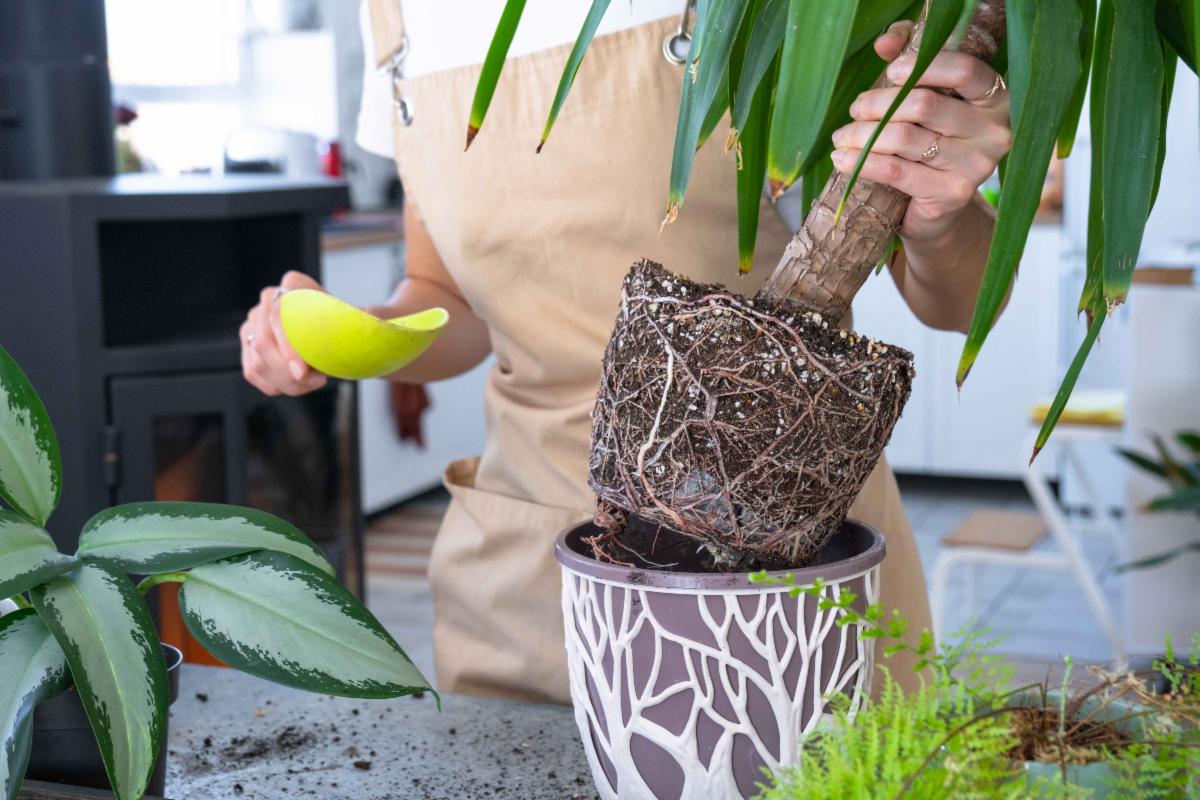
When the plant is carefully removed from its container, the roots might be observed circling
tightly around the root ball, forming a dense network.
Accelerated Drying of Potting Mix
The potting medium may dry out more rapidly than usual, even with consistent watering,
necessitating increased frequency of irrigation to maintain adequate hydration.
Reduced Growth or Yellowing Leaves
Plant growth may slow, and new leaves could be smaller or yellowish. This situation often
suggests nutrient deficiencies due to depleted or compacted growing media.
Top-Heavy or Unstable Plants
If the plant’s foliage becomes disproportionately large relative to the pot, stability may decrease, increasing the chance of tipping. Salt or Mineral Accumulation (a whitish residue) may develop on the soil surface or rim of the pot, indicating an accumulation of salts and minerals from fertilizers and tap water.
Step-by-Step Guide to Repotting
What you will need. A new pot 1 or 2 inches larger than the previous pot. The pot
should also have drainage holes. Fresh potting mix that is suitable for your plant type. A
clean workspace. Clean cutting shears for any root removal that might be needed.
Gloves (optional).
1. Prep the new pot; Add a layer of fresh soil at the bottom. If it’s terracotta, soak it first so
it doesn’t steal moisture from the plant.
2. Remove the plant; Gently tip the old pot sideways and slide the plant out. If it’s stuck,
squeeze the pot or use a butter knife around the edges.
3. Loosen the roots; Massage the root ball to untangle roots. If it’s root-bound, make a
few vertical cuts to encourage outward growth.
4. Place in the new pot; Center the plant and fill in around it with fresh soil. Leave about
an inch from the top to avoid overflow when watering.
5. Water thoroughly; Water until it drains from the bottom. This helps settle the soil and
Southwest Improvement Council (SWIC) is a 501(c)(3) nonprofit organization that relies on funds from individuals, foundations and businesses in our community that enable us to continue providing our dedicated programs and services.
Did you know that SWIC is eligible to receive Donor Advised Funds (DAFs)? In most cases, you can make a grant directly from your DAF account to SWIC via electronic funds transfer. Please contact Donna Zimmerman for more information @ donnaz@swic-denver.org
THANK YOU to all of those who have supported SWIC in the past, who currently do, and who would like to! If you, your business or organization would like to support SWIC through volunteering, product donation, or financial contribution, please reach out to us, we truly appreciate you and consider you part of our SWIC family!
THANK YOU TO OUR
SWIC PARTNERS!
SWIC-Denver | 5045 W 1st Avenue | Denver, CO 80219 US