THE JOURNAL FOR OPERATIONAL MEDICINE AND TACTICAL COMBAT CASUALTY CARE
|
For 20 years, the Journal of Special Operations Medicine (JSOM) has been the only published venue that brings together military SOF, civilian Tactical EMS, and federal Department of Justice agencies with tactical medical assets. Originally established by the Command Surgeon's Office of the United States Special Operations Command (USSOCOM-SG), we have grown into one of the world's most renowned peer-reviewed medical journals, now subscribed to in 80 countries!
|
|
|
Journal of Special Operations Medicine (JSOM) Newsletter
01 October 2020 - Issue 182
|
|
Greetings JSOM Newsletter Subscribers,
The Fall 2020 Edition of the JSOM is now available to our digital subscribers. If you are a print subscriber, your journal should be reaching you very soon.
I recently received an email from Dr. Stephen Rush, USAF Pararescue/Special Warfare. He is requesting information and assistance for a data base being compiled of mass casualty incidents (MCI or mascal) to try to extract lessons learned to create evidence based medicine to train and manage MCIs.
No Opsec info to be included.
They are primarily interested in the point of injury but if you were in one at a Role 2 or 3 they will compile and add a separate project.
If interested in helping please send an email to mascalstudy@gmail.com and they will send you a form to complete. It should take about 3 minutes.
|
Currently in production and available soon:
The 2020 updated and new versions to the following handbooks have been slightly delayed due to the authors' response to COVID19:
-
Pararescue Medical Operations (PJ MED) Handbook 8th Ed. If you currently own the ring-bound 7th ed, you will be able to buy the updated pages and update the handbook yourself. **The 8th Ed will be available as a spiral-bound handbook.
-
2020 Updated Ranger Medic Handbook: This title is currently at the printer. COMING SOON!
- NEW 2020 Advanced Ranger First Responder Handbook
Respectfully,
Michelle DuGuay Landers, MBA, BSN, RN
Breakaway Media, LLC
Publisher
Journal of Special Operations Medicine and Advanced Tactical Paramedic Protocols Handbook
Lt Col, USAFR/NC (Ret)
|
A note about the newsletter design: This newsletter has been created using one cohesive font and a unified JSOM brand and color design. If multiple fonts or unusual colors are appearing in your copy, it is a result of your personal settings or the settings attached to your email. For optimal viewing of this newsletter, including the sidebar items which can sometimes disappear depending on your email settings, we suggest opening the newsletter in a browser. |
ABSTRACT
America's adversaries will contest US military superiority in the domains of land, sea, air, space, and cyberspace. Fundamentally, these foes seek to disrupt the dominance of American fighting forces through anti-access and area denial (A2AD) systems, such as cyber exploitation, electromagnetic jamming, air defense networks, and hypersonic capabilities. According to Training and Doctrine Command (TRADOC) Pamphlet 525- 3-1, these A2AD capabilities create multiple layers of stand-off that inhibit the US ability to focus combat power and achieve strategic objectives in a contested, increasingly lethal, inherently complex, and challenging operational environment.1 The Department of Defense (DoD) plans to mitigate this shift in enemy strategy through the adoption of multidomain operations (MDO).1 MDO is defined as operations that converge capabilities to overcome an adversary's strengths across various domains by imposing simultaneous dilemmas that achieve operational and tactical objectives.1 Within this MDO construct, medical treatment expectations must shift accordingly as the ability to rapidly treat and evacuate patients may be constrained by enemy action. Thus, the notion of prolonged field care (PFC) may be a necessity on the future battlefield. As Special Operations Forces (SOF) continue to refine what PFC entails, it is imperative that an understanding of the incidence and type of diseases that require medical evacuation to higher levels of care be thoughtfully estimated. Armed with an understanding of the anticipated epidemiology, effective prioritization of training requirements and equipment acquisition is possible in a manner that is complementary to the overall success of the assigned mission. Furthermore, this prior planning mitigates risk, as the limitations of money and time impose significant opportunity costs in the short run should the disproportionate mix of disease states be pursued, which in turn, avoids jeopardizing Soldiers' lives over the long term.
|
|
ABSTRACT
This case describes the prolonged treatment of a 38-year-old man with a transpelvic gunshot wound requiring a diverting ostomy and cystostomy for damage control procedures with a comminuted acetabular and femoral head fracture. The team used a ketamine drip for prolonged field care over 48 hours. The benefit of using a ketamine drip included low supply requirement, excellent analgesia, and ease of administration, but side-effects included somnolence and atelectasis necessitating oxygen supplementation before evacuation.
|
|
October 2020 JSOM Feature Article |
|
Far Forward Gaps in Hemorrhagic Shock and Prolonged Field Care: An Update of ALM Fluid Therapy for Field Use
Dobson GP, Letson HL. 20(3). 128 - 134. (Journal Article)
|
|
ABSTRACT
Future expeditionary missions are expected to occur in more remote austere environments where combat medics and casualties may have to wait up to 7 days before resupply or safe evacuation. Currently, there is no effective fluid therapy for hemorrhagic shock (HS) at the point-of-injury and continuum-of-care over this extended period. We have been developing a small-volume IV or IO ALM therapy for noncompressible HS and have shown in preclinical models that it extends survival to 3 days, reduces abdominal bleeding by 60%, blunts inflammation, corrects coagulopathy, preserves platelet function, and prevents immunodeficiency. The ALM-survival phenotype is associated with an upregulation of the master genes of metabolism and mitochrondrial biogenesis in heart and brain and a downregulation in the periphery. Future translational studies will investigate the timing and nature of the "switch" and extend survival to 7 days. We will also discuss some of the controversies of ALM resuscitation in pigs, present our Systems Hypothesis of Trauma (SHOT), and discuss future clinical safety trials before field use.
Keywords: hemorrhage; trauma; survival; genetics; metabolism; inflammation; military medicine; resuscitation
|
|
The Journal Of Special Operations Medicine Podcast |
|
The JSOM podcast digs deeper into the articles and subjects that matter to our readers. Our podcast hosts, Captains Alex Merkle and Josh Randles, tackle articles from the journal based on merit, interest, and application for operators in the field. In addition, the podcast features a special, not to be missed Interview Series with leaders, doctors, and authors. |
|
Our October 15th eNewsletter will be updated with information regarding brand new interviews and conversations coinciding with the release of the Fall 2020 edition of the Journal of Special Operations Medicine. For now, please be sure to review and catch up on all the highlights from Summer.
In the Summer 2020 episode of the JSOM Podcast, Alex and Josh discuss the article, "Step Duration Effects on Blood Loss in Simulated Designs of Tourniquet Use Procedure". Guest Will Price breaks down the article, "Clothing Effects on Limb Tourniquet Application", and authors Matt Douma and Peter Brindley discuss their article, "Temporizing Life-Threatening Abdominal-Pelvic Hemorrhage Using Proprietary Devices, Manual Pressure, or a Single Knee: An Integrative Review of Proximal External Aortic Compression and Even 'Knee BOA'.
- Step Duration Effects on Blood Loss in Simulated Designs of Tourniquet Use Procedure Kragh JF, Aden JK, Dubick MA.
- Guest Will Price discusses: Clothing Effects on Limb Tourniquet Application. Wall PL, Buising CM, Hingtgen E, Smith H, Renner CH. Drs. Matt Dumas and Peter Brindley discuss their paper:
- Temporizing Life-Threatening Abdominal-Pelvic Hemorrhage Using Proprietary Devices, Manual Pressure, or a Single Knee: An Integrative Review of Proximal External Aortic Compression and Even "Knee BOA" O'Dochartaigh D, Picard CT, Brindley PG, Douma MJ.
Duration: 37:10
|
|
Highlights From The 20th Anniverseary JSOM Interview Series: |
|
MAJ Andrew Fisher, MS-4, PA-C, LP for a great review of pre-hospital whole blood in the military; where we are now and how we got there. He reminds us that, "everything old is new again." The first whole blood transfusion research was done by the military in 1940 (Armed Forces Blood Program) and was used extensively in WWII and the Korean War. But times change and lessons learned are lost to the sands of time as one generation of peacetime military surgeons hands off the reigns to the next. Listen here.
World-renowned tourniquet expert Dr. John Kragh. In this interview, Dr. Kragh takes us through his history in becoming a tourniquet expert as well as detailing the evolution of tourniquet use in combat situations as a battalion surgeon in Southwest Asia. Tourniquet use has evolved considerably even during the 20-years since the JSOM has been in publication. Be sure to read Dr. Kragh's contributions to this quarter's journal as a companion to this interview. Listen here.
CMSgt Michael Rubio, currently the commandant of the 351st Special Warfare Training Squadron of the PJ schoolhouse at Kirkland AFB. It's a great opportunity to hear from the best about how PJ training has changed during the past 20 years, and get a glimpse of where it is heading in the future. You can listen here. Look for another episode later this month.
|
|
JSOM Podcast
Wilderness Medical Society
|
|
In an effort to broaden and strengthen our ties with the Wilderness Medical Society and all who work in the wilderness medicine community, our webmaster and podcast hosts will be partnering with the organization to share more information and crossover content between our podcast platforms.
The mission of the Wilderness Medical Society is to encourage, foster, support, or conduct activities to improve the scientific knowledge of the membership and general public in human health activities in a wilderness environment.
The Journal of Special Operations Medicine has long partnered with the WMS in a shared science program as we understand the importance of sharing information with all who work in various forms of unconventional medicine.
|
|
Management of COVID-19 in Austere Operational Environments (Prehospital & Prolonged Field Care)
This practice management guide does not supersede DoD Policy. It is a guideline only and not a substitute for clinical judgment. It is based upon the best information available at the time of publication. It is designed to provide information and assist decision making. It is not intended to define a standard of care and should not be construed as one. Neither should it be interpreted as prescribing an exclusive course of management. It was developed by experts in this field. Variations in practice will inevitably and appropriately occur when clinicians take into account the needs of individual patients, available resources, and limitations unique to an institution or type of practice. Every healthcare professional making use of this guideline is responsible for evaluating the appropriateness of applying it in the setting of any particular clinical situation. The practice management guide is not intended to represent TRICARE policy. Further, inclusion of recommendations for specific testing and/or therapeutic interventions within this guide does not guarantee coverage of civilian sector care. Additional information on current TRICARE benefits may be found at www.tricare.mil or by contacting your regional TRICARE Managed Care Support Contractor.
|
|
Institutional Subscribers And Re-subscribers |
|
The JSOM is incredibly grateful to have the support of many institutions around the world. We would like to thank our recent institutional subscribers and re-subscribers for their support by acknowledging them in our eNewsletter and, when applicable, sharing their social media information. We reached a milestone, surpassing 50 institutions! We currently have 53 active institutional subscriptions, reaching a potential 59,000+ readers!
Visit https://jsom.us/Library for a full list of institutions that are currently subscribing to the JSOM. We are beginning a campaign to expand our institutional subscriptions. If you think your company would benefit from an institutional subscription, let us know! We'll be happy to talk to you and get the ball rolling. You don't have to be a university or medical center to subscribe - we have many EMS units, government agencies, and military medical units both in the United States and abroad.
Are you on the list? Great! Need to know how to access our resources? You can either contact your head librarian, or shoot an email to subscriptions@JSOMonline.org.
Institutions receive either a print copy of our journal, digital access, or both. Digital subscribers have unlimited access to our full compendium of articles, journals, and the ATP-P. If you are a student, researcher, doctor, or other medical professional at one of these institutions, please contact your librarian for login details. Additionally, the digital resources are typically available 2-3 weeks ahead of print publication.
If your institution is not on the list and you would like more information about our institutional access, contact our subscriptions manager, Dr. Scott Graverson.
|
|
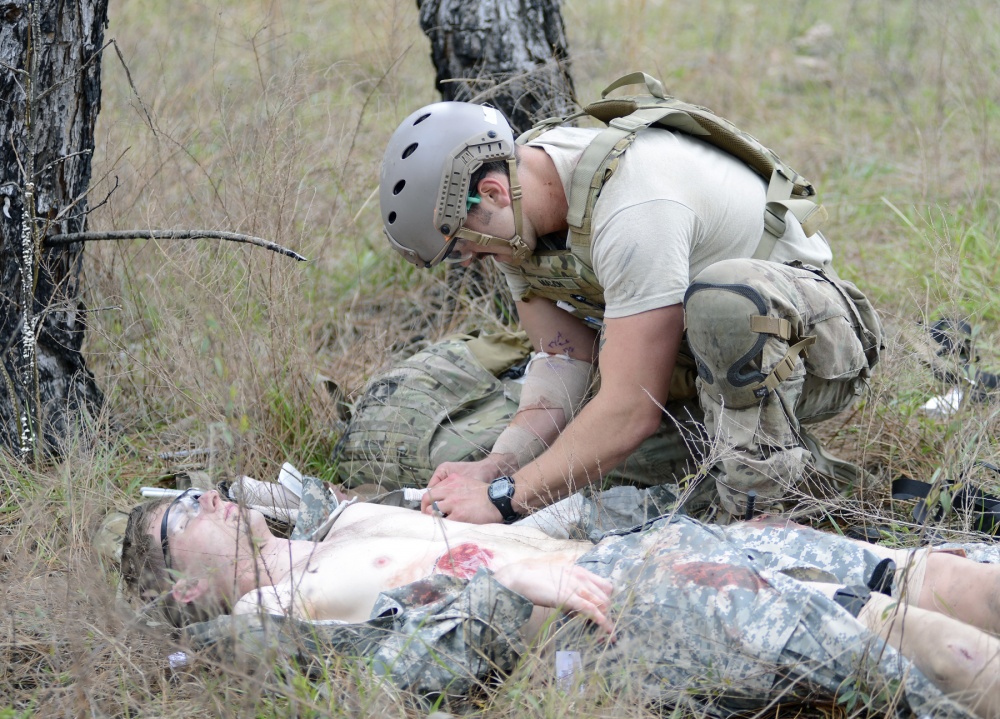
A student in the Special Operations Combat Medic Course at the U.S. Army John F. Kennedy Special Warfare Center and School treats a simulated patient during casualty training at Fort Bragg, North Carolina. Enlisted service members who completed the course specialize in trauma management, infectious diseases, cardiac life support and surgical procedures and qualify as highly trained combat medics with the skills necessary to provide initial medical and trauma care and to sustain a casualty for up to 72 hours. (U.S. Army photo by K. Kassens)
Do You Have a Photo to Share?
Please send us your approved medical action images for future covers, our journal Photo Gallery,
bi-weekly eNewsletters, and JSOM social media! All images must include captions in the emails in which they are sent. Images for print must be high resolution, at least 300 dpi. Images for the eNewsletter and social media must be at least 400px wide, 72 dpi.
|
|
Breakaway Media, LLC, is woman service-disabled veteran-owned small business (WOSB and SDVOSB) registered with the Central Contracting Office of the Department of Defense
DUNS #070397122 / Cage #6F0Z6
Primary SIC Code - 2721
GSA Contract Number GS-02F-004DA
Journal of Special Operations Medicine
1275 66th St N, # 41494
St. Petersburg, FL 33713
This disclaimer pertains to any publication (aka, "publications") written or electronic set forth by Breakaway Media, LLC (BAM) and includes, but is not limited to: The Journal of Special Operations Medicine (JSOM), social media posts to Facebook, Twitter, Instagram, LinkedIn, the JSOM eNewsletter, the JSOM website, and any promotional materials published by BAM. The views and opinions expressed in these publications are those of the authors, contributors, and sponsors of the JSOM and BAM, and do not necessarily reflect those of the JSOM, the JSOM Editorial Board ("the editorial board"), BAM, or its affiliates. Neither the JSOM, the editorial board, BAM, nor its affiliates hold themselves responsible for statements or products discussed in any BAM publications. Unless so stated, material in BAM publications does not reflect endorsement, official attitude, or position of the JSOM, the editorial board, BAM, or affiliates. Products advertised have not been tested by the JSOM, the editorial board, BAM, or its affiliates, and, as such, cannot be held liable for any injury or death caused by the use or misuse of the products contained herein. Neither BAM, the editorial board, nor its affiliates, make any warranty, representation, endorsement, or guarantee of products advertised, discussed, tweeted, retweeted, or shared any publication, to include the assumption of any liability whatsoever arising out of the application, use, or misuse of any product. As a medical publication, we are committed to sharing new technology and products we feel may be of interest to our readers, and encourage all readers and users of said products to use with caution and under proper authorization and professional guidance.
Tagging the JSOM on Instagram / Disclaimer
We assume by tagging us on Instagram, you are authorized to disseminate the photograph you are sharing with us. If you are a photographer whose image has been used or shared without authorization, please notify us immediately so we may give you proper credit.
|
|
|
|
|
|
|