APRIL 2026

Your Monthly Peek Into Sacramento’s Coordinated Access System


Stories, updates, and data from Sacramento’s front door to homelessness services.


March Data & Analysis


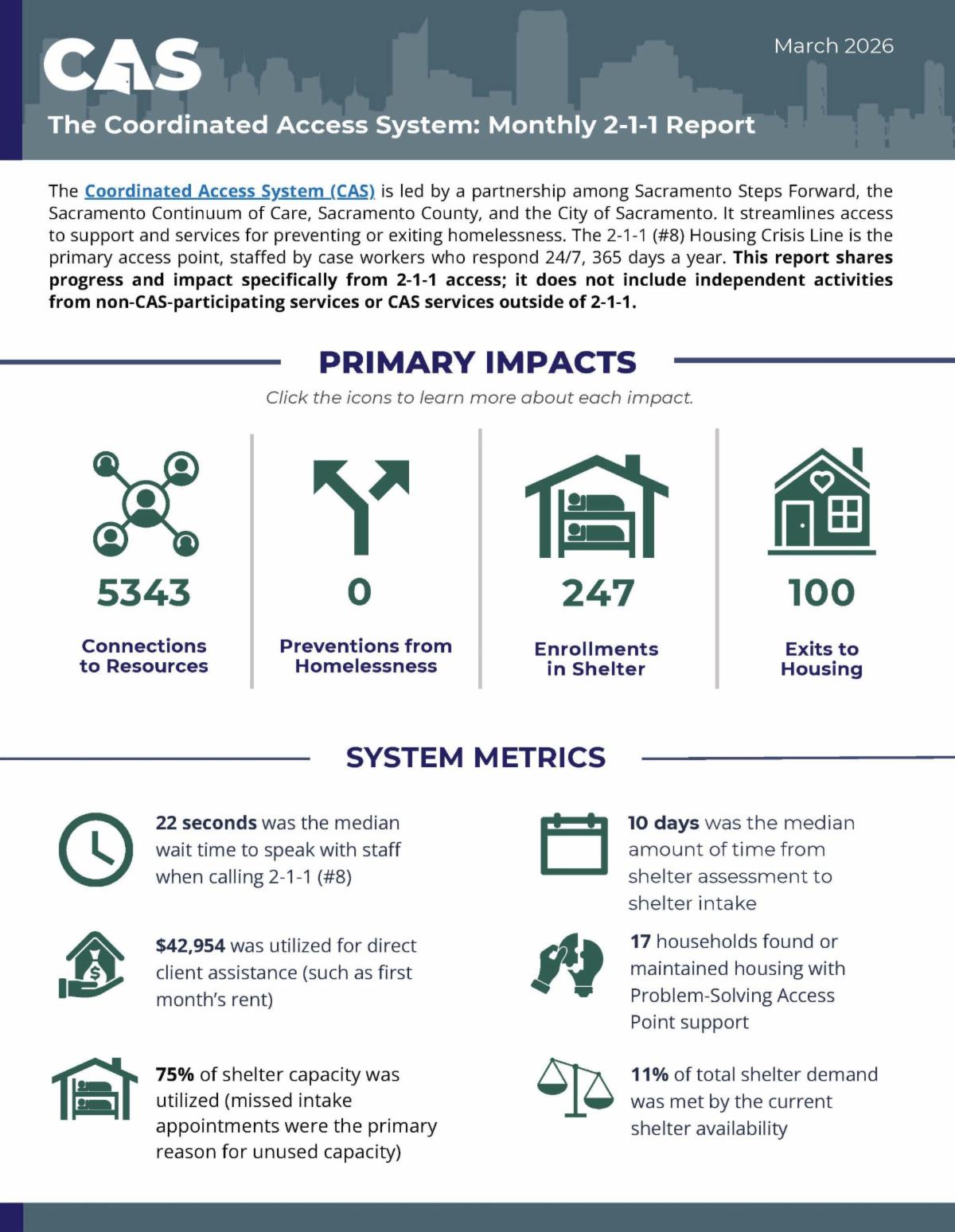
The 2-1-1 line connected more than 5,300 people to resources, with an average wait time of just 22 seconds. This month, shelter entries increased with 247 households entering shelter, up by 23 households from February. Housing placements also increased, with 100 households moving into housing, 19 more than last month.


While problem-solving support helped 17 households stay housed, direct financial assistance also continued to play a key role in stabilizing households. Prevention outcomes were low this month, reflecting limited program availability. With two new PSAP agencies onboarded, we’re optimistic this will strengthen prevention efforts in upcoming months.


At the same time, demand for shelter continues to outpace supply, with only 11% of need currently met. The average 10-day timeline from assessment to intake points to ongoing opportunities to improve flow through the system.


READ THE FULL REPORT & ANALYSIS ➜

Understanding the Role of the Coordinated Access System


Each month, we will take a closer look at one part of the Coordinated Access System and how it supports people experiencing or at risk of homelessness.


Depending on your role, your interaction with the Coordinated Access System (CAS) can vary significantly. The CAS serves as the operational arm of the Sacramento Continuum of Care (CoC), functioning as the central hub that connects organizations with available resources, service providers with clients, and individuals seeking assistance with the people and agencies best suited to help them. 


The CAS implements the policies and procedures established by the Sacramento CoC across participating programs. For organizations offering housing and services, the CAS supports onboarding agencies and organizations serving unhoused clients into the system to help manage and fill available inventory. Service providers working with clients use the system to navigate opportunities and prepare individuals for potential placements as they arise. Individuals seeking assistance are connected to resources through these providers, ensuring that all access is coordinated through trained professionals in the field. 


It is important to note that the CAS serves as a connector; it does not determine program capacity, services, or eligibility criteria. Instead, the CAS aligns program requirements with client needs, facilitating matches between limited available resources and individuals seeking services. In this way, the CAS operates as a neutral third party focused on coordination and access. 


The role of the CAS is especially critical given the wide range of resources distributed throughout Sacramento. The Sacramento CoC relies on the CAS to centralize access to opportunities from participating agencies and help ensure they are utilized effectively, fairly, and efficiently. 

Here's what's new:


Upcoming CAS Assessor Trainings: The next live CAS Assessor Trainings starts May 5, 2026! This multi-module training—open to any HMIS-participating provider and part of becoming a certified CAS Assessor—offers valuable insight into how to effectively navigate the Coordinated Access System. Being a CAS Assessor is essential for accessing assessments that determine eligibility for shelter and housing. Learn more and register now ➜


New PSAP Programs: Two new Problem-Solving Access Point (PSAP) Programs are expanding prevention efforts in our community. On April 7, United Way California Capital Region (UWCCR) joined the CAS as a new PSAP provider. United Way, in partnership with 2-1-1 Sacramento, is connecting with households at imminent risk of homelessness or experiencing homelessness to explore intervention pathways to support resolving their housing crisis.  


On May 4, CAS will welcome Community Health Works (COHEWO) as our newest PSAP partner to expand access to Housing Problem Solving efforts.


To explore eligibility for the program, CAS assessors can support their clients by administering a Crisis Assessment and calling 2-1-1 #8 for referral support.  Clients can also call 2-1-1 independently for assessment support.  

The People Behind

the Progress


Behind every referral and placement are people working together to make it possible.


This Month’s Spotlight: Michelle Reedus, CAS Director at Sacramento Steps Forward.


“What I wish people could see more clearly is the amount of collaboration it takes every day to make sure people are getting connected to the right support as quickly as possible.”


READ THE SPOTLIGHT ➜

The Q&A Corner


Four of this month’s most-asked questions.


Q: I am a Housing Navigator and not a CAS Assessor, how do I get a client connected to CAS? 


A: Clients can call 2-1-1 and press #8 to request completion of a Crisis Assessment or a Housing Conversation Tool and explore eligibility for resources and programs.  For housing referrals, ensure that a service provider is connected to the client in HMIS, to facilitate referrals.  


Q: What is the PSAP Program? 


A: The Problem-Solving Access Point (PSAP) program is a partnership between Sacramento Steps Forward (SSF) and local nonprofit organizations to support eligible participants in resolving their housing crisis by engaging in problem solving conversations to identify creative solutions, facilitate resource connections, and provide access to financial assistance.  


PSAP navigators are trained staff that support households in identifying creative housing options and community resources. Navigators can explore housing solutions such as rental assistance, security deposit, eviction avoidance, family reunification, utility assistance, furniture and household essentials, and more.  


Q: My client is in urgent need of support to stop an eviction. What services are available? 


A: CAS Assessors can administer the Crisis Assessment and call 2-1-1 #8 to explore connection to the PSAP program for prevention and intervention support. Clients not connected with a CAS Assessor can call 2-1-1 #8 directly to explore available support.  


Q: How do I become a PSAP Provider? 


A: Your agency can become a PSAP provider by partnering with Sacramento Steps Forward (SSF) to begin the process of establishing the PSAP program with your agency. Next steps for existing PSAP program staff include the following trainings:


  • HMIS User Training 
  • CAS Assessor Training and Certification
  • Housing Problem Solving (HPS) Training
  • PSAP Orientation 


To learn more about joining the PSAP community, complete this form.

🏠︎ Housing Highlights


BACS: Landlord Engagement Assistance Program (LEAP) 


Type: Prevention and Rapid Rehousing 


Status: Closing out 


Rivo Apartments (440 Arden Way) 


Type: Project Based Voucher Program 


Status: Processing Applications 


Anticipated Move-in Date: May 20, 2026 


Madison Square 


Type: Project Based Voucher Program 


Status: Processing Referrals 


Anticipated Move-in Date: May 1, 2026 


New Sequoia 


Type: Project Based Voucher Program 


Status: Processing Referrals 


Anticipated Move-in Date: May 1, 2026 


Auburn Oaks 


Type: Project Based Voucher Program 


Status: Processing Referrals 


Anticipated Move-in Date: May 1, 2026


Thank you for being part of this work.


Questions about the Coordinated Access System?

Contact: CAS@sacstepsforward.org