|
Greetings,,
There's a lot to check out in this edition. There's still time to register for this afternoon's Professional Development session on Interview strategies at 3:00.
We have a Save-the-Date for the Annual Community Meeting, which will be in Kingston, July 27-29. The McDonald Institute Visiting Scientist and Graduate Student Exchange programs are now open, as well as the CAPSS and GRIDS summer schools.
Be sure to check out the Community Bulletin, which includes some quick points of interest for the Canadian astroparticle physics community.
| | |
The Professional Development Opportunities (PDO) program supports the national Highly Qualified Personnel (HQP) community in building the skills, confidence, and connections needed for impactful careers in and beyond academia.
Join us for the next session on Wednesday, February 11, at 3 pm EST, where we will be joined by experts from Queen's Career Services to discuss various job interview strategies. This session will address common interview questions and the thought processes of selection committees when they interview candidates.
This session (and most of the PDO offerings) will be offered both in person and virtually over Zoom.
Register here for the Interview Strategies session.
| | |
Committing to Anti-Black Racism and Black inclusion in Canada?
February is Black Histories and Futures Month, a time to honour Black leadership and scholarship and to reflect on how we can collectively build more equitable futures in science and academia. We invite you to explore events and initiatives at your home institution and share what you learn with others in the network, while considering how anti-racism can be enacted in physics to build a culture of inclusion in our field.
Across the Canadian postsecondary sector, the Scarborough Charter on Anti-Black Racism and Black Inclusion in Canadian Higher Education provides a framework for action and accountability. Developed collaboratively by Black scholars, students, staff, and institutional leaders in 2021, the Charter supports universities and colleges in moving beyond statements of support toward measurable institutional change. Within the astroparticle physics network, this work is reflected through the commitments of partner universities, where researchers and trainees learn, teach, and conduct research in environments shaped by these broader equity initiatives. Where we cannot lead through lived experience, we work in partnership with Black leaders to support and learn from initiatives advancing inclusion in STEM.
We encourage you to explore your institution’s commitments to the Scarborough Charter and invite you to take action using the DEAP Tool for Researchers to identify pathways toward more inclusive research environments.
Further readings to consider:
| |
The Advancing I-EDI Award OPEN
The McDonald Institute is pleased to relaunch the Advancing Indigenization - Equity, Diversity and Inclusion (I-EDI) Fund for Astroparticle Physics, supporting initiatives that strengthen equitable training environments and research cultures across astroparticle physics and related disciplines.
The award prioritizes activities that expand I-EDI action in Highly Qualified Personnel (HQP) training and research environments through five funding streams:
-
Stream 1 (up to $1,000): Seed funding for new initiatives that build EDII capacity in labs, research groups, and departments, including pilot programs, training activities, or events.
-
Stream 2 (up to $2,500): Support funding for existing initiatives that advance EDII practice in the field.
-
Stream 3 (up to $2,500): Support for faculty actively advancing equity goals using the DEAP Tool for Researchers (or an equivalent assessment framework). Advising support is available.
New for Round 2 (2026):
-
Stream 4 (up to $5,000): Seed funding to advance community partnerships that build relationships with equity-deserving groups, create pathways into physics degrees, and foster interdisciplinary collaborations that strengthen long-term participation and retention in astroparticle physics.
-
Stream 5 (up to $12,000): Seeding support for research projects that examine and advance understandings of equity, diversity, inclusion, Indigenization, anti-racism, and accessibility (EDIIAA) in astroparticle physics, including research, evaluation, and knowledge mobilization activities.
Applications will be reviewed on a rolling basis, with internal adjudication occurring at the end of each month until available funds are fully allocated.
Students, postdoctoral fellows, staff, researchers, and faculty across the network are encouraged to apply. Learn more about eligibility, timelines, and application details at: https://mcdonaldinstitute.ca/the-edii-fund/
Please reach out to Alex Pedersen (alexandra.pedersen@mcdonaldinstitute.ca) with any questions.
| | |
Save the Date: Annual Community Meeting July 27-29
The 2026 Canadian Astroparticle Physics Community Annual Meeting will be held in Kingston, Ontario, July 27-29. This year’s meeting will focus on graduate student and postdoctoral fellow contributions to dark matter, neutrinos, multi-messenger astronomy, and astroparticle theory & computation.
Starting this year, the Institute will be alternating annual meetings between HQP-led and PI-led research discussions. This year’s HQP-led focus is intended to provide a forum for HQP attendees to present their specific research contributions and to discuss their own insights about the implications of their current and future work for the field at large and for practical application outside the field.
The first day of the meeting will provide a series of leadership-development workshops, including a unique hands-on exercise in relational thinking based on an Indigenous makers’ practice. The next two days will feature research presentations, keynote talks, panels, and social events.
Individual RSVPs will be sent next week – be sure to check your inbox. Registration and abstract submissions will open on Feb. 17.
| | |
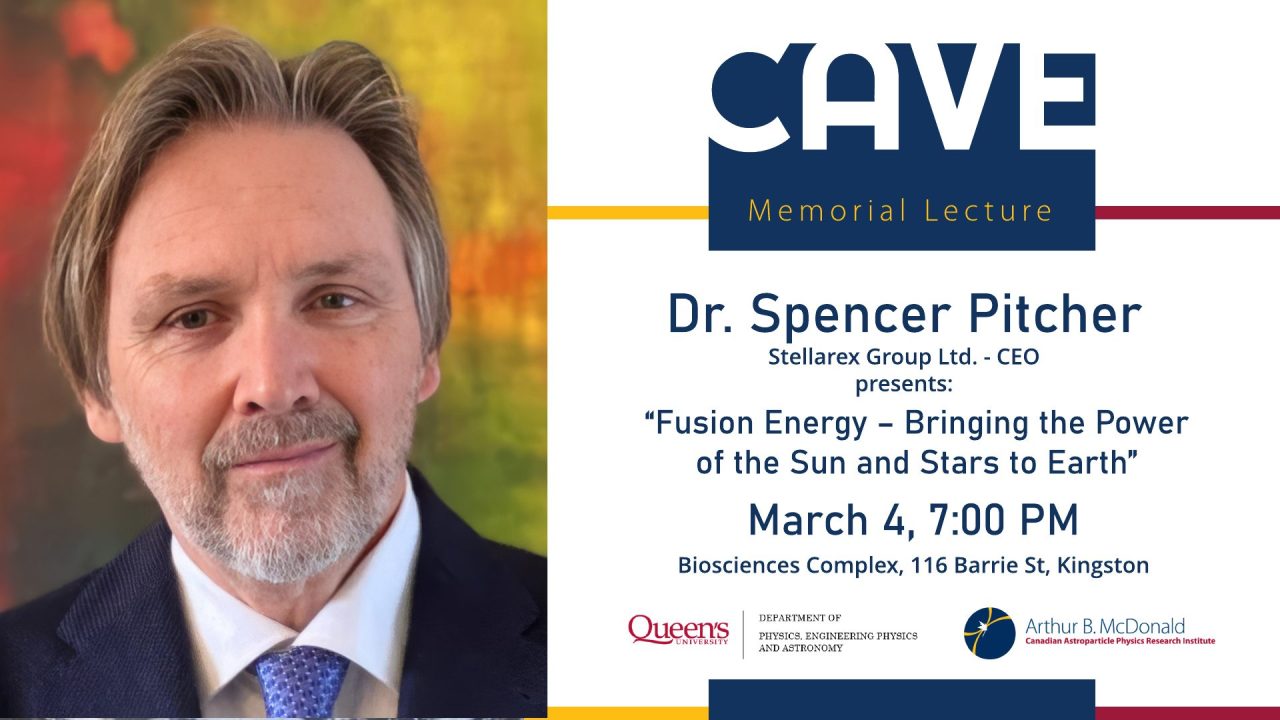
Dr. Spencer Pitcher, CEO of Stellarex Group Ltd., will give the 2026 Cave Memorial Lecture at Queen’s University in the BioSciences Complex on March 4, at 7-9:00 PM ET.
Recent technical advances have sparked a gold rush toward fusion energy. Advances include breakthroughs in supercomputers, computer simulations using Artificial Intelligence, advanced materials, and, in particular, the advent of high-temperature superconductors, which are used to make powerful magnets that contain fusion fuel hotter than the centre of the Sun!
Register for this event here.
| | |
Visiting Scientist Program - Open
The Visiting Scientist Program has been revamped and is now open to new applications. The program provides flexible cost-reimbursement support to full-time, post-PhD astroparticle physics researchers to work with new collaborators in Canada and internationally. The program also provides support for international colleagues' visits to Canada. Postdoctoral Fellows are eligible for support between 2-12 weeks duration. Faculty and Staff Scientists are eligible for up to 52 weeks. The program has been specifically designed to reduce financial barriers for high-value exchanges/visits that are not part of regular sabbatical leaves, or may not be eligible for full funding support from regular sources. It will not support conference registrations or conference travel. Maximum reimbursements are $16,000 CDN, and consist of travel support, capped accommodation supports, and city-specific capped cost-of-living per diems addressing differential costs for food, transit, and utilities. Full details at https://mcdonaldinstitute.ca/funding-opportunities/
Graduate Student Exchange Program - Open
The Graduate Student Exchange Program is now open to new applications. The program provides flexible cost-reimbursement support to master's and doctoral students in astroparticle physics to work with new collaborators in Canada or internationally. Students are eligible for support between 1-12 weeks’ duration. The program is designed to reduce barriers for supervisors to support their students’ high-value working exchanges/visits. The program will not support conference registrations or conference travel. Maximum reimbursements are $8,000 CDN, and consist of travel support, capped accommodation supports, and city-specific capped cost-of-living per diems addressing differential costs for food, transit, and utilities. Full details at https://mcdonaldinstitute.ca/funding-opportunities/
| | |
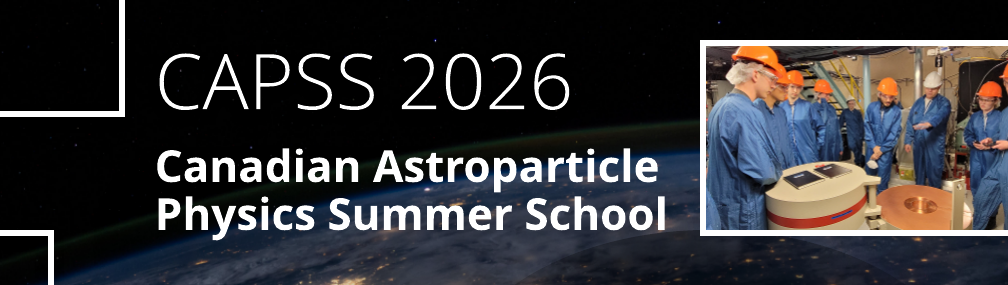
The Canadian Astroparticle Physics Summer School (CAPSS) is an intensive week-long undergraduate school that will introduce students to the current topics in the field of astroparticle physics at Queen’s University and SNOLAB.
Applications for the 2026 program are now open.
| | |
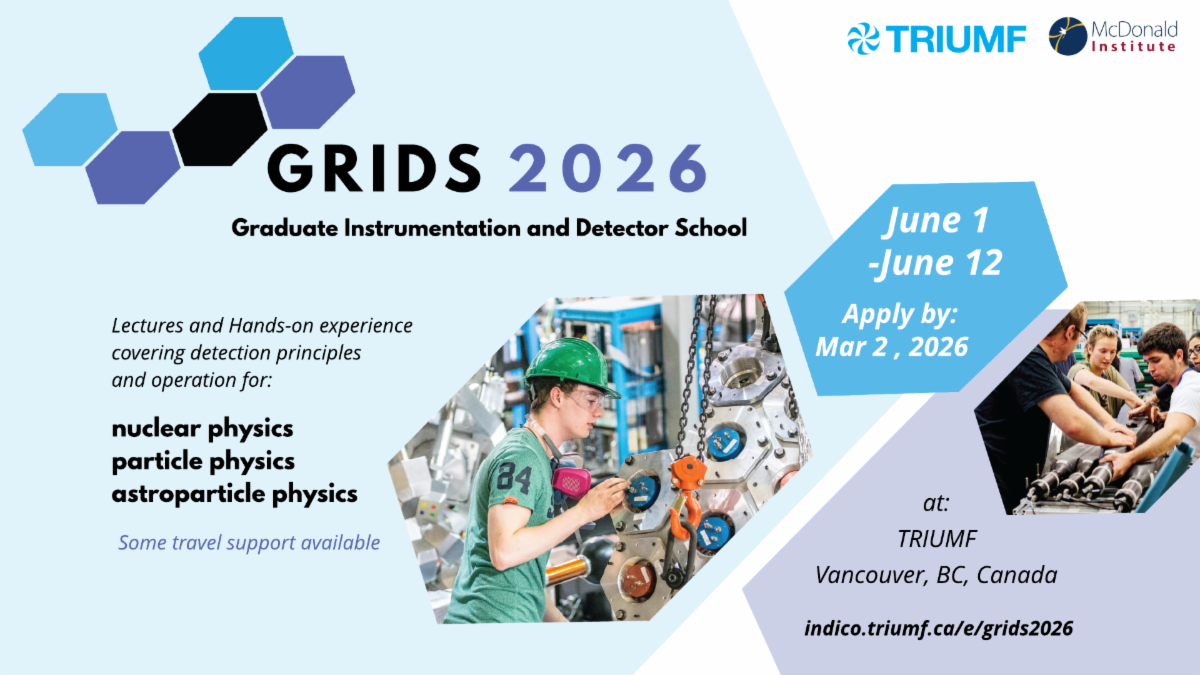
The GRaduate Instrumentation and Detector School (GRIDS) offers a diversified learning experience, combining lectures from leading experts with hands-on experience with typical detector and instrumentation technology.
The deadline to apply for GRIDS in 2026 is March 2.
| |
Join the Astroparticle Physics Community of Practice for I-EDIAA
We are launching a new Community of Practice (CoP) for researchers and trainee leaders interested in applying the DEAP Tool for Researchers (https://mcdonaldinstitute.ca/deap-tool-for-researchers/) in real research settings across Canada’s astroparticle physics network. This peer-learning group will create a practical space to share experiences, challenges, and emerging practices. The purpose of this group is to support goal-setting and action planning, and learn from one another about strengthening inclusive lab culture, mentorship, supervision, and research environments. Each meeting will feature a guest speaker, short reading, or case study, with dedicated time to reflect, share experiences, and connect insights back to the DEAP Tool to support progress within participants’ own research contexts.
Whether you are new to the DEAP Tool or already using it in your research group, we welcome participants who are interested in collaborative learning, applied problem-solving, and contributing to a culture of continuous improvement.
Those interested are encouraged to register, with the date and time of the first meeting to be scheduled in February based on participant availability: Astroparticle Physics Community of Practice for I-EDIAA – Fill out form
| | |
Community Bulletin
-
International experts for rare event searches met at a workshop at McGill University November 12-14, 2025 to discuss possibilities and opportunities for a coherent collaborative effort to search for neutrinoless double beta decay in in the isotope xenon-136. Members from the Xe-based double-beta decay experiments KamLAND-ZEN, nEXO, NEXT, PandaX, and XLZD presented the current state of the art in the field, and highlighted topics for future joint efforts. Participants at the workshop recognized the need for joining efforts towards realizing a nextgeneration flagship experiment with significant scientific reach in the search for neutrinoless double beta decay. - Excerpt from the December CINP newsletter: https://cinp.ca/sites/default/files/2025-12/newsletter_25dec.pdf
-
A multinational group of Polish, Chinese, and U.K. astronomers led by Sebestian Trojankowski reported in Nature that slight interaction between relic neutrinos and dark matter in the early universe might resolve the discrepancy between observed cosmic structure and what his predicted by ΛCDM cosmology. The 3-σ result was obtained by comparing high-red-shift, low-red-shift and weak lensing data through different eras of cosmic expansion against a model where relic neutrinos and dark matter interacted very slightly. Full paper at: https://www.nature.com/articles/s41550-025-02733-1
-
A UMass group has postulated a theoretical source for the 100 PeV transient event at KM3NeT in 2023. The team’s submission to Physical Review Letters suggests the explosion of a “quasi-extremal” primordial black hole could generate neutrinos with such extreme energies. Full paper at: https://journals.aps.org/prl/accepted/10.1103/r793-p7ct
👉 Submit an item for next month's bulletin.
| | |
|
Our newsletter provides the astroparticle physics community with updates, programs, and opportunities, and we want to help share your story! We invite all members of the community to contribute to this newsletter.
The McDonald Institute at Queen’s University is situated in the traditional territory of the Anishinaabe & Haudenosaunee First Nations. The Institute is part of a national network of institutions and research centres which operate in other traditional Indigenous territories. Visit www.whose.land to learn about the traditional territories where astroparticle physicists are grateful to live and work across Canada.
Thank you for your support. If you would like to view past newsletters from the McDonald Institute, please visit the Newsletter Archive.
| | Join us on our social media channels | | |
To update your contact information, such as your email address, institution, or position, or to change your subscription preferences, please use the Update Profile link in the footer below.
Unsubscribe from this newsletter
| | | | |