| |  | | |
Happy New Year! We hope you had a restful and holiday break and are having a fantastic start to the new year!
First things first, we’re very pleased to announce the winners of the 2025 HQP Excellence Awards! Congratulations! We'd also like to thank everyone who submitted an application, and our organizers and adjudicators for their time and attention in evaluating the applications. In many cases, it was not an easy decision, and we did end up with one tie! Unfortunately, we also had one award with only a single application, which did not meet the program's requirements. We hope this program continues and look forward to receiving your applications later this year!
Winners:
Research Achievement:
MSc: Avani Bhardwaj, PhD: Nirmalya Brahma & Jeremy Savoie (tie), PostDoc: James Page
Community Leadership:
MSc: Gabby Gelinas, PhD: Samin Majidi, PostDoc: N/A [application threshold not met]
Teaching and Science Communication:
MSc: Kimia Ghanaatpisheh, PhD: Brian Krar, PostDoc: Pooja Woosaree
Undergraduate Award:
Cheyanne Monk
| | |
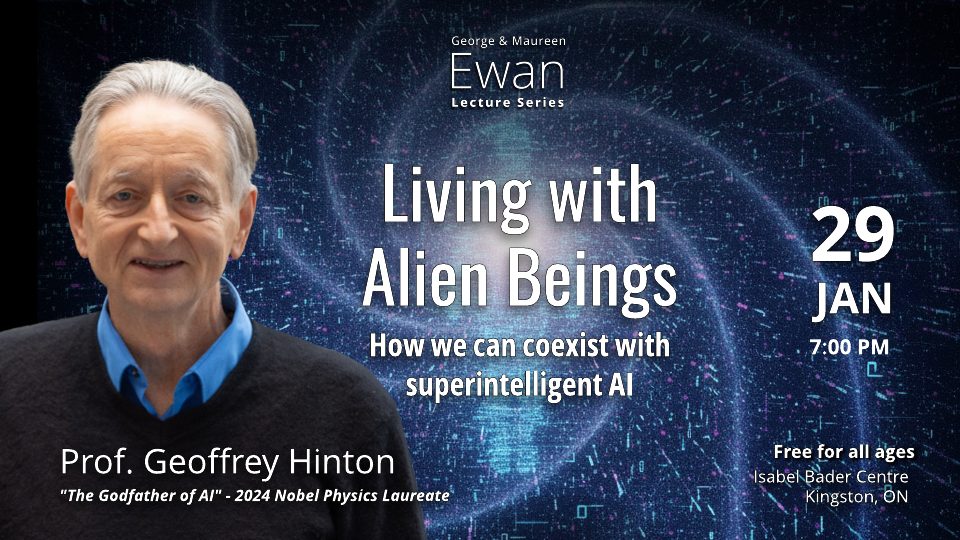
We are thrilled to be hosting Prof. Geoffry Hinton in Kingston for the 2026 George and Maureen Ewan Lecture next week. Unfortunately, this event is completely sold out. There may be a few waiting list tickets left, and we will be recording the talk and posting it on our YouTube channel shortly after.
For members of the Queen’s community, there will be a special Physics Departmental Colloquium by Prof. Hinton on January 30th at 1:30 PM in Stirling Hall Auditorium A. This talk will also be recorded and available afterward.
| | |
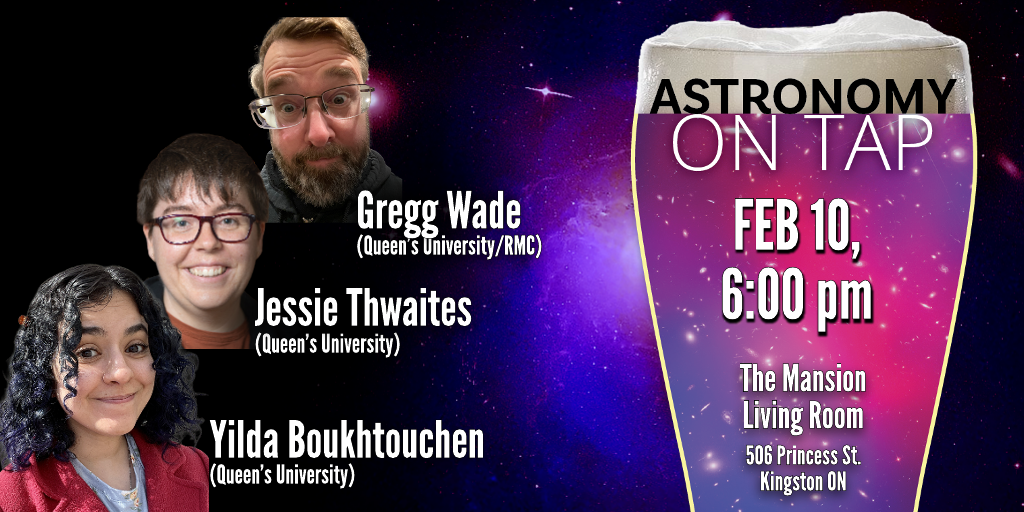
Missing out on the Hinton lectures? Have no fear! The next best thing is here - Astronomy on Tap! Join us for the evening of Feb 10th for talks from three amazing Queen's researchers. Enjoy a beverage, chat with local scientists, and test your knowledge and win prizes in science trivia!
| | |
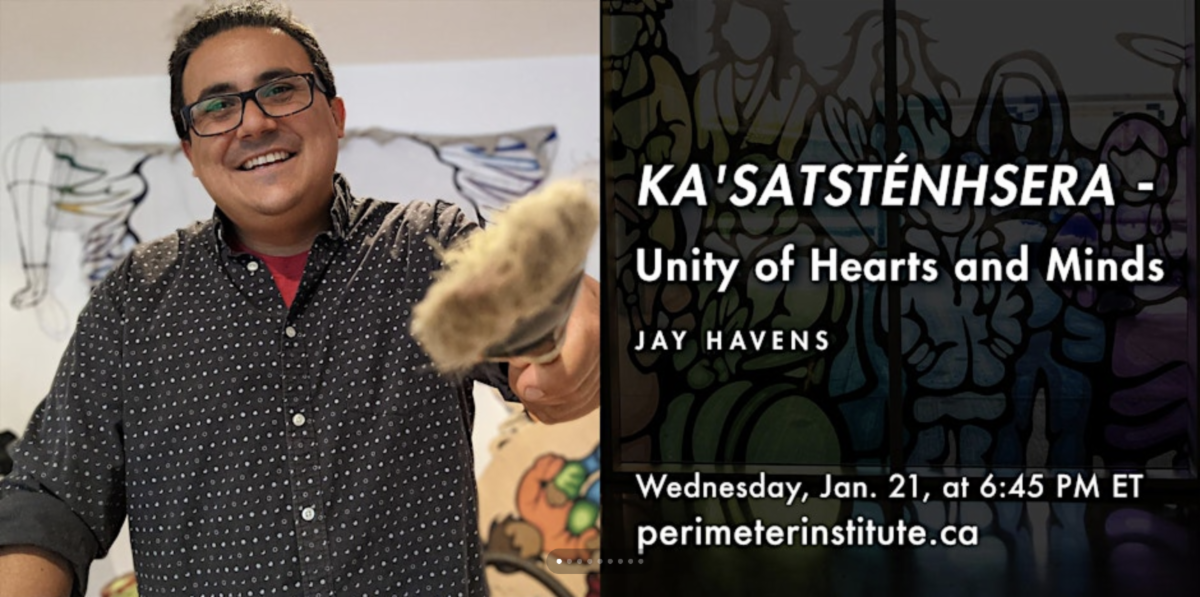
Ka'satstenhera – Unity of Hearts and Minds
Wednesday, January 21, at 6:45 pm ET
| | |
The Perimeter Institute hosts artist Jay Havens, who shares Haudenosaunee history, culture & art - from Woodland school to the Indigenous Group of Seven - in a talk on unity. Jay Havens (they/them) is a 2Spirit artist, educator, and collaborator of Mohawk (Kanien’keha’ka) and Scottish Canadian ancestry. Their new mural, titled Ka'satsténhsera, which translates to unity of hearts and minds, is in Perimeter’s central atrium and represents a diverse group, or family, coming together to share ideas and perspectives.
The event is in person at Perimeter Institute and there will be a recording posted to YouTube afterwards.
https://www.eventbrite.ca/e/kasatstenhsera-unity-of-hearts-and-minds-tickets-1976510326593
| | |
Community Bulletin
-
See Dr. Art McDonald’s November Canadian Science Policy Conference interview with Dr. Encieh Erfani, addressing fundamental and applied science, Ontario university policy and international astroparticle physics progress on YouTube.
-
JUNO’s November posting of higher precision sin2 θ12 and Δm221 neutrino oscillation parameter estimates are already generating discussion about normal vs. inverted mass hierarchy likelihoods based on the new measurements and existing data in this Jan. 14 arXiv post. There’s a public outreach-friendly overview of JUNO’s early operations in CERN Courier.
-
The IceCube Neutrino Observatory has just released a major paper: “Evidence for Neutrino Emission from X-ray Bright Active Galactic Nuclei.” This work strengthens the evidence that the cores of X-ray bright AGN, including the famous NGC 1068, emit high-energy neutrinos, marking another key step in uncovering the cosmic origins of these elusive particles.
👉 Submit an item for next month's bulletin.
| | McDonald Institute seeking new Scientific Director | |
Since the establishment of the McDonald Institute, Tony Noble has been the scientific director, leading the Institute from its initial CFREF funds and the programs that made it possible, to the new NSERC funds. A big thank you to Tony for his tenure and leadership as he looks to end his term as the scientific director later in 2026. We now invite applications for the scientific director role, with the opportunity to bring in a new vision for the astroparticle physics community in Canada.
The Scientific Director guides strategic planning, champions major initiatives, and ensures alignment with federal research priorities, funding agencies, and international scientific efforts. They foster an inclusive, collaborative research culture, mentor emerging scientific talent, and promote interdisciplinary connections across cosmology, particle physics, and underground science. As the Institute’s chief scientific ambassador, the Scientific Director represents the McDonald Institute nationally and internationally, strengthens partnerships, elevates the profile of Canadian discovery science, and supports the Institute’s commitment to training, outreach, and public engagement.
If you are ready to shape the future of Canadian astroparticle physics and lead a national
community of researchers toward new scientific frontiers, we invite you to express your interest
by submitting a curriculum vitae and a statement of scientific vision for the McDonald Institute through https://boyden.thriveapp.ly/job/3099
| | |
The Advancing EDII Award (Re)Opens January 23, 2026
The McDonald Institute is pleased to relaunch the Advancing Indigenization - Equity, Diversity and Inclusion (I-EDI) Fund for Astroparticle Physics, supporting initiatives that strengthen equitable training environments and research cultures across astroparticle physics and related disciplines.
The award prioritizes activities that expand I-EDI action in Highly Qualified Personnel (HQP) training and research environments through five funding streams:
-
Stream 1 (up to $1,000): Seed funding for new initiatives that build EDII capacity in labs, research groups, and departments, including pilot programs, training activities, or events.
-
Stream 2 (up to $2,500): Support funding for existing initiatives that advance EDII practice in the field.
-
Stream 3 (up to $2,500): Support for faculty actively advancing equity goals using the DEAP Tool for Researchers (or an equivalent assessment framework). Advising support is available.
New for Round 2 (2026):
-
Stream 4 (up to $5,000): Seed funding to advance community partnerships that build relationships with equity-deserving groups, create pathways into physics degrees, and foster interdisciplinary collaborations that strengthen long-term participation and retention in astroparticle physics.
-
Stream 5 (up to $12,000): Seeding support for research projects that examine and advance understandings of equity, diversity, inclusion, Indigenization, anti-racism, and accessibility (EDIIAA) in astroparticle physics, including research, evaluation, and knowledge mobilization activities.
Applications will be reviewed on a rolling basis, with internal adjudication occurring at the end of each month until available funds are fully allocated. Students, postdoctoral fellows, staff, researchers, and faculty across the network are encouraged to apply. Learn more about eligibility, timelines, and application details at: https://mcdonaldinstitute.ca/the-edii-fund/ Please reach out to Alex Pedersen (alexandra.pedersen@mcdonaldinstitute.ca) with any questions.
LAST CALL for Applications:
- HQP Pooled Resources Round 2:
Round 2 of the HQP Pooled Resources competition is closing soon! This round supports astroparticle physics faculty, whose research is aligned with the McDonald Institute Research Strategy, to hire undergraduate and graduate researchers working in Canada. For successful applicants, the awarded ticket is expected to be filled (i.e., an individual has been identified for this funding) by the end of May 2026, and all positions made possible by this funding should start no later than Sept 2026.
The deadline for applications is next week Wednesday, January 28, 2026 4.00 pm EDT.
- Cross Disciplinary Internships:
The McDonald Institute’s Cross-Disciplinary Internship (CDI) program continues to connect students from outside physics with astroparticle research teams across Canada. This program aims to build new bridges between disciplines and the study of astroparticle physics.
As always, students who are in non-physics degrees are invited to co-apply with an astroparticle physics postdoc or faculty supervisor. Students receive a $12,000 CAD paid research internship, gaining hands-on experience, mentorship, and national networking opportunities. Postdoc and faculty supervisors contribute $500 CAD towards professional development opportunities during the internship.
Why host a non-physics student in your lab you ask? Supervisors and research groups benefit from fresh ideas, creative problem-solving, and collaboration that strengthens innovation across Canada’s astroparticle physics community.
This year, we’re expanding our program to include an Indigenization Cross-Disciplinary Internship (I-CDI) stream to explore reciprocal knowledge exchanges between Indigenous Knowledges and Perspectives (IKP) and astroparticle physics in a meaningful way. We welcome applications from Indigenous students in post-secondary institutions who want to contribute their skills and perspectives to Canada’s astroparticle physics research community.
Supervisors are invited to co-design cross-disciplinary projects and to connect with interested students from any Canadian post-secondary institution.
Please connect with Alexandra Pedersen (alexandra.pedersen@mcdonaldinstitute.ca) if you are curious about the program or are working on your application for support.
Deadline to apply is January 30th, 2026.
| | |
The Professional Development Opportunities (PDO) program is designed to support the national Highly Qualified Personnel (HQP) community in building their skills, confidence, and connections needed for impactful careers in and beyond academia. We encourage new and existing HQP to join us, and for faculty to promote these opportunities within their research groups.
Join us for the next session on Wednesday, February 11, at 3 pm EST, where we will be joined by experts from Queen's Career Services to discuss various job interview strategies. This session will address common interview questions and the thought processes of selection committees when they interview candidates. This session (and most of the PDO offerings) will be offered both in person and virtually over Zoom.
Register here for the Interview Strategies session on February 11.
If you have any questions regarding registration or accommodation, please feel free to reach out to Nikhil Arora (Education & Outreach Officer) at arora@mcdonaldinstitute.ca
| |
Join the Astroparticle Physics
Community of Practice for I-EDIAA
We are launching a new Community of Practice (CoP) for researchers and trainee leaders interested in applying the DEAP Tool for Researchers in real research settings across Canada’s astroparticle physics network. This peer-learning group will provide a space to share experiences, challenges, and emerging practices. The purpose of this group is to support goal-setting and action planning, and learn from one another about strengthening inclusive lab culture, mentorship, supervision, and research environments. Each meeting will feature a guest speaker, short reading, or case study, with dedicated time to reflect, share experiences, and connect insights back to the DEAP Tool to support progress within participants’ own research contexts.
Whether you are new to the DEAP Tool or already using it in your research group, we welcome participants who are interested in collaborative learning, applied problem-solving, and contributing to a culture of continuous improvement.
Those interested are encouraged to register, with the date and time of the first meeting to be scheduled in February based on participant availability:
Astroparticle Physics Community of Practice for I-EDIAA – Fill out form
| | |
Conference Roundup
2026 CAP Congress
The 2026 CAP Congress will be held from June 21-25 at the University of Ottawa and Carleton University. The annual CAP Congress is an excellent opportunity to share your research, learn more about physics research and discovery across Canada, network with other physicists and physics students, participate in professional development activities, and help to celebrate physics in Canada and abroad.
Abstract Submission Deadline has been extended to January 22, 2026
Cosmological Frontiers in Fundamental Physics 2026
Cosmology is at a crossroads. Are the rising observational tensions harbingers of doom for our beloved LCDM paradigm? Is the young field of gravitational wave astronomy about to revolutionize our understanding of black holes, and their cosmic dynamics? What is the best explanation of the early universe? What are the most exciting new ideas? This annual workshop brings together leaders from our three institutes and beyond to address these questions, and plan a roadmap to advance the cosmological frontiers of fundamental physics.
Abstract submission deadline: Feb 16, 2026
CITA@40: A Celebration of Cosmic Discovery
The Canadian Institute for Theoretical Astrophysics (CITA) will host its 40th-anniversary event, CITA@40 / Kingston Meeting, in Toronto from May 27–29, 2026. This gathering marks four decades of research in theoretical astrophysics, from the early universe to black holes and star formation. It also continues the tradition of the Kingston Meeting, a long-standing forum for Canada’s theoretical astrophysicists that predates CITA itself. Full details of the meeting at: https://conference.cita.utoronto.ca/event/2/overview
The event will feature scientific talks spanning CITA’s history and scholarship, with a focus on both past achievements and future directions. Over 132 CITA alumni now hold tenured faculty positions worldwide, reflecting the institute’s global impact. The meeting provides an opportunity for alumni, researchers, and collaborators to reconnect and engage in discussions about the field’s evolution.
Abstracts for presentations are due by March 2, 2026, and registration is open. Questions and inquiries can be directed to the organizing committee.
SWCC 2026
The 2026 Science Writers and Communicators of Canada Conference will take place June 15 - 16 in Montréal, Québec. This year's theme is: Discovery. Dialogue. Decision.
Abstract Submission deadline: Jan 31, 2026
|
| |
Physics Master's Program - Perimeter Scholars International (PSI)
Taught by academic staff and faculty at Perimeter Institute and by some of the world’s top physicists, students at PSI are fully integrated into the unique international culture and dynamic research atmosphere at Perimeter Institute for Theoretical Physics — a leading centre for education — while earning a Master of Science from the University of Waterloo in Ontario, Canada. Interested in the PSI program? These Perimeter students give their best advice for PSI applicants.
Application Submission Deadline: February 1, 2026
| |
Our newsletter provides the astroparticle physics community with updates, programs, and opportunities and we want to help share your story! We invite all members of the community to contribute to this newsletter.
The McDonald Institute at Queen’s University is situated in the traditional territory of the Anishinaabe & Haudenosaunee First Nations. The Institute is part of a national network of institutions and research centres which operate in other traditional Indigenous territories. Visit www.whose.land to learn about the traditional territories where astroparticle physicists are grateful to live and work across Canada.
Thank you for your support. If you would like to view past newsletters from the McDonald Institute, please visit the Newsletter Archive.
| | Join us on our social media channels | | |
To update your contact information, such as your email address, institution, or position, or to change your subscription preferences, please use the Update Profile link in the footer below.
Unsubscribe from this newsletter
| | | | |