Issue 76

September 10, 2026


Greetings!


We hope you had a fantastic Summer and are ready to dive into another academic year!


A special note for faculty and senior researchers: This time of year is a great opportunity to inform and remind your students about the opportunities and initiatives that the McDonald Institute provides for the Astroparticle Physics community. The best way to stay connected is through this newsletter, where we announce new programs, deadlines, events, and employment or professional development opportunities. We will also send an email soon with information about this year’s welcome package for new students.


Live Now: 


McDonald Institute Seminar: Yong Xu (McGill) (Hybrid)

September 10, 2026, 12:30pm - 1:30pm ET

“Weakly Coupled Messengers of Reheating”

Live on YouTube or in person at Queen's in Stirling 401


Upcoming:


Beyond Classical Scaling: Quantum Computing for the Next Generation of HPC

Friday September 11, 2026 - 10:00 am - 11:00 am

https://www.queensu.ca/research/events/quantum-computing 

(In-person only.)


HQP Town Hall: "The Year Ahead" (Virtual)

Monday, Sept 14, 2:00-3:00 PM ET

Usually on the first Monday of the month, the HQP Town Hall is open to all members of the Astroparticle Physics community to connect with representatives from the McDonald Institute Highly Qualified Personnel Advisory Committee (HQPAC) to discuss ideas and ask questions. This month's meeting theme is "the Year Ahead" and will focus on the initiatives and goals of the committee for this academic year.

https://mcdonaldinstitute.ca/events/hqp-townhall-sept26/


Future Fusion Opportunities for Canada (FFOC) webinar (Virtual)

Date: Tuesday, September 22 at 1:00 PM ET

Join the Fusion Energy Council of Canada (FECC) with Dr. Spencer Pitcher of Stellarex, exploring the development and future of stellarator fusion technology. The webinar will provide insight into Stellarex’s fusion technology and its approach within the broader fusion landscape, while also discussing progress in the fusion sector, opportunities for students and early-career researchers, and the skills and training that may be valuable for those interested in pursuing a career in fusion energy.

https://luma.com/5edfcaef


Job Opportunities:


Postdoctoral Researcher: Ion manipulation position for Ba-tagging at McGill University Deadline: Sept 30. Apply here.


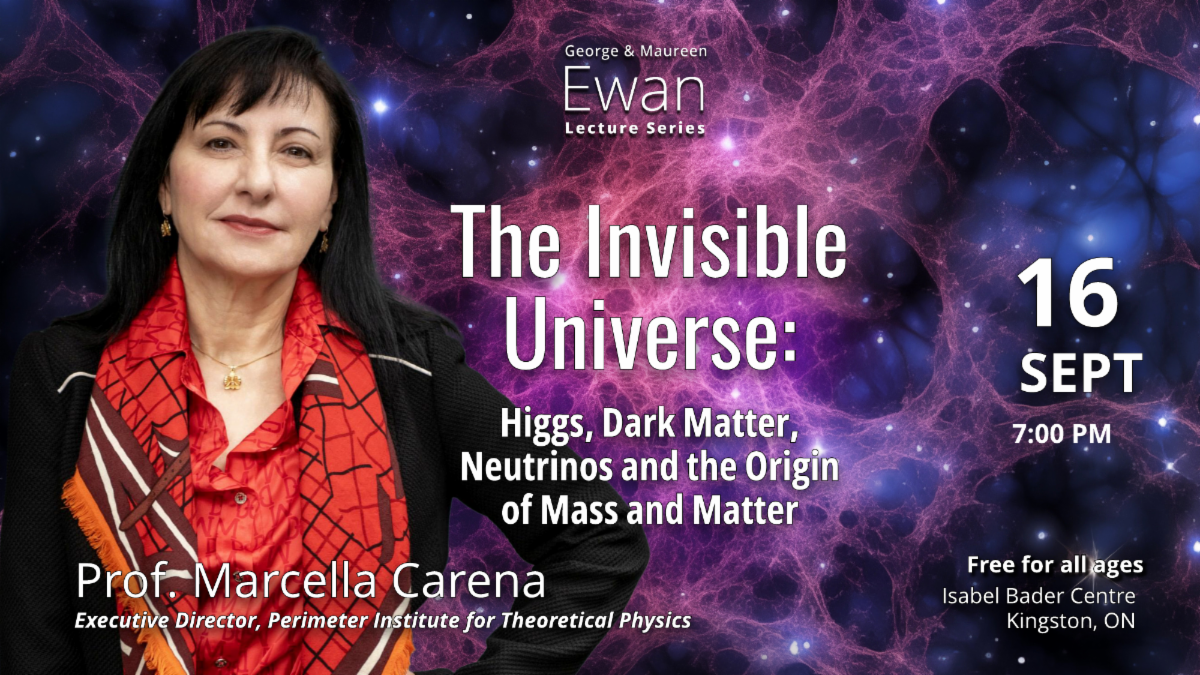
Join us next Wednesday, September 16th at the Isabel Bader Centre for the Performing Arts in Kingston for the 2026 Ewan Memorial Lecture, featuring Prof. Marcella Carena, Executive Director of Perimeter Institute. Dr. Carena will tell Kingston's science-curious public about the Higgs, Dark Matter, Neutrinos and how these invisible parts of the Universe played a role in the origins of mass and matter.


If you've been to a Ewan Lecture before, you'll know to register for your free tickets ASAP!


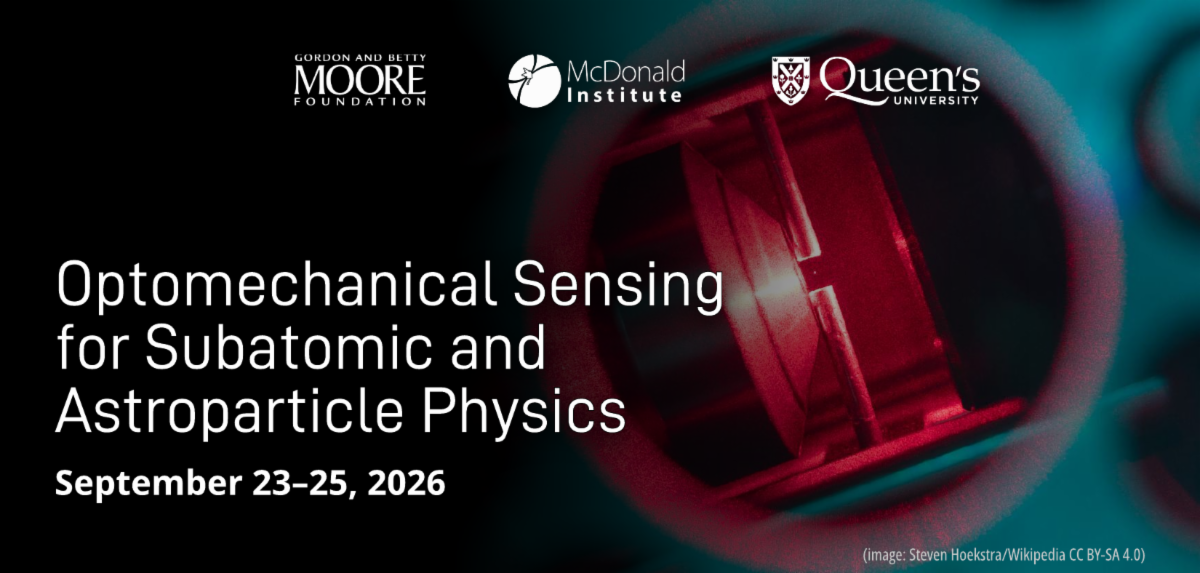
We’re pleased to be hosting the Optomechanical Sensing for Subatomic and Astroparticle Physics workshop at the Donald Gordon Centre in Kingston, September 23–25, 2026.

The workshop will bring together researchers working across optomechanics, quantum sensing, AMO physics, and subatomic/astroparticle physics, with a particular focus on how advanced quantum measurement techniques can open new opportunities in fundamental physics.


Deadline to register and submit a talk: Sept 11

https://indico.global/event/18677/


HQP Pooled Resources - Opening Soon


Round 3 of the McDonald Institute HQP Pooled Resources Competition will open soon, in early October. This round is open to undergraduate, master’s, and PhD students. The duration of support will be up to four months for undergraduate students, and up to two years for master’s and PhD students. Keep an eye on our Funding Opportunites page, and we will provide an update in next month’s newsletter as well.


An Introduction to Entrepreneurship with the DDQIC.


September 22nd, 12:30 pm ET on Zoom and in person at Queen's in Stirling 201.


This interactive workshop introduces the fundamentals of entrepreneurship and research commercialization. This workshop will introduce the common first steps at the DDQIC, including the innovator’s mindset and design thinking, to help identify meaningful problems, evaluate potential applications, and move ideas beyond the laboratory. The session will provide practical tips, strategies, and resources for navigating the early stages of entrepreneurship. Whether you are developing a new technology, exploring the commercial potential of your research, or simply interested in entrepreneurial thinking, this workshop will offer practical tools to help you approach innovation with greater confidence and purpose.


Register here.


The McDonald Institute Professional Development Opportunities Program supports the national student and postdoc community in building the skills, confidence, and connections needed for impactful careers in and beyond academia. We encourage new and existing students and postdocs to join us, and faculty to promote these opportunities within their research groups. 


Thank you to our Summer Students. 


A huge thank you to our summer students Ella Hammett, Isabella Bothelo, Nicole Muchos, and Sebastian Blaha, who did great work with us this past summer. Ella, Isabella & Nicole led Queen's Summer of Science 2026, a 4-week summer camp for high school students. Sebastian created lesson plans and workshops on astroparticle physics for high school classrooms. All summer students also got the opportunity to do research in astrophysics, studying galaxy formation and evolution. Ella and Nicole analyzed observations and simulations of spiral galaxies to understand the Milky Way's unique properties. Isabella studied stars within the Milky Way to better understand its formation history. Sebastian studied how supermassive black holes suppress star formation in massive galaxies. It’s been a pleasure working together, and I’m very grateful for all the time, effort, and enthusiasm they brought to their project.


- Nik Arora, Education and Public Outreach Officer.


Aslan Lauzon worked with the Queen's McDonald Institute Engineering team as the Research and Design Engineering Intern for the summer, kicking off the first four months of his professional internship after finishing his 3rd year of Mechanical Engineering. His primary task involved performing Computational Fluid Dynamics (CFD) simulations of radon migration and circulation in the NEWS-G detector. He iterated on the existing gas circulation nozzle design, improving the expected radon removal rate by a factor of two by reducing circulation dead zones in the detector. He was an excellent team member who also contributed to a number of other mechanical and fluids design tasks for the PICO and SBC experiment. We wish him the best of luck as he continues his internship at Rocket Lab in New Zealand! 


-Jonathan Corbett, Intermediate Design Engineer


Our newsletter provides the astroparticle physics community with updates, programs, and opportunities, and we want to help share your story! We invite all members of the community to contribute to this newsletter.


The McDonald Institute at Queen’s University is situated in the traditional territory of the Anishinaabe & Haudenosaunee First Nations. The Institute is part of a national network of institutions and research centres which operate in other traditional Indigenous territories. Visit www.whose.land to learn about the traditional territories where astroparticle physicists are grateful to live and work across Canada.


Thank you for your support. If you would like to view past newsletters from the McDonald Institute, please visit the Newsletter Archive.


Astroparticle-Physics-colour_HEX-Web-01 image
CFREF_Logo_EN image
 
Join us on our social media channels
Facebook  Linkedin  Instagram  Youtube  Bluesky


To update your contact information, such as your email address, institution, or position, or to change your subscription preferences, please use the Update Profile link in the footer below.


Unsubscribe from this newsletter