AUGUST 2026

Your Peek Into Sacramento’s Coordinated Access System


Stories, updates, and data from Sacramento’s front door to homelessness services.


July Data & Analysis


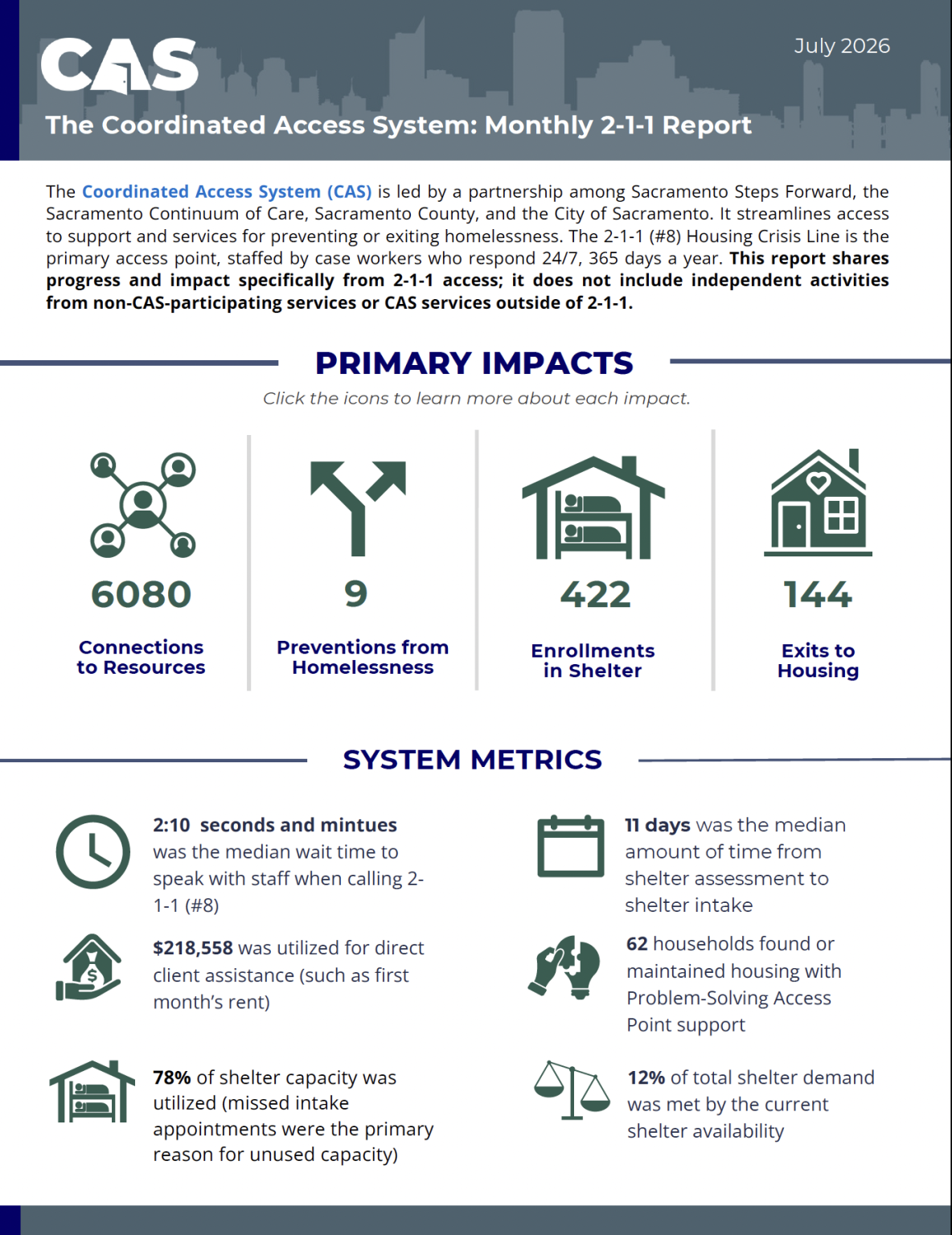
July was another strong month for helping individuals move toward greater stability. Connections to resources increased from 5,832 to 6,080, and Problem-Solving Access Points (PSAPs) helped 62 households find or maintain housing, up from 49 in June. The direct client assistance utilized for PSAPs also increased substantially, from $127,368 in June to $218,558 in July.


This direct assistance supported people facing a range of housing challenges, including individuals experiencing homelessness for the first time, college students, and families moving into new homes after experiencing homelessness. We saw across the board how timely, flexible assistance can help meet different needs and remove barriers to housing stability.


Shelter enrollments also increased, from 383 to 422, primarily because clients had to be exited and re-enrolled when moving between shelter locations. Overall, July’s results reflect the continued role of problem solving and direct assistance in helping people navigate housing crises and move toward a place they can call home.


READ THE FULL REPORT & ANALYSIS ➜

Improving Access through the Sacramento Youth Resource Guide App


Each month, we take a closer look at one part of the Coordinated Access System and how it supports people experiencing or at risk of homelessness.


Ahead of its September 2026 launch, we’re highlighting the Sacramento Youth Resource Guide (SYRG) mobile app: a new tool that will help Transition-Age Youth (TAY) across Sacramento quickly find services, connect with support, and navigate local resources from their phones.


Sacramento Steps Forward has collaboratively developed this app in partnership with SkyClutch, 2-1-1 Sacramento, and the Sacramento Continuum of Care's Youth Action Board. The SYRG will bring a wide range of resources into one centralized, mobile-friendly platform. TAY will be able to browse services by category, search for options near them, and connect with live referral and support specialists when they need additional help.


The app will include resources related to housing, food access, employment, health care, education, transportation, and other needs. It will also offer curated resources specifically for youth, location-based searching, and a simple interface that will make it easier to find trusted local support while on the go.


By making local information easier to find and navigate, the SYRG app will provide another accessible way for TAY to connect with resources and support across Sacramento.


The SYRG app will launch in September. Stay tuned for more information about how to access and use this new resource!

Updates & Reminders


Elevating Vulnerable Households in the CAS

Did you know that 2-1-1 has a dedicated backline for providers to elevate Extremely Vulnerable Households (EVH) for shelter placements? If you are a certified CAS Assessor, you can use the phone number to get expedited help for clients who have completed a crisis assessment resulting in an EVH status.  


How to access the EVH CAS Assessor Backline:  


  • A certified CAS Assessor must complete crisis assessment with the client. 
  • If the client qualifies as EVH, the CAS Assessor will contact the dedicated backline with the client nearby. 
  • 2-1-1 will review the assessment details and, if a shelter bed is available, will help schedule an intake appointment. 
  • If no shelter bed is currently available, 2-1-1 will instruct the CAS Assessor and/or client to call back or await a call from 2-1-1. 


REQUEST THE CAS ASSESSOR BACKLINE PHONE NUMBER ➜

HOW TO BECOME A CERTIFIED CAS ASSESSOR ➜


Please note: The EVH backline is only available for case managers working with an EVH as confirmed by the household’s most recent Crisis Assessment score. 

The People Behind the Progress


Behind every referral and placement are people working together to make it possible.


This Month’s Spotlight: Dennis Smiley Jr., Coordinated Access Systems Supervisor for 2-1-1 Sacramento


"I wish more people understood that the Coordinated Access System is more than a process or a database; it is a network of people working together to help individuals navigate some of the most difficult moments of their lives. Behind every assessment is a person with a story, experiences, strengths, and barriers that require a compassionate and individualized approach.."


READ THE FULL SPOTLIGHT ➜

The Q&A Corner: Problem Solving Access Points


This month’s most-asked questions.


Q: What does Extremely Vulnerable Household (EVH) refer to? 


A: The Extremely Vulnerable Household (EVH) Policy prioritizes households identified as extremely vulnerable for the next available and appropriate shelter placement, regardless of current location within Sacramento County.  


Definition of Extremely Vulnerable:  


  • Individuals: CA score of 6 or higher  
  • Families: CA score of 10 or higher  


Households meeting EVH criteria are prioritized for immediate placement when eligible units become available. 


Q: What can I do if my client is enrolled in a Rapid Re-Housing (RRH) program, but it isn’t going to be a good fit? What should I do? 


A: Client choice is what matters most. If the client does not want to move forward with the RRH program, you can communicate the client’s decision to the Rapid Re-Housing program. Be sure to update the HCT with the client’s current preferences and needs. 


Please keep in mind that disconnecting from a Rapid Re-Housing program does not automatically connect the client to another housing program. Housing opportunities are still based on program eligibility, vulnerability score, and document readiness. 


Q: Is Transitional Housing considered permanent housing? 


A: No. Transitional Housing (TH) is a temporary housing intervention designed to provide stable housing and supportive services while participants work toward permanent housing. Lengths of stay typically range from 1 to 12 months, depending on the program. 


Within CAS, Transitional Housing programs generally fall into two categories: 


  • Programs that provide interim housing where participants do not pay rent. 
  • Programs that require participants to pay a reduced, below-market rent. 


Both types of programs include supportive services, such as case management and life skills development, and referrals are made through the CAS referral process. 

🏠︎ Housing Highlights


Central Sacramento Studios II: Move-ins anticipated in October 2026 


Service Provider: LifeSTEPS 


Type: Project-Based Voucher Site 


Client Eligibility:  

  • Homeless 
  • Singles and Couples only 
  • Income can’t exceed 30% AMI 
  • 290s are not eligible 


Exciting news is on the horizon for Central Sacramento! A new supportive housing site in the heart of downtown will provide 51 households experiencing homelessness with a pathway to greater stability and independence. 


The community will offer studio and one-bedroom homes with ongoing rental subsidies for individuals and couples, helping residents access safe, stable, and affordable housing for the long term. 


Residents will also have access to case management services provided by LifeSTEPS, offering personalized support and connections to resources that can help each household thrive. 


The CAS will begin sending referrals during the first week of September as we move closer to welcoming residents into their new homes. 


Thank you for being part of this work.


Questions about the Coordinated Access System?

Contact: CAS@sacstepsforward.org