THIS WEEK IN
Federal Policy News
|
|
Farm Bureau Survey Shows Thanksgiving Dinner Cost Up 14% |
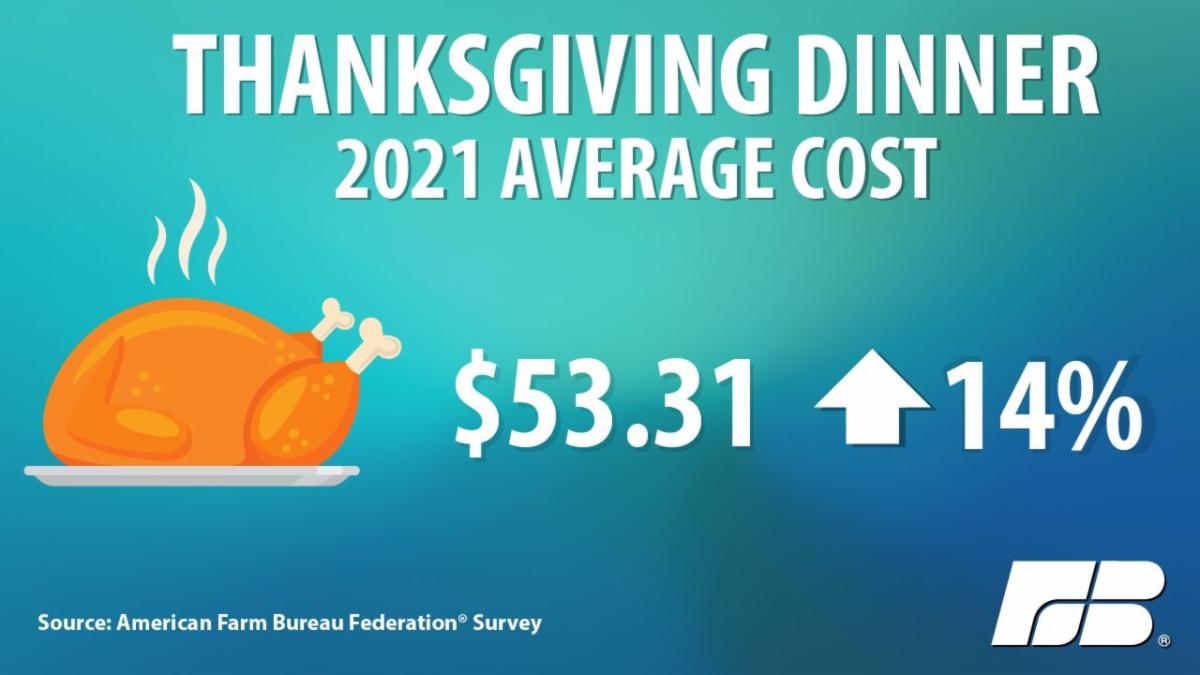
Enjoying Thanksgiving dinner with family and friends is a priority for many Americans, but paying attention to how the meal will impact the budget is also important. American Farm Bureau’s 36th annual survey indicates the average cost of this year’s classic Thanksgiving feast for 10 is $53.31 or less than $6.00 per person. This is a $6.41 or 14% increase from last year’s average of $46.90.
The centerpiece on most Thanksgiving tables – the turkey – costs more than last year, at $23.99 for a 16-pound bird. That’s roughly $1.50 per pound, up 24% from last year, but there are several mitigating factors.
The shopping list for Farm Bureau’s informal survey includes turkey, stuffing, sweet potatoes, rolls with butter, peas, cranberries, a veggie tray, pumpkin pie with whipped cream, and coffee and milk, all in quantities sufficient to serve a family of 10 with plenty for leftovers.
|
|
AFBF Opposes Build Back Better Act |
AFBF sent a letter to all members of the House of Representatives stating its opposition to the Build Back Better legislation ahead of the vote taken on the House floor. While the bill no longer contains some of the tax increases that most concerned farmers and ranchers, the totality of the bill’s tax and spending increases remain concerning enough for AFBF to oppose. |
|
Senate Begins Work on Reconciliation Bill |
With the passage of the Build Back Better (BBB) Act in the House this past Friday, the $1.7 trillion package now heads to the Senate, where it is expected to face a number of challenges and alterations before receiving a vote. The legislation will only require 50 votes in order to be passed via a process known as reconciliation. Although this gives Democrats a chance to pass the bill without any Republican support, Senators Kyrsten Sinema (D-AZ) and Joe Manchin (D-WV) have been vocal in their concerns on overall price and funding mechanisms.
In addition, the reconciliation process limits what can be included in the bill. The “Byrd Rule” prevents non-budgetary items from being inserted in the legislation—which is officially decided on by the Senate Parliamentarian. Given these potential roadblocks, the legislative process is not expected to go smoothly despite a commitment from Senate Majority Leader Chuck Schumer to get the bill passed by Christmas.
|
|
Court-Ordered Stay Remains in Place for OSHA ETS |
Heading into this week, a court-ordered stay has remained in place for the Emergency Temporary Standard (ETS) issued by the Occupational Health and Safety Administration (OSHA). Originally published on November 4th, an initial emergency stay ordered in the following days was further upheld by a 3-judge panel with the US Fifth Circuit Court of Appeals on the 12th. This remains in effect as it now heads to the Sixth Circuit for additional review. The ETS would put into place a number of workplace requirements for employers with 100 or more employees depending on their vaccination policies. Cal/OSHA and other state-run plans have until December 4th to issue an ETS that is either the same or stronger than the federal version, but it remains to be seen how the current litigation will impact this timeline. |
|
Ag Industry Sends Letter to DOL RE Processing Delays |
On November 15th, CA Farm Bureau signed onto a large coalition letter sent to Secretary Marty Wash at DOL to express the serious concerns about the unprecedented processing delays of Farm Labor Contractor (FLC) certificates and Farm Labor Contractor Employee (FLCE) certificates by the Department of Labor (DOL) and specifically, the DOL Wage and Hour Division (WHD) office in San Francisco.
These extreme delays are harming agricultural and forestry employers’ ability to operate their businesses, support their U.S. employees, grow and harvest crops, and contribute to the U.S. economic recovery in the rural communities in which we operate.
|
|
Comments Submitted to CEQ on NEPA |
CAFB has submitted comments to the White House Council on Environmental Quality (CEQ) in response to their published Proposed Rulemaking for what they are calling a “Phase 1” rulemaking that would largely rescind three major parts of the 2020 NEPA rule and reverts to the 1978 regulations. NEPA impacts construction of infrastructure, grazing permits as well as forest management. |
|
Waters of the United States |
On November 18, U.S. EPA and the U.S. Department of the Army announced a proposed rule to re-establish the pre-2015 definition of waters of the United States (WOTUS). This “Step 1” proposed rule would repeal the NWPR and bring back and updated version of the pre-2015 regulation. The proposed rule is expected to be published in the Federal Register in the coming days. Once published, there will be a 60-day comment period. Additionally, the agencies announced that they will hold three public meetings to discuss the proposed rule in January 2022. More information on the Agencies’ current WOTUS activities can be viewed on EPA’s website here. |
|
EPA Final Biological Evaluations for Glyphosate, Atrazine and Simazine |
EPA has finalized its biological evaluations (BEs) for glyphosate, atrazine, and simazine. The BEs find that all of these chemicals may affect, and are likely to adversely affect, certain listed species or their designated critical habitats. The “likely to adversely affect” (LAA) determination means that EPA reasonably expects that at least one individual animal or plant, among a variety of listed species, may be exposed to the pesticide at a sufficient level to have an effect, which will be adverse. EPA made no changes to the LAA determinations in the final biological evaluations for these chemistries, even though organizations, including AFBF, provided comments on the draft biological evaluations.
|
|
Cattle Price Discovery and Transparency Act Introduced in Senate |
On November 17th, Senators Fischer, Grassley, Tester and Wyden introduced the Cattle Price Discovery and Transparency Act.
This bill will:
- Establish regional mandatory minimum thresholds of negotiated cash and negotiated grid trades based on each region’s 18-month average trade to enable price discovery in cattle marketing regions.
- Require the U.S. Department of Agriculture (USDA) to create and maintain a publicly available library of marketing contracts between packers and producers in a manner that ensures confidentiality.
- Prohibit the USDA from using confidentiality as a justification for not reporting and make clear that USDA must report all Livestock Mandatory Reporting information, and they must do so in a manner that ensures confidentiality.
- Require more timely reporting of cattle carcass weights as well as require a packer to report the number of cattle scheduled to be delivered for slaughter each day for the next 14 days.
The bill has been endorsed by American Farm Bureau, U.S. Cattlemen’s Association, National Farmers Union, and National Grange.
|
|
Robert Bonnie Confirmed as Under Secretary for Farm Production and Conservation |
On November 16, the U.S. Senate voted 76-19 to confirm Robert Bonnie as the USDA’s Under Secretary for Farm Production and Conservation Programs. Until confirmation, he had been serving as the Deputy Chief of Staff for Policy and Senior Advisor on Climate to USDA Secretary Tom Vilsack. Bonnie previously served in the Obama administration as Undersecretary for Natural Resources and Environment where he oversaw the U.S. Forest Service and the Natural Resources Conservation Service. Bonnie was the co-chair of the Biden administration’s transition team for USDA. The farm production and conservation mission area include the Farm Service Agency, the Risk Management Agency, and the Natural Resources Conservation Service. |
|
NRCS California Leadership Positions Announced |
The Natural Resources Conservation Service (NRCS) has announced three new leadership selections at NRCS California. Allen Curry has been named as Assistant State Conservationist for Field Operations in Salinas and Johnnie Siliznoff has been named as Assistant State Conservationist for Field Operations in Fresno. Additionally, Jon Gustafson has been named State Resource Conservationist. Jon will work with staff and partners to provide leadership over agency conservation planning and technical standards. These assignments are effective November 21, 2021. |
|
Sara Arsenault
Federal Policy, Director
916-561-5619
|
|
Matthew Viohl
Federal Policy, Associate Director
916-561-5612
|
|
Erin Huston
Federal Policy, Consultant
916-849-3746
|
|
|
|
|
|
|