|
|
Quarterly Newsletter
Dec 2025
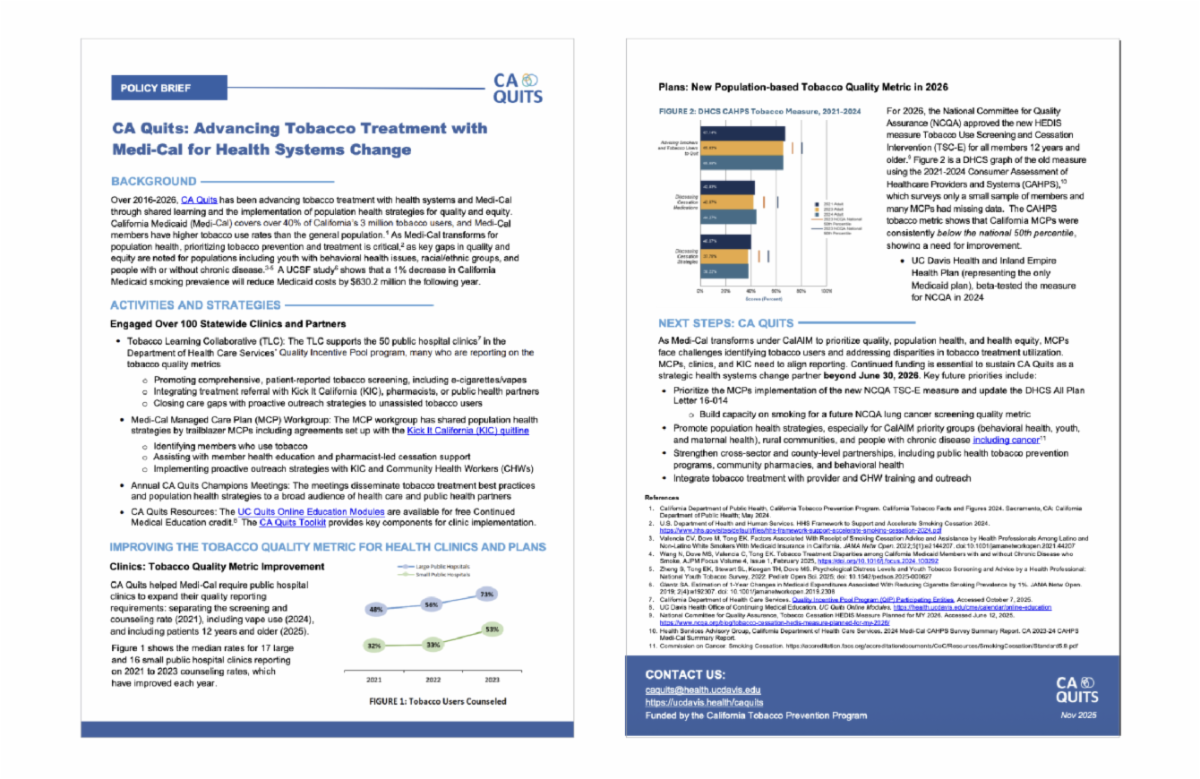
| | CA Quits released a new policy brief that highlights accomplishments in advancing tobacco treatment with Medi-Cal for health systems change (2023-2026). Clinics and health plans have improved outreach, referrals, and counseling rates, especially for underserved communities. | | |
Quick Highlights:
- 100+ clinics and partners engaged in proactive strategies like team-based care, electronic referrals, and tailored outreach.
- Hospital systems improved tobacco quality counseling rates, including on vaping, over three years.
- CA Quits' partners, UC Davis Health and Inland Empire Health Plan, helped beta-test the new National Committee Quality Assurance (NCQA) tobacco screening and cessation measure for individuals 12 and older.
The “Next Steps” section offers a roadmap for how we all can build on this progress, whether you’re supporting Medi-Cal plans, implementing screening workflows, or building partnerships across systems.
| | HEALTH SYSTEMS COLLABORATIVE | | |
Two Care Gap Strategies for Tobacco
CA Quits continues to partner with public hospital clinics to improve performance on the Tobacco Assessment and Counseling quality metric for the Department of Health Care Services (DHCS) Quality Incentive Program (QIP). The end of the calendar year is a key period for health systems to close tobacco-related care gaps and meet performance targets.
UC Davis Health and UC San Diego Health have implemented population-based proactive outreach in collaboration with Kick It California to support Medi-Cal patients with tobacco counseling gaps.
By the end of December, Kick It California will have conducted outreach to hundreds of identified tobacco users to offer cessation services. Data from these efforts will be analyzed in early 2026 for quality reporting.
|
2025 Tobacco Learning Collaborative
This year, the Tobacco Learning Collaborative (TLC) focused on updates to the 2025 tobacco quality metric, which expands screening and assistance to patients ages 12+ and includes e-cigarettes and vapes. CA Quits hosted two TLC sessions and provided tailored technical assistance to 35 public hospital clinics.
Topics included:
- 2025 QIP Tobacco/Nicotine Screening: Tools & Strategies
- Year-End Updates: Tobacco Screening & Treatment
TLC virtual meetings will resume in the new year to support shared learning and peer-to-peer engagement. For more information, contact Moreen Sharma, CA Quits Public Hospital Systems Coordinator, at mmsharma@health.ucdavis.edu.
|
New Commission on Cancer Cessation Standard
Starting January 1, 2026, the American College of Surgeons Commission on Cancer (CoC) will require cancer programs to comply with the new smoking cessation standard as part of its CoC accreditation requirements. Cancer programs must now:
- Screen all newly diagnosed cancer patients for cigarette smoking status and
- Provide cessation intervention within 30 days of first clinic encounter
This measure underscores the importance of integrating tobacco treatment into comprehensive cancer care.
Dr. Elisa Tong (CA Quits Principal Investigator) will lead a webinar about the new standard for the California Dialogue on Cancer on January 27, 2026. Please contact CA Quits, at caquits@health.ucdavis.edu to register.
| | MEDI-CAL MANAGED CARE PLAN WORKGROUP | | |
CA Quits facilitated three Medi-Cal Managed Care Plan (MCP) workgroup meetings and engaged 18 MCPs in 2025.
Topics discussed included:
-
Tobacco Quality Improvement & Measures. We reviewed DHCS’s key priorities for quality improvement, which include children's preventive care, maternity outcomes and birth equity, and behavioral health integration. MCPs shared their past and upcoming tobacco-related efforts to engage the members and communities they serve.
-
Tobacco Cessation Programs and Partnerships. Kern Family Health Care and Kern County Tobacco Prevention Program shared their partnership in providing cessation services to Medi-Cal members and the community. Inland Empire Health Plan provided an update on their pilot cessation interventions and their partnership with a local hospital cancer center for comprehensive lung cancer screening services.
-
NCQA HEDIS Tobacco Measure. This meeting focused on the preparation and implementation of the new NCQA HEDIS quality measure, Tobacco Use Screening and Cessation Intervention (TSC-E), which requires health plans to report on tobacco use screening and cessation intervention for individuals ages 12 and older in 2026. The MCPs identified three areas of focus for implementation: data access and infrastructure, providing education and tools to their provider networks, and using multi-modal member outreach efforts.
We look forward to our continued partnership with MCPs in 2026. For more information about the MCP workgroup, contact Shannon Haggitt, Plan & Partner Manager, srhaggitt@health.ucdavis.edu.
| | |
This fall, CA Quits, with feedback from the California Statewide Cessation Partners and MCPs submitted recommendations to DHCS to update the All Plan Letter (APL) 16-014 which guides Medi-Cal Managed Care Plans to implement “Comprehensive Tobacco Prevention and Cessation Services for Medi-Cal Beneficiaries”.
Recommendations included incorporating the new National Committee for Quality Assurance (NCQA) tobacco measure reporting requirements, expanding guidance on youth tobacco cessation, addressing tobacco use and behavioral health, and updating resource information.
| | |
Throughout the year, CA Quits submitted public comments for the inclusion of tobacco prevention and cessation efforts in the following statewide initiatives:
- CA Department of Health Care Access and Information Rural Health Transformation
- DHCS Continuing the Transformation of Medi-Cal (CalAIM) Concept Paper
- DHCS 2025 Comprehensive Quality Strategy
- DHCS Behavioral Health Transformation Population-Level Behavioral Health Measures
CA Quits submitted additional public comment to the Centers for Medicare & Medicaid Services (CMS) & Mathematica Child and/or Adult Core Sets to expand the tobacco quality metric to include both adult AND youth to align with the recent release of the NCQA tobacco measure.
Since 2024, the Health and Human Services Framework to Support and Accelerate Smoking Cessation has provided examples of programs to strengthen performance measurement, including tobacco use and cessation, within the Medicaid Adult Core Set’s mandatory behavioral health quality metric.
| | |
The Contribution of Digital Treatment to Efforts to
Reduce Global Tobacco Use
A recent NEJM review highlights the growing role of digital tobacco-cessation tools, including text-messaging programs, mobile apps, and AI-supported coaching. While these tools can significantly expand access and engagement, uptake remains low and evidence varies by platform. The authors call for stronger integration of digital tools within clinical care and health-system workflows.
| | |
Improving Tobacco Treatment in Behavioral Health
Settings Through System Change
A 2025 study using the ATTOC (Addressing Tobacco Through Organizational Change) model showed that behavioral-health outpatient clinics improved their readiness and capacity to provide tobacco-cessation services through leadership engagement, staff training, and policy enhancements. The results reinforce the importance of system-level change, not just individual provider training.
| | |
Upcoming Webinars
-
1/8/26: The Bridge Training Institute - A three-hour virtual training on Youth Vaping & Tobacco Use: Strategies for Intervention for mental-health and education professionals to understand youth vaping trends and offers practical strategies, including motivational interviewing, for school and clinical settings.
-
1/22/26: UCSF Smoking Cessation Leadership Center - Cessation 2025: Year in Review will focus on three studies published in 2025 that examine nicotine product use and cessation efforts among adults and youth.
-
2/4/26: Kick It California - A free webinar for schools, community organizations, and health professionals that walks through Kick It California’s Youth Vaping Alternative Program (YVAPE), including referral processes, tracking systems, and cessation resources for students using nicotine or cannabis vape devices.
| | | | |