| |
|
Welcome to The Flicker,
MRBO's e-newsletter
December 2025 | Volume 6, Issue 12
| | Conservation through Science, Education, and Advocacy | | Support MRBO Through CoMoGives This December | | |
CoMoGives season is almost here, and your year-end gift to the Missouri River Bird Observatory has never mattered more. Throughout December, MRBO is participating in this community-wide fundraiser that strengthens more than 100 local nonprofits working to make Missouri a better place for people and wildlife.
| | | |
This year, we’re simplifying our Peer-to-Peer campaigns. There are no item or service offerings in exchange for donations, as these are not tax-deductible. Instead, this year you’ll see campaigns identifying ways to support the work you value: community engagement, bird conservation, education programs, habitat protection, and the daily operations that keep our mission moving.
No matter the size, your gift helps ensure we can continue welcoming visitors, supporting volunteers, mentoring youth, and advocating for science-based conservation across Missouri!
Give through CoMoGives this December and help us start 2026 strong. CoMoGives will open December 1st, and you can jump to MRBO’s page here. Thank you so much for your support!
| | Action Alert: Clean Water Act protections under extreme threat! | |
On November 17th, the EPA proposed major rollbacks to the definition of Waters of the United States.
-
This change would eliminate Clean Water Act protections for more than five million miles of streams and over 80% of remaining wetlands nationwide—millions of acres that filter pollution, buffer floods, and sustain wildlife.
-
Early analyses show that removing these safeguards would open the door to more contamination, disrupted hydrology, and higher costs for communities.
-
For birds and the people who care about them, this means greater threats to the healthy waterways that support migration, nesting, and resilient landscapes.
-
Increased pollution in drinking water sources also poses serious risks to human health, especially for children whose developing bodies are more vulnerable to contaminants.
MRBO will be submitting comments opposing this proposal and we encourage Missourians to speak up for the waters that our state’s wildlife and communities depend on.
“We’ve forgotten that we have clean water because of the Clean Water Act,” said Jim Murphy of the National Wildlife Federation. “Revoking these long-standing protections will hit families in their pocketbooks by raising water treatment costs and home insurance rates. This rule will increase the risk of elevated nitrates and cyanotoxins in drinking water, harming our health. Over time, the impacts to water quality, wildlife and our way of life will be significant. The crisis facing aquatic wildlife will deepen and it will become harder to find places to fish, boat and swim.”
If you would like assistance in drafting a comment, please contact us at dana.ripper@mrbo.org and ethan.duke@mrbo.org.
| | A Special Thank You to Our Monthly Donors | | | | |
Every month, our dedicated recurring donors make a lasting impact on the Missouri River Bird Observatory’s work to protect birds and their habitats. Your steady support helps us plan ahead, fund critical projects, and respond quickly to conservation needs. We are incredibly grateful for your ongoing commitment—it truly keeps our mission flying high!
If you’d like to join this amazing group and support MRBO every month, click here to become a monthly donor!
| | MRBO is heading to Costa Rica and YOU can join us! Help support MRBO with this special fundraiser on the trip of a lifetime! | | Join MRBO in Costa Rica for a week of wildlife and wilderness! Experience one of the most biodiverse countries on Earth! With 12 climatic zones and numerous micro-ecosystems within its borders, Costa Rica is a haven for neotropical flora and fauna. From lush rainforest to cloud forest and coastal floodplains, witness the amplitude of animals that inhabit each. Embark on a journey of discovery and rich knowledge by visiting one of the world’s leading institutions in tropical education and research. Learn about conservation efforts to protect endangered and threatened species and discuss sea turtle research in Tortuguero National Park. | | Bird-friendly Tip of the Month | | Bird Watching at Smithville Lake
Saturday, December 6th from 9:30 a.m. to 11 a.m.
Camp Branch Office: 17201 Paradesian Rd. Smithville, Mo. 64089 | |
|
Old Fashioned Christmas In The Village
Saturday, December 6th from 5 p.m. to 7 p.m.
Downtown Arrow Rock, Missouri
| | | | |
Join state historic site staff, friends and family as they open up the historic buildings for a Christmas from long ago. MRBO will have our visitor center, gift shop, and KnOWLedge nest open during Arrow Rock’s Old Fashioned Christmas in the Village. Site buildings will be open and decorated for Christmas. Guests will be encouraged to tour the buildings and visit with interpreters.
| |
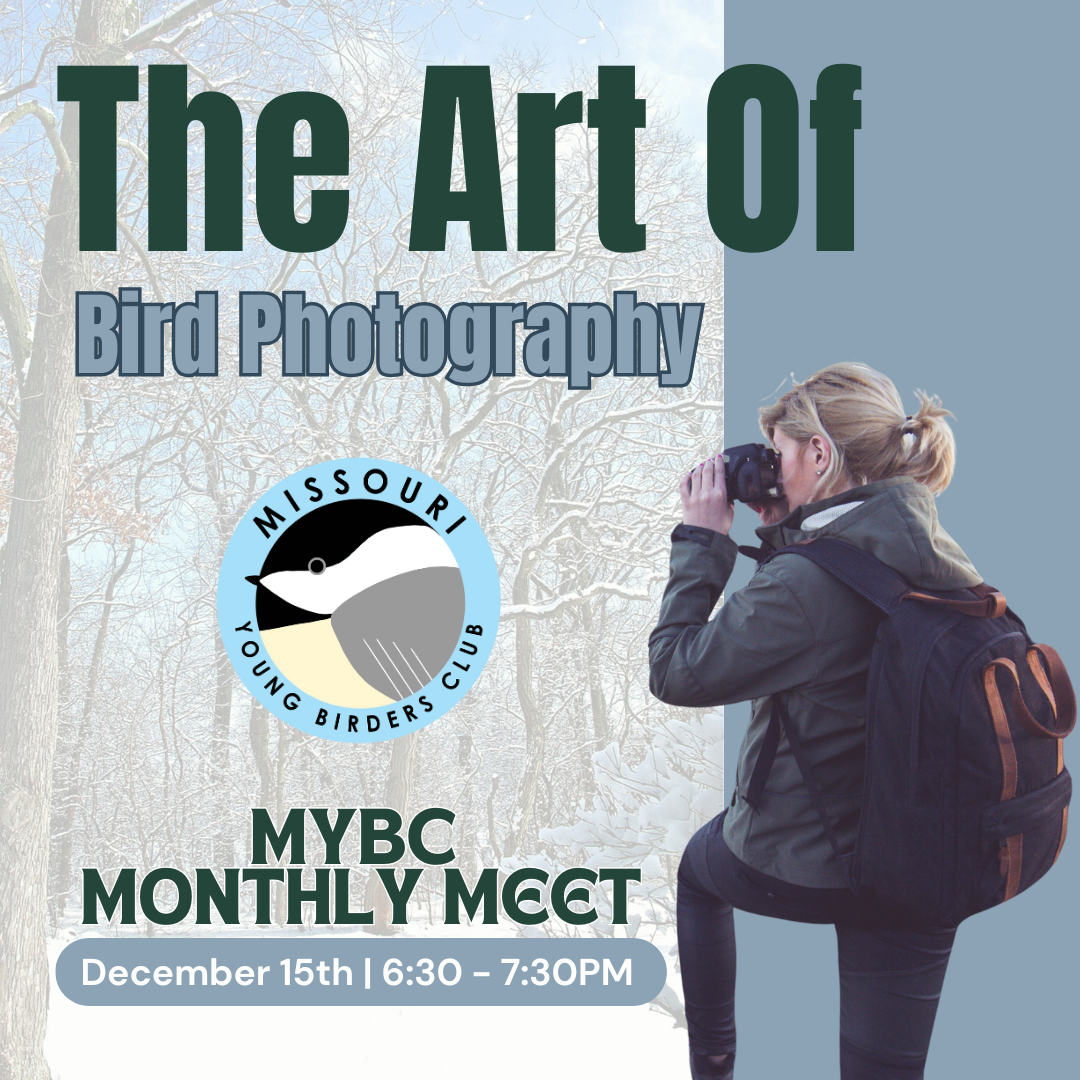
Missouri Young Birders Club Monthly Meeting
Monday, December 15th from 6:30 p.m. to 7:30 p.m.
Every third Monday of the month at 6:30 p.m. on Zoom
| | |
🪶 Calling all young nature lovers! If you’re between 8 and 17 and fascinated by the world of birds, join the Missouri Young Birders Club (MYBC) for an exciting adventure in birding and wildlife conservation!
This December, we’re diving into the art of bird photography! Become part of a growing community of young nature enthusiasts and explore Missouri’s amazing wildlife with us! Visit our website for more information.
| | | Last Monthly Webinar of 2025! | |
Bird-friendly Communities Presentation: Winter Birds
Saturday, January 17th from 10 a.m. to 11 a.m.
East Hills Library 502 N Woodbine Rd, St Joseph, MO 64506 | | | | |
Find out how you can help St. Joseph become a Bird-Friendly community! MRBO's Kaylee Woelfel will share simple, practical ways to be bird-friendly in your home, neighborhood, and community. This program will touch on the 7 simple actions and how we can create safe spaces for our birds specifically during winter.
| | In addition to the presentation, we will create window clings to make your windows more bird friendly. The presentation will be geared for adults, but all ages are welcome. Register to save your seat! | | 2026 Plastic Learning Series
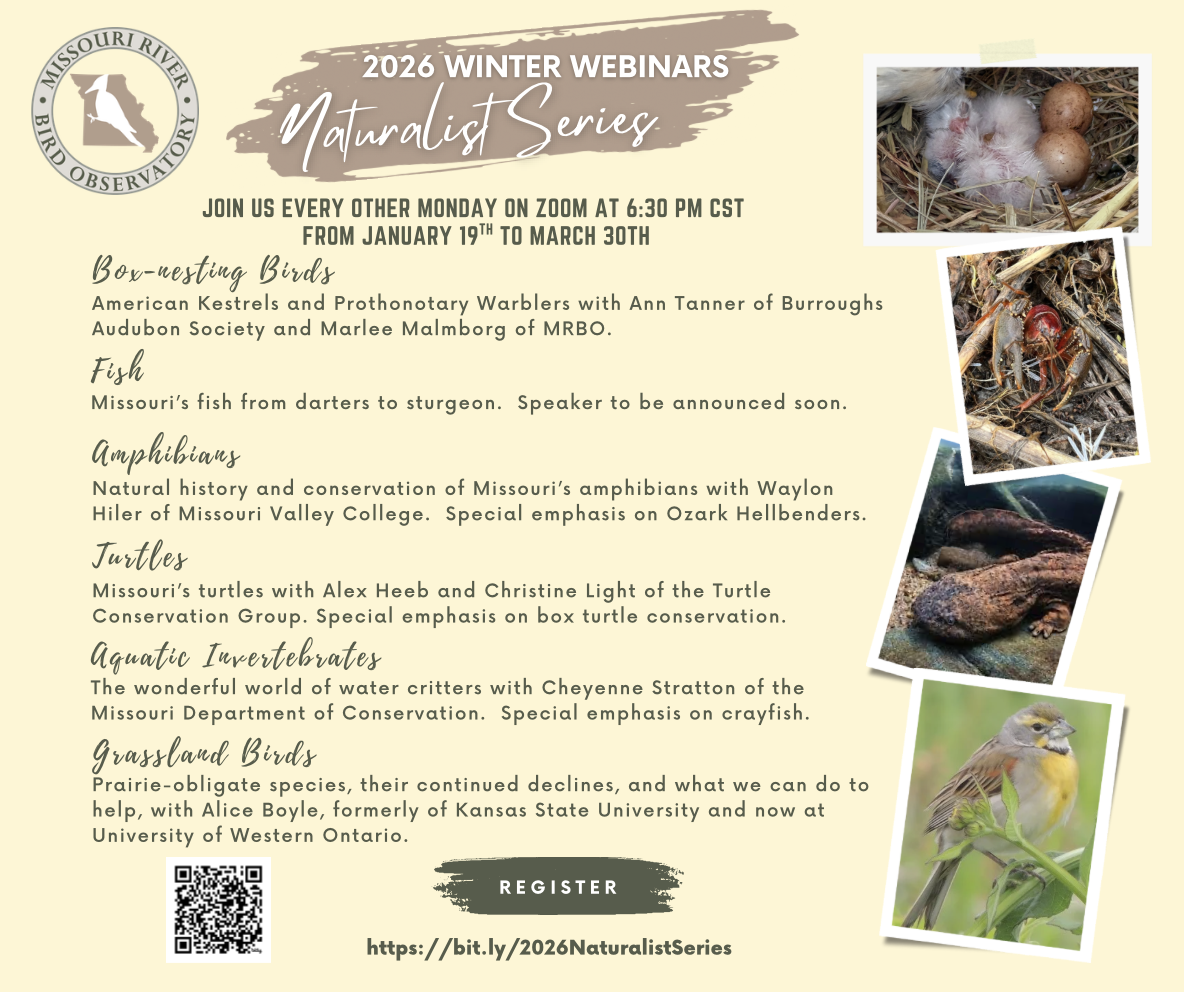
Every other Monday from January 19th to March 16th on Zoom at 5 p.m. | | 2026 Winter Webinars - Naturalist Series
Every other Monday from January 19th to March 30th on Zoom at 6:30 p.m. | | "Show-Me Less Plastic" Community Workshop
Saturday, January 24th from 11 a.m. to 2:30 p.m.
Runge Nature Center, 330 Commerce Drive Jefferson City, MO 65109 | | From Single-Use to Lasting Impressions:
Celebrating Plastic Free Lunch Days | | |
This November marks seven years of Plastic Free Lunch Days in the United States! This program was originally launched in 2018 by Cafeteria Culture—a national nonprofit working to reduce plastic and food waste through youth action. Since then, 4,000 schools have participated and prevented over 20 million single-use plastic items from reaching landfills and wildlife.
What is a Plastic Free Lunch Day? On the surface, it’s self-explanatory—a school organizes one day without plastic in the cafeteria. But, like other sustainability initiatives, it addresses so much more. The build up to a Plastic Free Lunch Day usually includes education about how most plastic is dangerous and nonessential, a student-led cafeteria waste audit, and uplifting student voices for a healthier school. Then, on the day itself, students conduct another audit to witness their collective action. This is no hypothetical lesson. It’s a real-world consequence they can measure themselves.
So what really is a Plastic Free Lunch Day? It is waste reduction, environmental stewardship, active learning, student empowerment, community health, immediate change, and leaves a lasting impression on participants.
In an era of single-use trays, cartons, utensils, and condiment packets, a movement like this is essential. MRBO is excited to join the effort in coordinating Plastic Free Lunch Days across Missouri to support our schools, students, and a statewide shift toward sustainability.
| | |
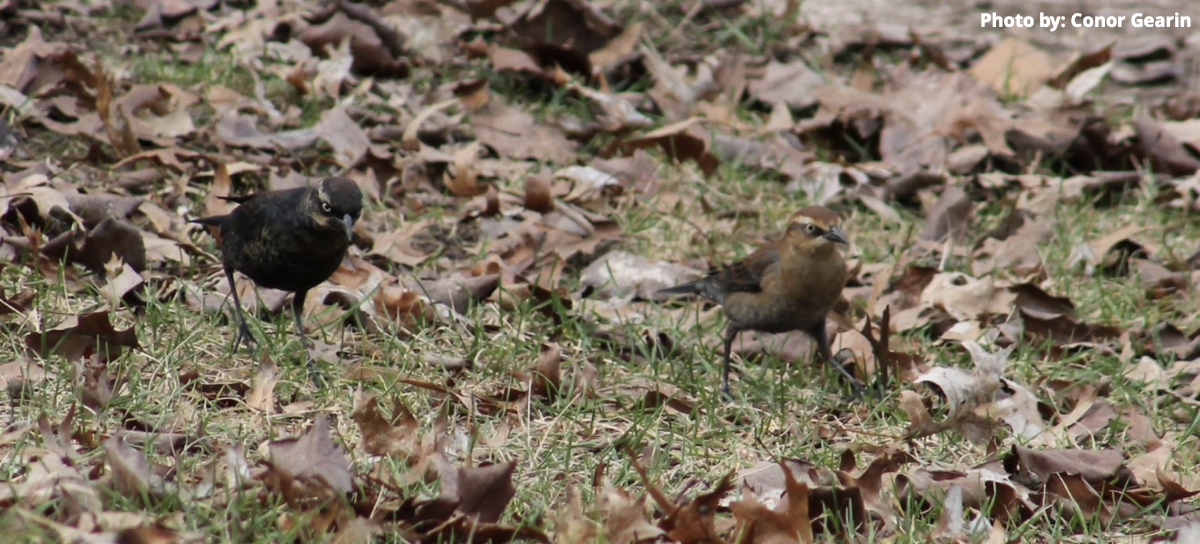
December's Bird of the Month: Rusty Blackbird (Euphagus carolinus)
The Missouri Young Birders Club has selected the Rusty Blackbird as December’s Bird of the Month, a fitting choice for the season, as this species is most often seen in Missouri during migration and throughout the winter months. Rusty Blackbirds are typically found in quiet, wet woodlands, swampy forests, and around marshes or ponds. In winter, they often join large mixed flocks alongside familiar species such as Common Grackles, Red-winged Blackbirds, and European Starlings.
Like their blackbird relatives, Rusty Blackbirds undergo just one molt each year. Their well-known "rusty" look appears when pale, cinnamon-colored feather edges emerge in fall and winter. As these feather tips slowly wear away, they reveal the glossy black or charcoal-gray breeding plumage underneath. Winter males show a pale-yellow eye and a buffy eyebrow. Females are gray-brown with pale eyes, rusty feather edging, and a bold eyebrow that stands out against the darker feathers around the eye. By spring, males become a rich, dark black.
Rusty Blackbirds feed heavily on insects in the summer but switch to acorns, pine seeds, and berries in winter. Much of their nesting behavior remains a bit of a mystery to science, but we do know that females typically lay three to six eggs in nests placed in trees or shrubs near water.
Sadly, this unique species has experienced one of the most dramatic declines of any North American songbird. Surveys estimate that Rusty Blackbirds have been decreasing by nearly 3 percent each year, resulting in a population loss of roughly 75 percent since the mid-1960s. The reasons behind this decline are complex. Loss of wet woodland habitat through drainage, logging, and agricultural development has played a major role, especially in the southeastern United States where most Rusty Blackbirds spend the winter. Long-term reductions in beaver populations also led to a loss of beaver ponds, an important habitat type for the species.
Fortunately, the story of the Rusty Blackbird is not written without hope. As beaver populations rebound and wetland restoration efforts grow, more suitable habitat is slowly returning. Protecting and nurturing healthy habitats, both on breeding grounds and wintering areas, remains a meaningful way to help species like the Rusty Blackbird.
| | | December's Wild Edible - Wintergreen | | | | |
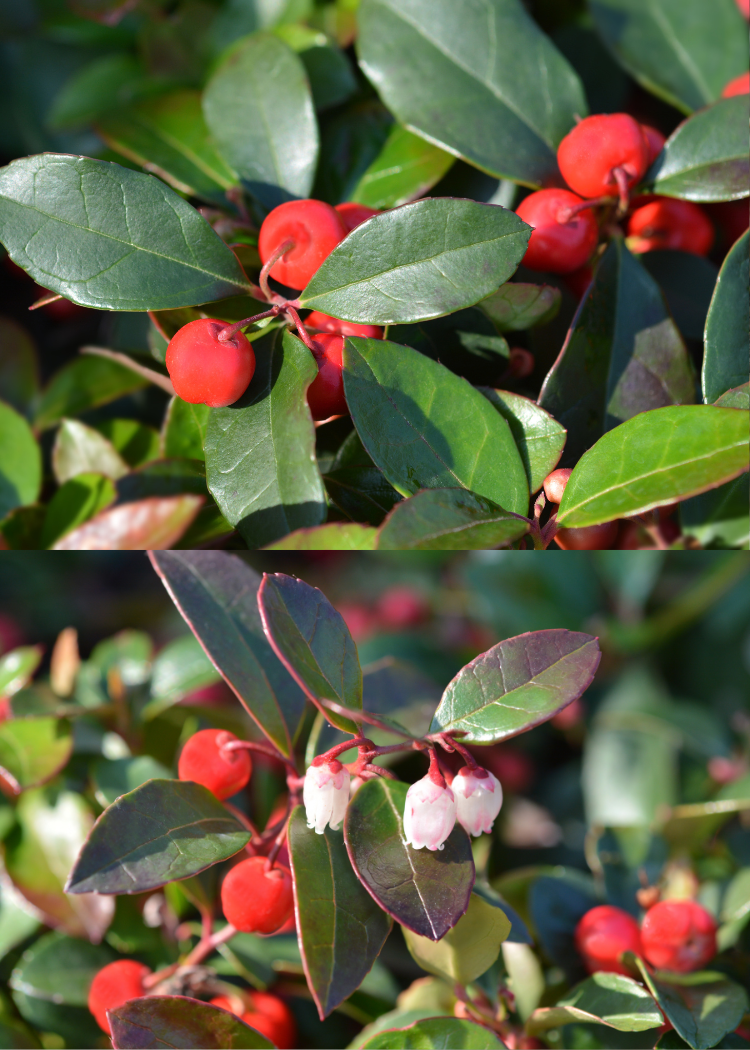
If you’re a fan of that distinctive wintergreen flavor, you’re in luck—this little plant offers its refreshing aroma all year long. Wintergreen is a perennial groundcover most common in the eastern United States, though it can also be found in Missouri where conditions are right. It thrives in well-drained soils within hardwood forests, especially beneath maples.
One of the easiest times to spot wintergreen is during the colder months. Its oval, glossy leaves remain evergreen through winter, making it stand out against a dormant forest floor. In especially frigid weather, those leaves may take on a reddish tint, but the plant remains vibrant and active. Because wintergreen photosynthesizes year-round, responsible harvesting is essential—never strip a plant of all its leaves, and only take what you truly need.
| | |
Wintergreen’s bright, fresh flavor makes it a versatile ingredient for home cooks and foragers alike. The leaves can be used fresh or dried and are especially popular for making simple syrups, teas, and infused baked goods.
A word of caution for foragers: wintergreen can sometimes be confused with other low-growing plants. Although wintercreeper resembles vinca, wintergreen is set apart by its white flowers that mature into red berries, while vinca species bloom in purple. Always confirm a plant’s identity before harvesting. If you’re unsure during winter, return during the growing season to check for blooms and berries—your safest guideposts.
Recipe: Homemade Wintergreen Simple Syrup
This quick recipe captures wintergreen’s bright, minty essence—perfect for seasonal cocktails, mocktails, or drizzling over desserts.
Ingredients:
- 1 cup fresh wintergreen leaves (loosely packed)
- 1 cup water
- 1 cup sugar
- Optional: a few fresh cranberries or a strip of lemon peel for color/flavor
Instructions:
- Rinse wintergreen leaves thoroughly. Gently bruise them with your fingers to release their aroma.
- In a small saucepan, combine water and sugar. Heat over medium until the sugar dissolves completely.
- Remove the syrup from heat and add the wintergreen leaves. Cover and let the mixture steep for 20–30 minutes.
- Strain out the leaves and let the syrup cool.
- Store in a sealed jar in the refrigerator for up to two weeks.
How to use it:
Add a splash to sparkling water or tea, mix it into holiday cocktails, drizzle it over vanilla ice cream, or use it to sweeten whipped cream or frostings.
| | |
406 Main Street
Arrow Rock, MO 65320
660-837-3888
| | | | |