Your Monthly News & Updates | |
|
Read Any Good Books Lately? Please Tell Us About Them | |
|
Any history-related books…or articles…or movies…or historic places you’ve visited that you think would interest us. Not just Medfield history. Please send an email to me – with a sentence or two about why they’re interesting.
The historical society’s March 6 presentation is going to be different from usual, and more interactive. More like a book discussion group.
A few decades ago, I was at a meeting where the guest speaker didn’t show up. Caught off-guard, the person in charge stumbled and bumbled and crumbled.
I thought, “I’ll never let that happen to me!” If in a similar bind, I’d lead a discussion of books, movies, etc., that those in the audience might find interesting. I’d collect all the suggestions from the audience and email the information to all the meeting participants…and then to readers of the following month’s Portal.
That time has come, because my intended March speaker has cancelled.
To make this meeting successful, it’s important that you come with your own ideas – and share them – so you can leave enriched with good ideas and suggestions from other people. And I’ll make sure I compile and share everyone’s input.
Extra points if you share something about Black History Month (February) or Women’s History Month (March)!
To jog your memory – go to your Minuteman Library online, click “my account,” and then click on “reading history” in the left column. Unless you opted out, it should list everything you’ve ever checked out.
Thank you!!
Thanks to Daniel Allenby, Phyllis Bonica, Bob Bryant, Jane Bryce, Tom and Kathleen Connors, Barbara Cronin, Fred and Lucinda Davis, Ellen Dunlap, Fritz Fleishmann and Katrin Fischer, Vicki Fritschi, Alice Goodsell, John Laracy, Bill MacGregor, Wendy Clarridge Moore, Gus Murby, Stephen Roy, Geoff Sauter, Sarah Tiberi, Ray Warburton, Ted Wheelock, and Amy Wilson.
These good folks have sent in donations and membership dues for 2023 even without my asking.
Everyone gets such a relentless blizzard of donations requests in December that I wait until the rush is over. In the next few weeks, I’ll be sending reminders to others on the list. Of course, if don't want to wait, you can join, renew, or donate now simply by clicking on one of the buttons below.
| |
Medfield Man, In Uniform, Reenacts His Father, WWII POW | |
|
Monday, Feb 6
7:30 pm
First Parish Unitarian Universalist Church
26 North Street, Medfield
At age 11, Richard Gray moved with his family from the Ozarks to California during the Depression…only to be relocated months later, after his father died at 35, to the home of an aunt and uncle in Iowa.
There, as a 16-year-old, he joined the National Guard band to earn money to help his family and to buy a clarinet. Little did he know that his small unit would soon be among the first US ground troops to go up against the Germans, taking on “Desert Fox” Rommel’s Afrika Korps.
Gray’s introduction to combat was in the Battle of Kasserine Pass in February 1943. The U.S. Army’s II Corps, under the incompetent Major General Lloyd Fredendall, were beaten, and Gray was wounded and taken prisoner. Fredendall was relieved of his command – sent back to Washington, D.C. – and promoted!
Richard’s proud son, Jonathan Gray of 87 North Street, Medfield, has been reenacting his father’s story for over 10 years, performing at schools, at scouting events in Medfield, and other Massachusetts locations. He will be performing it for the Medfield Historical Society on Monday, February 6, in the basement of the old meetinghouse, aka First Parish Unitarian Universalist church.
The presentation is free and open to the public. Mark your calendar!
| |
When Slavery Existed in Medfield | |
|
by Richard DeSorgher
On the issue of slavery in America, one usually thinks right away about the Southern States, but as William Tilden reminds us in his “History of Medfield 1650-1886,” that in Medfield’s early history, “slavery was common with most wealthy citizens.”
The earliest slaves in the then Massachusetts Bay Colony were Native Americans, but by the time Medfield was first settled there were 150 Africans living in Massachusetts Bay Colony. The first Africans into Massachusetts came in 1638 when the British ship, the Desire, imported the first several Africans.
By 1740, the number of slaves in Massachusetts Bay colony had increased to over 3,000.
In 1641 Massachusetts Bay passed what were called the Body of Liberties. These laws defined who could be enslaved but did not take away the “natural rights” of enslaved men and women. An important characteristic of slavery in Massachusetts that distinguished it from slavery in the Southern Colonies was in the area of legal rights. Blacks and Native Americans, enslaved or free could, for example, testify in court and initiate lawsuits.
| |
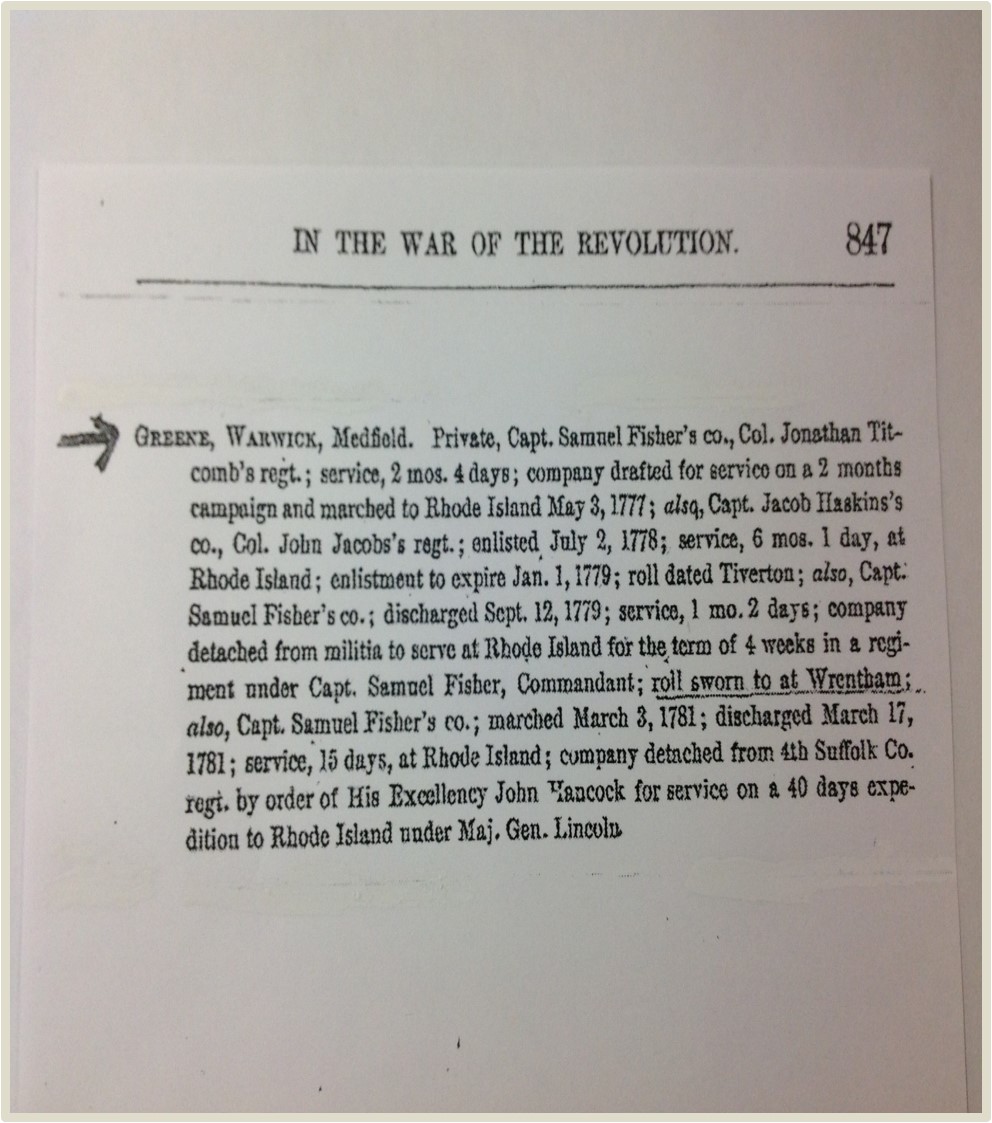
Warwick Greene, Private, of Medfield served in the Revolutionary War in Captain Samuel Fisher’s Company. | |
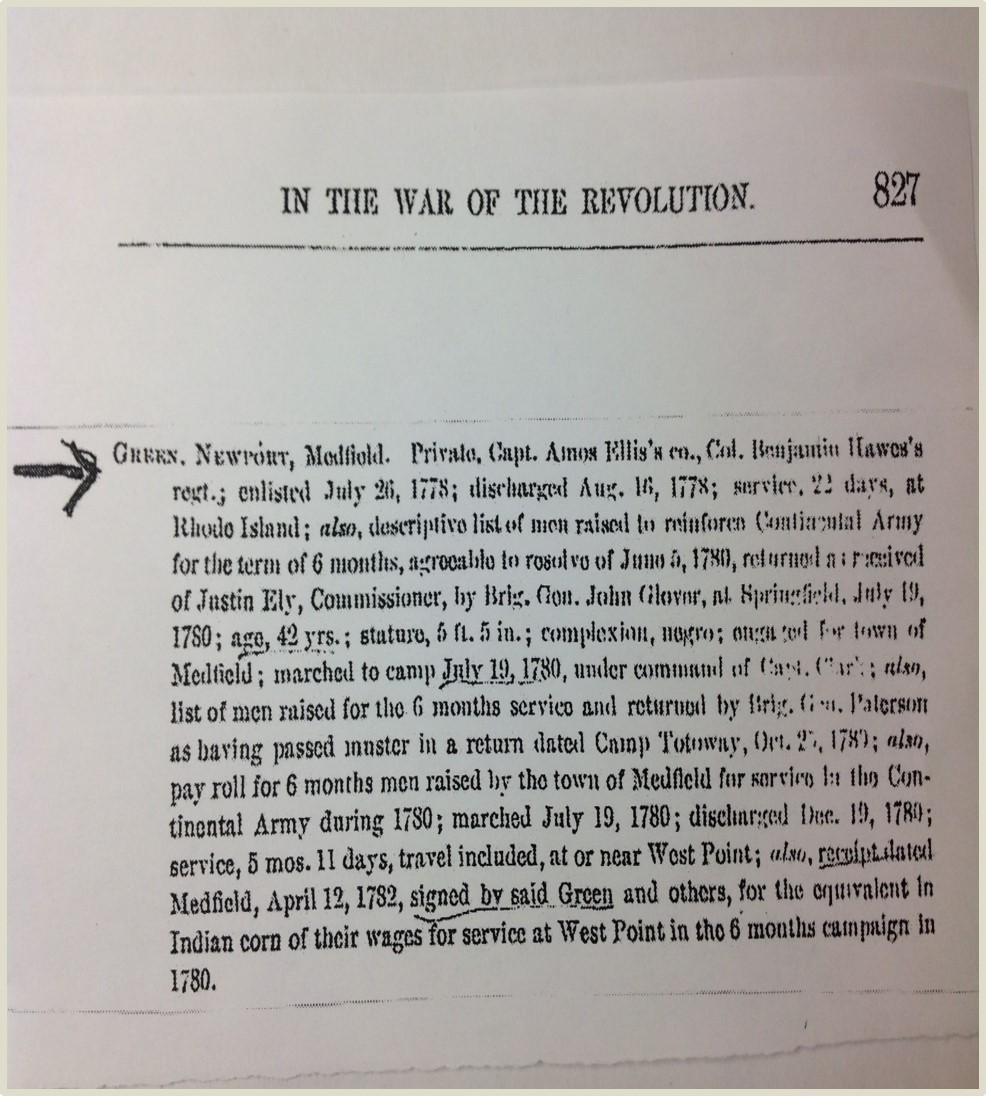
Newport Green, Private, of Medfield served in the Revolutionary War in Captain Amos Ellis’s Company. | |
|
In 1741, Medfield’s First Parish Church voted that infant slaves could receive baptism “if the masters think it their duty, even though their parents not being in covenant.”
By the middle of the 1700s, Boston-based ships would sail to Africa, collect African slaves and deliver their human cargo to the Barbados and other West Indian islands or to southern colonies such as Virginia. In exchange the ships would return to Boston with cargos of wine, salt, sugar and tobacco.
A high percent of the Black new arrivals in Massachusetts during the legal slave trade had been shipped here from the West Indies rather than directly from Africa.
Click here to read more >>
| |
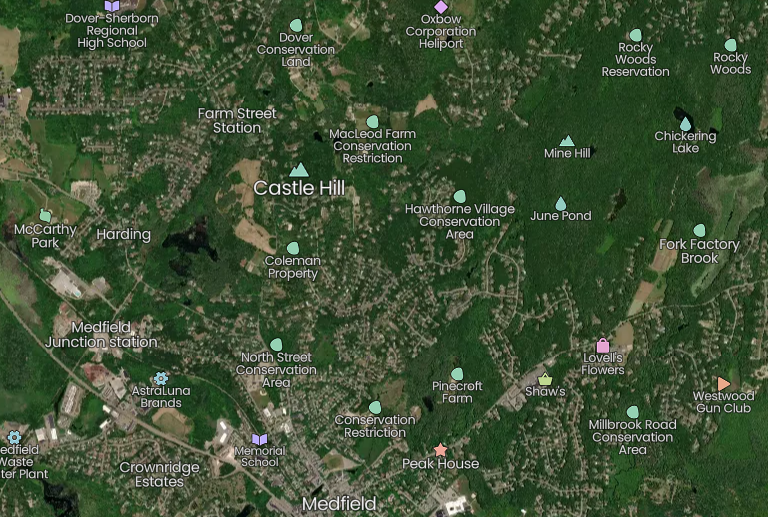
Satellite map showing location of Castle Hill. | |
|
Tilden mentions a number of other hills under “Localities” on that page. Do you know where these are located?
Noon Hill – The principal elevation of land in the south part of the town, over which the sun appears at noon as viewed from the centre.
Mt. Nebo – A hill about a mile east of the village. The first way from Dedham lay over a slope of this hill, from which, as they journeyed, our pioneers might easily have viewed the land of their future settlement.
Cedar Hill – Southeasterly of Rocky Woods. One of the most elevated points of land in this region. From the summit, Boston Harbor can be seen.
Mine Hill – About two miles east of the village and north of Main Street. Certain appearances of the soil led people to suppose that precious metals would be found there. A deep excavation was made; and specimens from it were sent to England for examination, it is said, more than a hundred years ago Nothing of value was obtained from it.
Planting-field Hill or “The Planting Field” – A ridge of land east of South Street, southward of the school-house, ending at Lake Woods. The dwellers in the village quite early took up lands on the slopes of this hill for tillage purposes.
Hatter Hill – A rise of land on the Dedham road, a mile east of the village.
| |
State Hospital Project Advances | |
|
The next step for the redevelopment project at the former Medfield State Hospital – on 45 acres, 334 rental units in 27 historic buildings that will be rehabbed – is the Monday, February 6, public hearing on the site plan developed by Trinity Financial.
The Medfield Planning Board routinely holds a site plan hearing on any construction project except for a single-family house. Hearings like this give the public and members of the board the opportunity to ask questions, air concerns, and assure that the proposed project will meet laws and regulations relating to construction, zoning, stormwater management, open space, amenities, pedestrian and traffic circulation, parking, etc.
Todd Trehubenko, chair of the Medfield State Hospital Redevelopment Committee, said his team’s work is basically done. The committee's mission was largely fulfilled with last year's special town meeting vote and with the awarding of the contract to Trinity Financial, which has deep experience in development projects involving historic restoration. Noting the length and detail of the documents Trinity has prepared, he said he thinks Trinity Financial has done a good job. He thinks they’ve worked well with the Massachusetts Historical Commission and the National Park Service to lay the groundwork to get historical tax credits.
Trinity has also worked with MassWorks (part of Mass. Housing and Economic Development) in the past. In concert with the town of Medfield, Trinity will be seeking MassWorks funds to support infrastructure work at the former hospital site. In 2022 MassWorks awarded some 65 infrastructure grants to Mass municipalities – the highest award was $6.5 million.
In addition, Trinity has been working to address noise concerns about the nearby shooting range on state-owned land used for law enforcement training, and they will be meeting with Longmeadow Road residents to address concerns about traffic and access.
The project will be all-electric – no fossil fuels. Solar panels will be used on flat roofs.
However, solar panels would not meet the Secretary of the Interior’s standards to qualify for historical tax credits on buildings with pitched roofs, which are on the majority of buildings on site.
| |
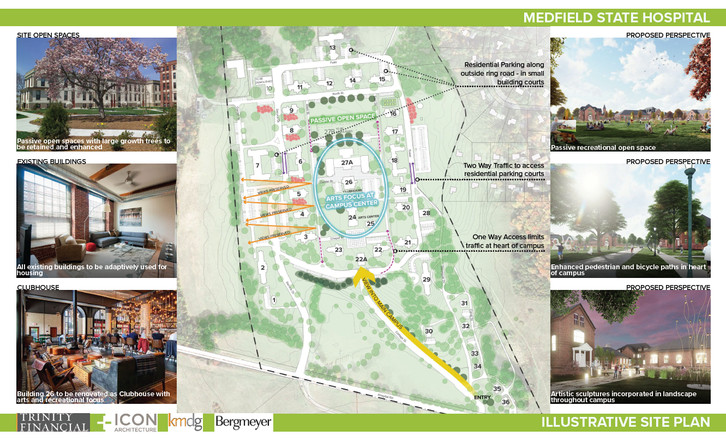
Trinity illustrative site plan for the former Medfield State Hospital. | |
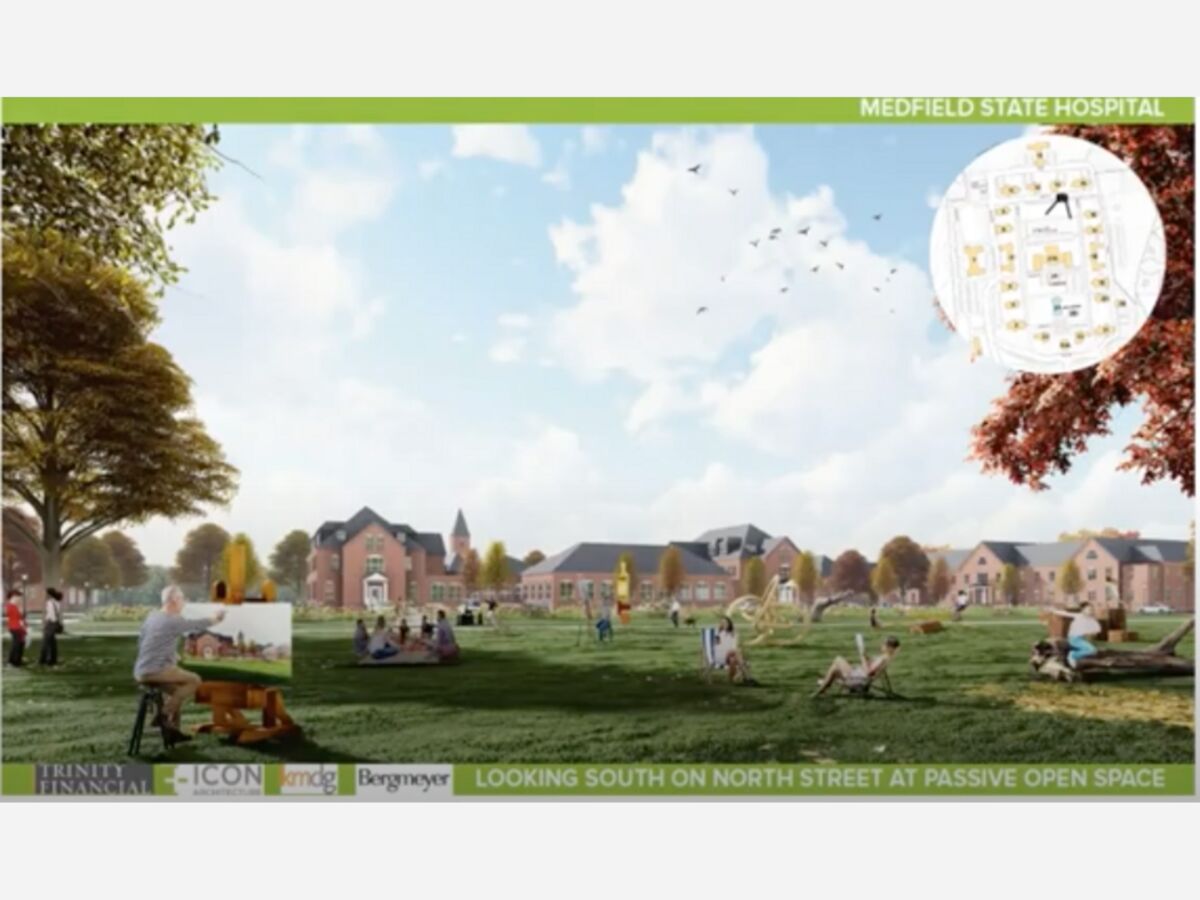
Illustration of passive open space looking south on Trinity's proposed site plan. | |
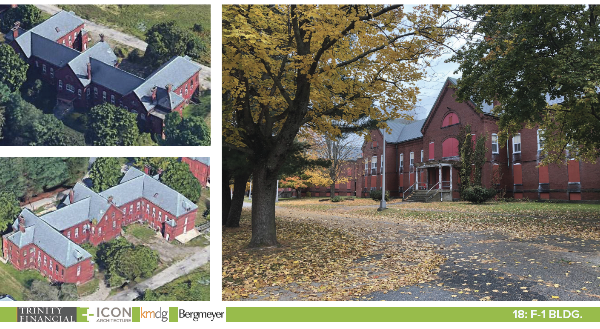
Trinity Financial Design Concept for Building F1. | |
|
Geothermal heating and air conditioning?
There’s a possibility of geothermal heating and air conditioning for some or all the buildings. Trinity is concerned about the higher initial cost for geothermal (GT) compared to more conventional heating systems. However, Jim Nail, co-chair of the Medfield Energy Committee (MEC), says that case studies of other GT projects that MEC has compiled, such as Hebrew Senior Living's NewBridge on the Charles community in Dedham, show it could in fact be done in Medfield.
Jim said GT equipment would be more durable and more economical in the long run than traditional air-to-air heat pumps, and the equipment will be less visible on the campus. A GT heat pumps system also has the advantage that it produces no on-site carbon dioxide emissions, thus helping Medfield and the Commonwealth in achieving zero-net carbon objectives.
To address the financial concerns, the system can be outsourced to geothermal specialist companies, similarly to how Trinity is outsourcing the solar installations. He said the Medfield Energy Committee has members with expertise and connections in the GT industry that could fill this gap in Trinity's experience.
The energy committee will continue to pursue GT for the hospital redevelopment project.
| |
People and Places of the Past | |
Midcentury Medfield Memories: The Blizzard of '78 45 Years Ago | |
|
by Tim Flaherty
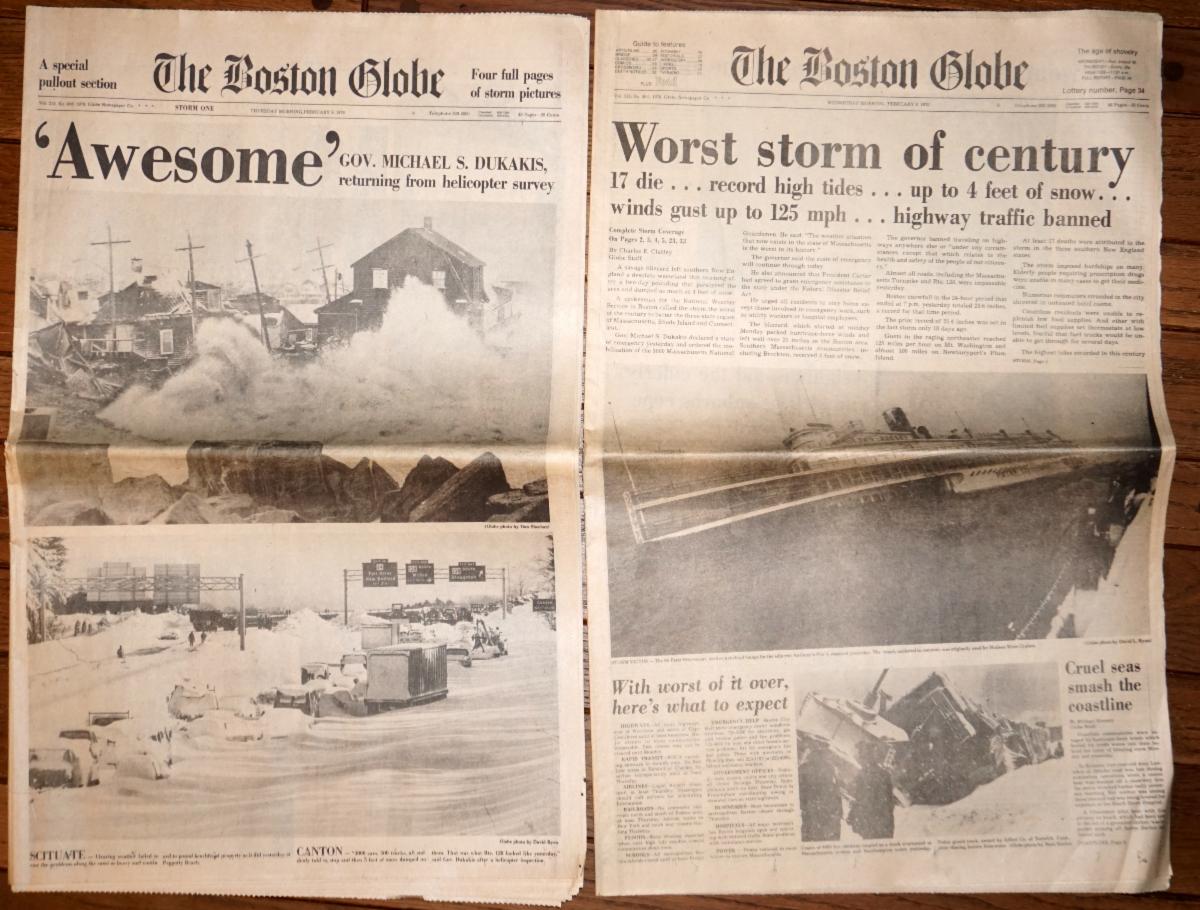
From February 5 to 7, 1978, the Blizzard of ‘78 hit New England. It started later and was much more powerful than most local meteorologists had anticipated. In the preceding days, weather centers knew something was coming, but they just couldn’t make up their minds about how much. Meteorologist Harvey Leonard from WCVB-TV did predict that Massachusetts was going to get hit hard.
When the snow didn’t start in the early morning as forecasters had predicted, skeptical people got into their cars and drove off to work – in retrospect, a big mistake. The blizzard on its way to the northeast had an unusual beginning, and most of the people of Medfield became aware of the storm’s creation only after the snow had stopped 34 hours later.
|  | |
(If you asked Midwesterners, they’d say their Great Blizzard of ’78 occurred between January 25 and 27, 1978, dumped 52 inches of snow on Muskegon, Michigan, blew 10- to 20-foot drifts and wind chill of -50 degrees in Indiana, and caused 71 fatalities and $100 million in damage.)
Meteorologists mentioned in news reports that the sun and the new moon aligned to cause high tides that produced record floods. In Massachusetts the flood destroyed 2,000 homes between Marblehead and Plymouth, damaging another 10,000 homes. There were 80+ mph winds, with gusts to 110 mph in Scituate, and about 100 deaths attributed to the storm. Damage was estimated at $500 million, close to $3 billion in 2023 dollars.
Click here to read more >>
| | | | |