Direct Fuel Injection: The benefits and the drawbacks
If you drive a relatively new Subaru, Honda or Toyota (Lexus and Acura included) you likely have a fuel injection system that is a "Direct Injection" system. Initially fuel injection systems placed the injector in the intake manifold port above the intake valve in the cylinder head. Toyota started using it as early as 2006 and Honda and Subaru around 2013. By 2017 nearly all of their models had direct injection. I am going to break it down for you along with some diagrams to help better understand my explanation as well as provide advice on how to maintain a direct inject vehcile.
Why Did Automakers Change from Port Injection to Direct Injection?
For decades, gasoline engines used port fuel injection (PFI). In a port-injected engine, the fuel injector sprays gasoline into the intake runner, where it mixes with the incoming air before flowing over the intake valve and into the combustion chamber where the mixture is ignited by the spark plug. This design proved to be reliable, relatively simple, and had the added benefit of keeping the intake valves clean because the fuel (with it's detergents) continuously washed away oil residue and fuel deposits.
As fuel economy standards became more demanding and emissions regulations became stricter, manufacturers needed a way to produce more power from smaller engines while using less fuel. Direct injection (DI) became one of the most effective solutions. Instead of spraying fuel into the intake runner, a direct injection system sprays fuel directly into the combustion chamber at extremely high pressure, often between 2,000 and 5,000 PSI.
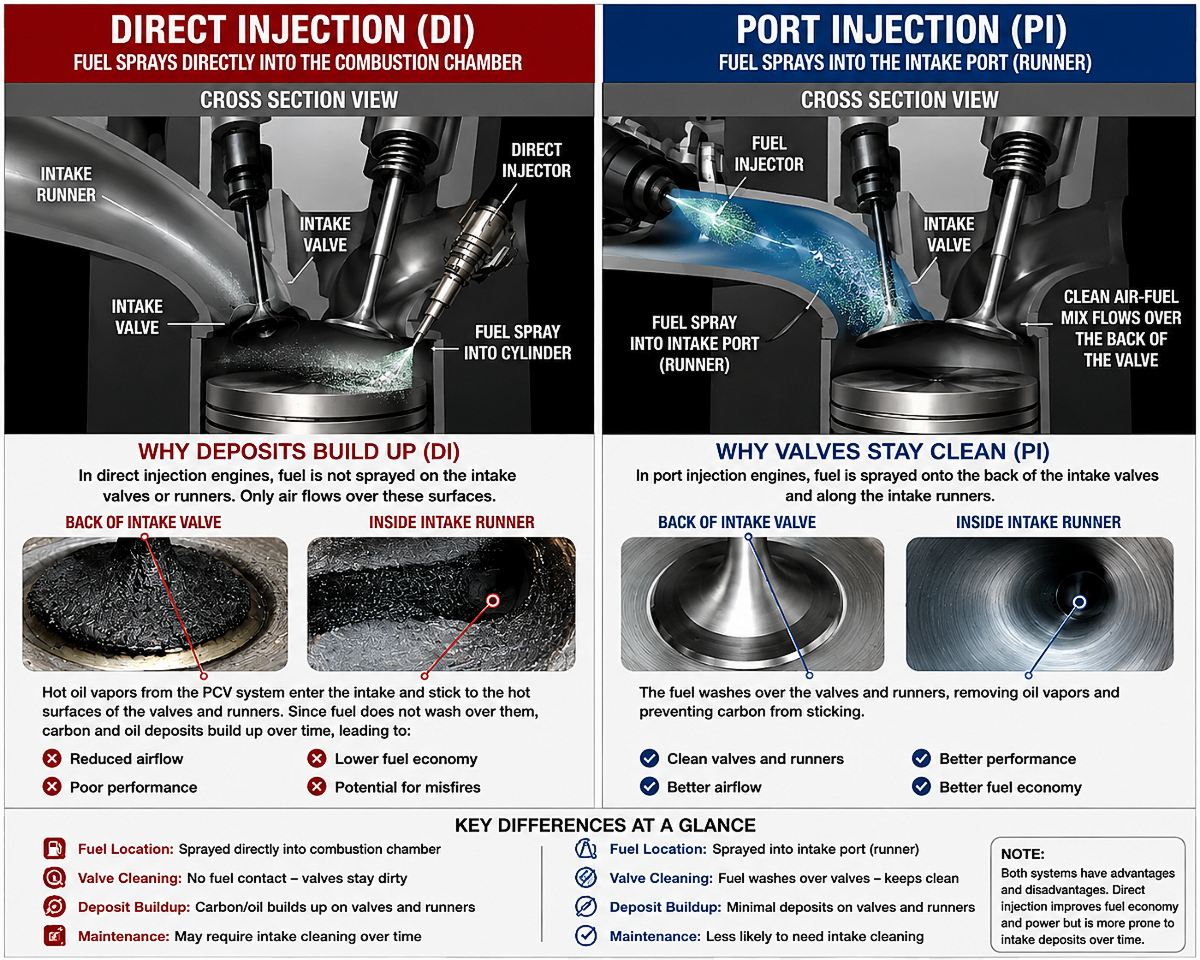
Today, nearly every automobile manufacturer uses direct injection on many of its gasoline engines because it helps improve performance, increase fuel economy, and reduce emissions. (see first image below for visual description)
The advantages of Direct Injection: Fuel Economy and Power
- First, fuel is injected directly into the combustion chamber at precisely the right time. This allows the engine computer to control fuel delivery much more accurately than previous fuel systems.
- Second, the extremely high fuel pressure creates a very fine fuel mist. These tiny fuel droplets mix more thoroughly with the incoming air, resulting in a more complete and efficient combustion process.
- Another advantage is that fuel is injected directly into the cylinder where it absorbs heat as it vaporizes. This cooling effect lowers combustion temperatures and allows engineers to increase engine compression ratios or turbocharger boost without causing engine knock. Higher compression and improved combustion efficiency both contribute to better fuel economy.
- Finally, direct injection allows manufacturers to build smaller turbocharged engines that produce the same—or even greater—power than larger engines while consuming less fuel. This process, often referred to as "downsizing," has become one of the biggest reasons manufacturers have adopted direct injection technology.
The Pitfalls of Direct Injection
Although direct injection offers significant improvements in performance and fuel economy, it also introduced one of the most common maintenance issues found in modern gasoline engines.
In a port-injected engine, gasoline continually sprays over the backs of the intake valves and through the intake runners. This fuel naturally washes away oil residue before it can harden into carbon deposits.
In a direct-injected engine, fuel never contacts the intake valves or intake runners. Only air flows through the intake system while small amounts of oil vapor from the Positive Crankcase Ventilation (PCV) system and other normal engine ventilation systems pass through the intake tract.
These oil vapors stick to the hot surfaces of the intake valves and intake runners. Over thousands of miles, repeated heating and cooling causes the oil residue to harden into thick carbon deposits.
Problems Caused by Carbon Buildup
As carbon deposits become thicker, they begin to interfere with normal engine operation by restricting airflow into the combustion chamber. Depending on the amount of buildup, drivers may experience:
• Reduced airflow into the engine
• Rough or unstable idle
• Hesitation during acceleration
• Poor throttle response
• Reduced horsepower
• Lower fuel economy
• Increased exhaust emissions
• Cold-start misfires
• Check Engine Light illumination
• Reduced overall engine performance
Some engines develop only minor deposits throughout their life, while others accumulate heavy carbon buildup depending on engine design, oil quality, driving habits, and mileage.
NOTE: Toyota Owners, You are in good luck. Toyota in it's wisdom, their engineers realized the problem direct inject could cause so they retained the port injector when they incorporated the new direct injector! Due to this, they rarely need a carbon removal procedure.
How Is Carbon Removed?
It can be removed chemically or mechanically.
Unlike port-injected engines, direct-injected engines cannot clean the intake valves by simply adding a fuel system cleaner to the gas tank because the fuel never reaches the backs of the intake valves.
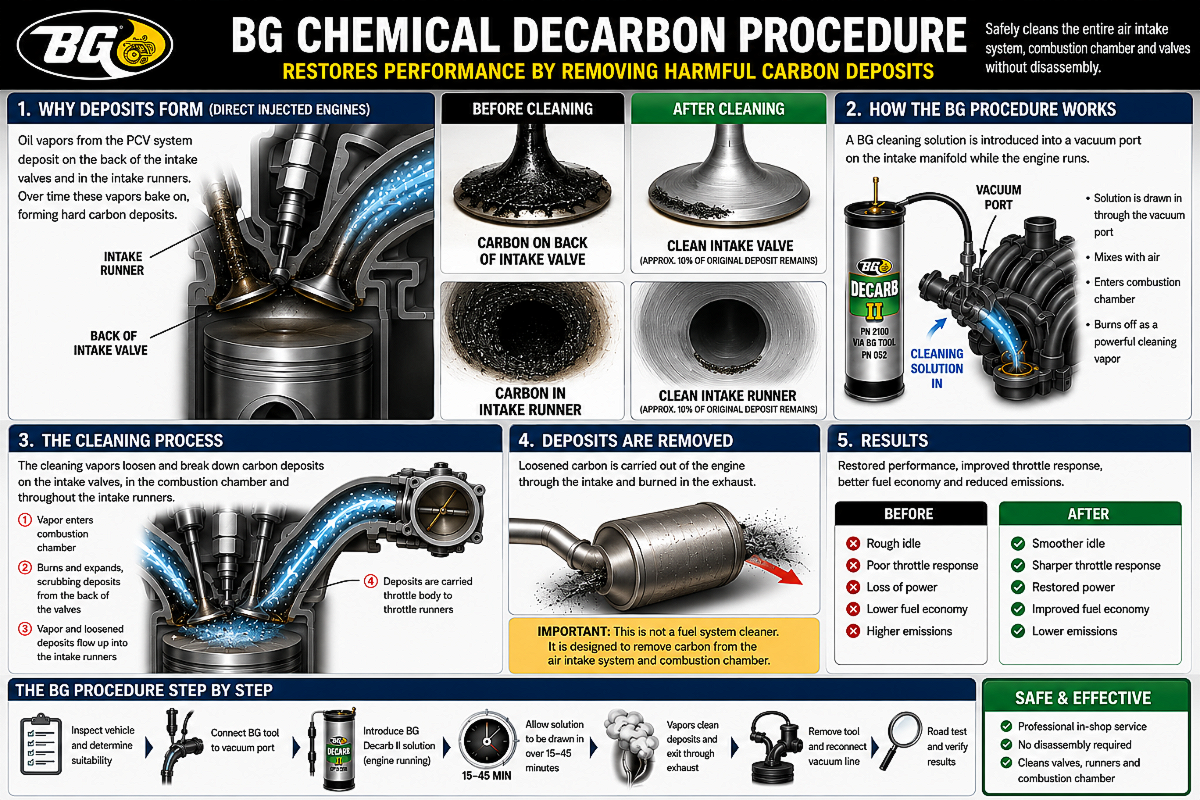
The BG chemical method.
If used regularly it can be a great way to maintain a minimal buildup on the valves and intake system. (second picture below). BG offers a product that we use which atomizes a carbon cleaning solution down the intake runners and onto the back of the valves. This is very effective if done every 15000 miles and it's unlikely to need a full walnut shell blast in the future. This is the less costly procedure because far less labor is involved.
When carbon buildup becomes excessive, the most effective cleaning method is walnut shell blasting.
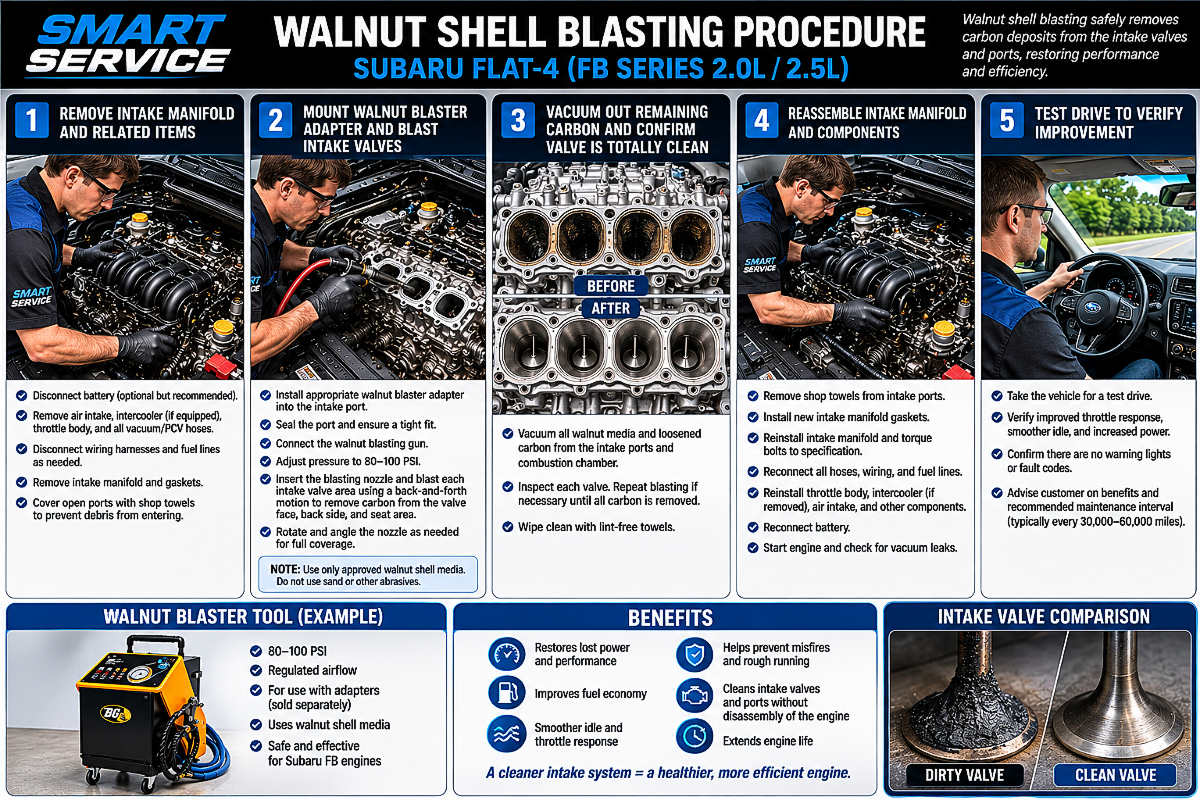
Walnut Shell Blasting:
During this service, the intake manifold is removed to expose the intake ports. Using a specialized walnut shell blasting machine and intake port adapter, finely crushed walnut shell media is blasted onto the intake valves while they are in the closed position. The walnut shell media safely removes hardened carbon deposits without damaging the metal valve surfaces.
After each intake port has been cleaned, the remaining walnut shell media and loosened carbon are thoroughly vacuumed from the cylinder head. Once all four cylinders have been cleaned and inspected, the intake manifold is reinstalled using new gaskets, the engine is reassembled, and a road test is performed to verify proper operation and improved engine performance.
Direct injection has allowed automobile manufacturers to build engines that are more powerful, more fuel efficient, and produce lower emissions than previous generations of gasoline engines. However, by eliminating the fuel spray over the intake valves, manufacturers also eliminated the natural cleaning action that port fuel injection provided.
As a result, intake valve carbon buildup has become a normal maintenance consideration on many direct-injected gasoline engines. Periodic inspection and professional walnut shell blasting, when needed, can restore proper airflow, improve performance, smooth idle quality, improve throttle response, and help the engine continue operating at its designed level of efficiency.
At Smart Service, we provide both the BG Chemical cleaning as well as the more involved Walnut Shell Media Blasting procedure depending on the severity of the buildup. Getting on a cleaning program early is the best method. It's like keeping your teeth cleaned at a dentist instead of waiting a few years and going in for a more expensive repair.
NOTE: Please be aware that the diagrams below are AI generated and may not represent the exact configuration of your vehicle engine.
|