You are invited to join us on Friday, May 16th at 9 am for an informative TEN Talk Transparency in Texas Government: Understanding TPIA, TOMA, and FOIA. We will demystify three powerful laws that give you access to government information and meetings. Whether you're a concerned citizen, community activist, or simply curious about how your local government operates, this session will equip you with practical knowledge about the Texas Public Information Act, Texas Open Meetings Act, and the federal Freedom of Information Act. Learn how to request public records at both state and federal levels, understand what information you're entitled to access, and discover how to effectively participate in open meetings. This informative hour will transform how you engage with government at all levels and empower you to become a more informed and effective advocate for transparency in your community. | | | | |
DATE: Friday, May 16, 2025
TIME: 9:00 AM to 10:00 AM
WHERE: Zoom (link sent upon registration)
TOPIC: Transparency in Texas Government
~CLICK THE BUTTON TO REGISTER~
| | The Attorney General’s Public Information Act Handbook is found HERE. | | |
The Attorney General’s Open Meetings Handbook is found HERE.
To request assistance related to a request for information under the Public Information Act if you believe a governmental body has failed to respond appropriately to your request or is overcharging for your records: https://oag.my.site.com/OpenRecords/s/
| | | |
THIS WEEK'S BILL SPOTLIGHT:
SB 985 Bettencourt / HB342 Hayes
| | SB 924 from the 88th Regular Session updated provisions in the Election Code related to combining election precincts. While SB 924 (88R) made improvements in this area of state law, the bill sponsor informed the committee that it inadvertently removed an important provision allowing political parties to combine precincts during primary elections to avoid unreasonable expenditures for election equipment, supplies, and personnel. SB 985 (89R) seeks to address this issue by providing for a county commissioners court and the county executive committees of political parties to combine county election precincts under certain circumstances. | |
SB 985 amends the Election Code to authorize the following entities to combine county election precincts to avoid unreasonable expenditures for election equipment, supplies, and personnel if changes in county election precinct boundaries to give effect to a redistricting plan result in precincts with fewer than 3,000 registered voters:
• a commissioners court, for a general or special election; or
• for a primary election, the county executive committee of a political party conducting the primary election.
The bill subjects such a combined precinct to the population cap prescribed under state law for county election precincts generally and to the prohibition against establishing a combined precinct resulting in certain adverse effects to a group covered by the federal Voting Rights Act.
SB 985 expands the existing authorization for the commissioners court of a county with a population of less than 1.2 million that does not participate in the countywide polling place program to combine county election precincts in a general or special election on the recommendation of the county election board if certain conditions are met, including inability to secure a suitable polling place location, by doing the following:
• making that authorization applicable to the commissioners court of any county that does not participate in the countywide polling place program; and
• additionally authorizing the county executive committee of a political party conducting a primary election to combine precincts in the primary election on the recommendation of the county election board if those conditions are met.
SB 985 establishes that for the purposes of appointing a presiding election judge and an alternate presiding judge to a county election precinct combined under the previously described authorizations added or amended by the bill, the combined precinct must be considered a single precinct and the judges must be appointed in accordance with the procedures provided under statutory provisions relating to election judges and clerks.
| | |
FILIBUSTERS AND CHUBBING
Source: Legislative Reference Library
A filibuster is the prolonged discussion of a bill by an individual, intended to delay legislative action. Filibusters are permitted in the Senate but not in the House of Representatives.
Filibusters are governed by the Senate rules and by precedents interpreting the rules.
• Rule 3.02 prohibits eating or drinking in the Senate chamber.
• Rule 4.01 requires a member of the Senate to stand at his or her desk to address the Senate. The member speaking may not sit, lean, or use a desk or chair in any way. Bathroom breaks are not allowed.
• Rule 4.03, which governs the interruption of a member who is speaking, allows other senators to raise objections if a speaker does not confine his or her remarks to the issue under consideration or if his or her voice is inaudible.
If a point of order is raised that the senator speaking has violated the rules for decorum or debate, the presiding officer will warn the senator twice; after a third violation, the Senate may vote on the point of order. If it is sustained, the senator speaking must yield the floor.
Senator Bill Meier holds both the state and national record for his 43-hour filibuster on SB 1275 during the 65th regular session in 1977. Senator Meier objected to a provision of the bill which would have prevented public inspection of the records of the Industrial Accident Board.
Chubbing refers to the practice of one or more members of the legislature debating bills at great length to slow down the legislative process. It is frequently practiced on those legislative days which have deadlines near the end of session. Chubbing occurs in both the House and the Senate.
| | | | The origin of the use of the word "chubbing" to refer to a tactic of talking at length to delay the consideration of legislation is not known. It appears that the use of this term in Texas dates back at least to the 1950s. This usage may be unique to Texas. The Oxford Dictionary of American Political Slang lists the term as originating in Texas and cites its appearance in newspapers and magazines. Texas newspapers articles from the early 1970s through the present describe the practice of chubbing but give no information about the origin of the term. | | The technique is also mentioned in several of the general books on Texas politics in the Library's collection; the earliest is from The Texas Citizen : the Guide to Active Citizenship in the Lone Star State by William Henry Gardner, published in 1955. In a section on delaying tactics Gardner writes "A number of maneuvers are employed by opponents of a bill to defeat it or delay its passage. In the House, members may prevent a bill that is on the calendar from being taken up for floor consideration by a time-consuming stratagem known as chubbing, which consists of talking at length on a number of other irrelevant matters." | | |
Tuesday, May 13, 2025, by 10 p.m. (120th day) Deadline for the House to distribute its last House daily calendar with House bills and House joint resolutions [relates to House Rule 6, Sec. 16(a), requiring 36-hour layout of daily calendars before consideration, and House Rule 8, Sec. 13(b), establishing the deadline for consideration]
Wednesday, May 14, 2025, by 9 a.m. (121st day) Deadline for the House to distribute its last House local and consent calendar with consent House bills [relates to House Rule 6, Sec. 13(a), requiring 48-hour layout of local and consent calendars before consideration, and House Rule 8, Sec. 13(b), establishing the deadline for consideration]
Thursday, May 15, 2025 (122nd day) Last day for the House to consider 2nd reading House bills and House joint resolutions on the daily or supplemental calendar [House Rule 8, Sec. 13(b)]
Friday, May 16, 2025 (123rd day) Last day for the House to consider consent House bills on the local and consent calendar on 2nd and 3rd reading and all 3rd reading House bills and House joint resolutions on the supplemental calendar [House Rule 8, Sec. 13(b)]
Monday, May 19, 2025 (126th day) First day the Senate can consider bills and resolutions on the first day they are posted on the Senate Notice of Intent Calendar [Senate Rule 5.14(b)]
Wednesday, May 21, 2025, by 9 a.m. (128th day) Deadline for the House to distribute its last House local and consent calendar with local House bills [relates to House Rule 6, Sec. 13(a), requiring 48-hour layout of local and consent calendars before consideration, and House Rule 8, Sec. 13(a), establishing the deadline for consideration]
Friday, May 23, 2025 (130th day) Last day for the House to consider local House bills on the local and consent calendar on 2nd and 3rd reading [House Rule 8, Sec. 13(a)]
| | Saturday, May 24, 2025 (131st day) Last day for House committees to report Senate bills and Senate joint resolutions [The House rules do not contain an express deadline for committees to report measures, but, technically, this is the last day for a House committee to report a Senate bill or Senate joint resolution in order for the measure to have any chance of being placed on a House calendar. However, this deadline does not take into consideration the time required to: (1) prepare the bill analysis; (2) obtain an updated fiscal note or impact statement; (3) prepare any other paperwork required for a committee report; or (4) prepare the committee report for distribution to the members of the House as required by the rules. Realistically, it normally takes a full day or more for a measure to reach the Calendars Committee after the measure has been reported from committee.] | | | |
Sunday, May 25, 2025, by 10 p.m. (132nd day) Deadline for the House to distribute its last House daily calendar with Senate bills and Senate joint resolutions [relates to House Rule 6, Sec. 16(a), requiring 36-hour layout of daily calendars before consideration, and House Rule 8, Sec. 13(c), establishing the deadline for consideration]
Monday, May 26, 2025, by 9 a.m. (133rd day) Deadline for the House to distribute its last House local and consent calendar with Senate bills [relates to House Rule 6, Sec. 13(a), requiring 48-hour layout of local and consent calendars before consideration, and House Rule 8, Sec 13(c), establishing the deadline for consideration]
Tuesday, May 27, 2025 (134th day) Last day for the House to consider 2nd reading Senate bills and Senate joint resolutions on the daily or supplemental calendar [House Rule 8, Sec. 13(c)]
Wednesday, May 28, 2025 (135th day) Last day for the House to consider local and consent Senate bills on 2nd and 3rd reading and all 3rd reading Senate bills and Senate joint resolutions on the supplemental calendar [House Rule 8, Sec. 13(c)]
Last day for the Senate to consider all bills and joint resolutions on 2nd or 3rd reading* [Senate Rule 7.25; Senate Rule 10.01 subjects joint resolutions to the rules governing proceedings on bills] [*The Senate deadline for passing all bills and joint resolutions does not take into consideration the House deadline for passing Senate bills and joint resolutions. Realistically, to be eligible for consideration by the House under its end-of-session deadlines, Senate bills and joint resolutions must be passed by the Senate and received by the House before the 130th day. Accordingly, even though Senate Rule 7.24(b) indicates the 137th day is the last day for Senate committees to report all bills and joint resolutions, the practical deadline for Senate committees to report is before the 130th day.]
| | | | |
Thursday, May 29, 2025, before midnight (136th day) Deadline for the House to distribute Senate amendments [relates to House Rule 13, Sec. 5(a), requiring 24-hour layout of Senate amendments before consideration, and House Rule 8, Sec. 13(d), establishing the deadline for acting on Senate amendments]
Friday, May 30, 2025 (137th day) Last day for the House to act on Senate amendments (concur or request a conference committee) [House Rule 8, Sec. 13(d)]
| | |
Before midnight: deadline for the House to print and distribute House copies of a conference committee report on the general appropriations bill [relates to House Rule 13, Sec. 10(a), requiring 48-hour layout of a conference committee report on the general appropriations bill before consideration during a regular session, and House Rule 8, Sec. 13(e), establishing the deadline for adoption of conference committee reports]
Before midnight: deadline for the Senate to print and distribute Senate copies of conference committee reports on tax, general appropriations, and reapportionment bills [relates to Senate Rule 12.09(a), requiring 48-hour layout of certain conference committee reports before consideration in regular session, and Senate Rule 7.25, establishing the deadline for voting on a bill; Senate Rule 10.01 subjects joint resolutions to the rules governing proceedings on bills.]
Saturday, May 31, 2025, before midnight (138th day) Deadline for the House to print and distribute House copies of all conference committee reports on joint resolutions and on bills other than the general appropriations bill [relates to House Rule 13, Sec. 10(a), requiring 24-hour layout of certain conference committee reports, and House Rule 8, Sec. 13(e), establishing the deadline for adoption of conference committee reports]
Deadline for the Senate to print and distribute Senate copies of all conference committee reports on joint resolutions and on bills other than tax, general appropriations, and reapportionment bills [relates to Senate Rule 12.09(b), requiring 24-hour layout of certain conference committee reports before consideration during the last 72 hours of a regular session, and Senate Rule 7.25, establishing the deadline for voting on a bill; Senate Rule 10.01 subjects joint resolutions to the rules governing proceedings on bills]
| | | | |
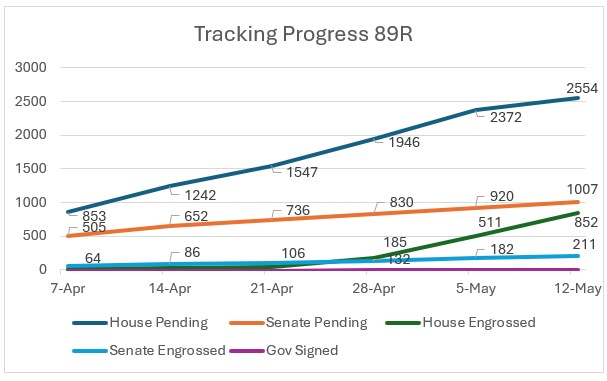
As of 5/12/25, Number of bills this session...
Left pending in House Committee or Subcommittee: 2,554
Passed to Engrossment by the House: 852
Left pending in Senate Committee or Subcommittee: 1007
Passed to Engrossment by the Senate: 211
Bills signed by the Governor: 6
| | |
REGISTER TO ACCESS PREVIOUS TRAININGS
Texas Legislature Online (TLO) REGISTER
Effective Legislative Advocacy at the Texas Capitol REGISTER
ISSUE FORUM: Countywide vs. Precinct Polling Panel Discussion REGISTER
Bifurcation of the Texas Voter Roll REGISTER
Candidate Training REGISTER
Ranked Choice Voting: What it could mean for Texas Elections REGISTER
Texas Election Update: REGISTER
| | |
Thank you for staying connected with TEN—your go-to source for reliable information and practical training. Because of your involvement, grassroots advocates across Texas are stepping up with confidence, equipped to make a real difference in their communities. When you take part in the campaign, legislative, and electoral processes, you're helping build a stronger, more responsive Texas.
We’re truly grateful for your commitment to standing up for election integrity and making your voice heard. It’s everyday Texans like you—showing up, staying informed, and taking action—who bring our mission to life. Every step you take, whether big or small, helps move Texas toward meaningful, lasting change.
Thank you for being engaged grassroots and for believing, like we do, that real change begins one Texan at a time.
Melissa Conway
Texas Election Network
Managing Director
832-648-0770
| | Follow TEN on Social Media! | | | | |