JULY 2026

Your Peek Into Sacramento’s Coordinated Access System


Stories, updates, and data from Sacramento’s front door to homelessness services.


June Data & Analysis


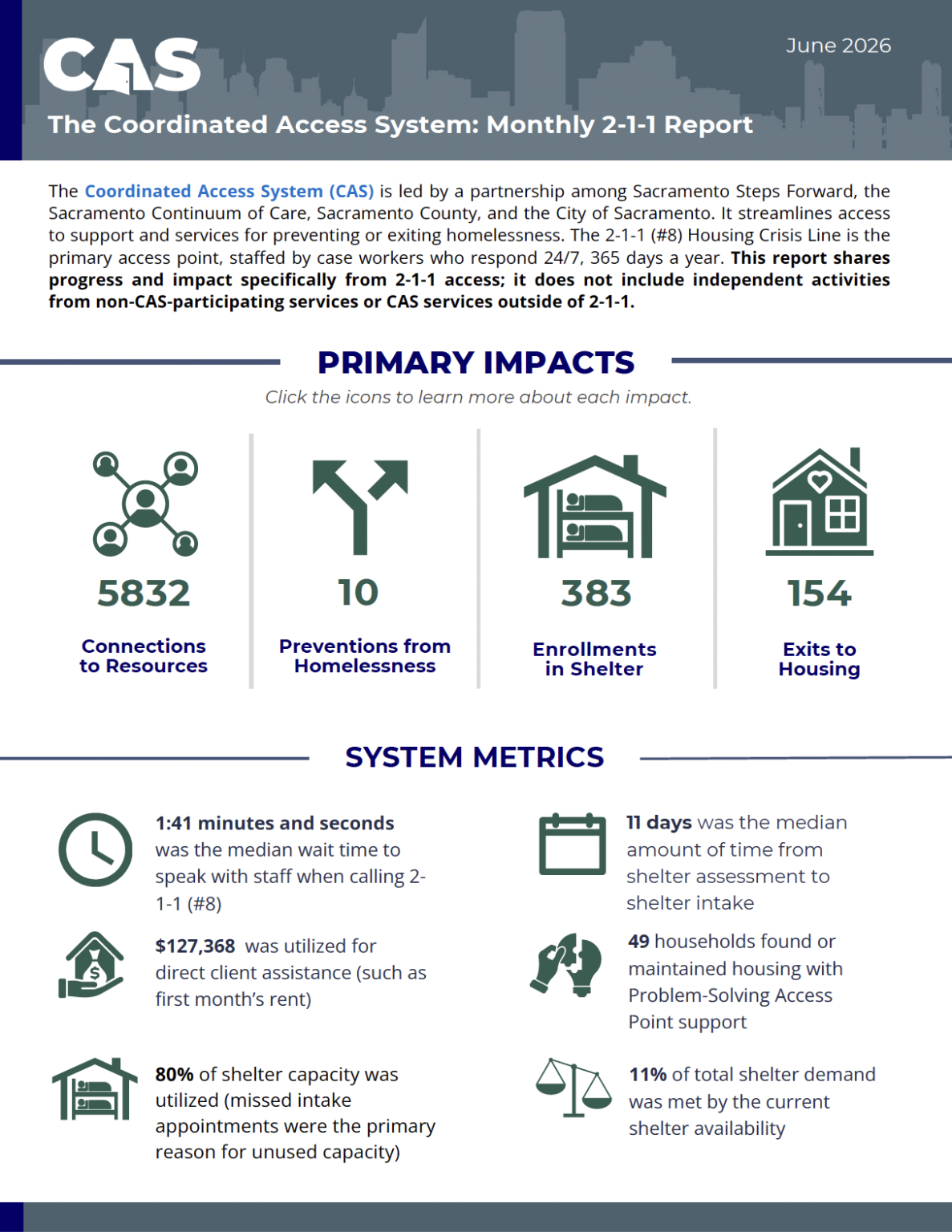
In June, we saw a continuation of the strong momentum from May, with gains across several key measures of housing stability. Connections to resources increased to 5,832 (up from 5,702 in May), exits to permanent housing rose to 154 (up from 119), and Problem-Solving services helped 49 households (up from 44) find or maintain housing.


Direct client assistance also grew, increasing from $121,342 in May to $127,368 in June. These funds helped more households address immediate barriers such as housing costs and other expenses that can threaten housing stability.


The June results demonstrate steady progress across prevention, resource connection, and permanent housing outcomes, thanks to the ongoing work of providers across Sacramento’s coordinated homelessness response system.


Among the people helped was a man experiencing short-term memory loss, a significant barrier to finding support. Learn more about his story and the latest data below.


READ THE FULL REPORT & ANALYSIS ➜

Case Conferencing: The Power of Coordinated Problem-Solving


Each month, we take a closer look at one part of the Coordinated Access System and how it supports people experiencing or at risk of homelessness.


Case conferencing is a structured, collaborative approach to resolving homelessness and is considered a best-practice tool across the nation. It brings together service providers to address housing and service challenges for individuals and families experiencing homelessness. Through a coordinated team approach in Sacramento, case conferencing has increased the success of securing housing and supports for the most vulnerable clients, increasing the effectiveness of our homeless response system. 


In the most recent cycle of case conferencing, which took place April through June this year, service providers from 34 programs came together in weekly meetings to discuss a total of 109 households. Case managers, housing navigators, and service coordinators supported each other in performing housing assessments, gathering documents, sharing employment resources, accessing healthcare, and breaking down complex barriers to housing. 


While housing is always our primary goal, we take a holistic approach to address as many service needs as possible along the way. Our work often starts with identifying the best pathway for increasing income, ensuring that health insurance coverage is active, and clients are accessing physical and behavioral healthcare when needed. Of households discussed in the last cycle, 30% increased their income through employment or public benefits, and 41% of households enrolled or reinstated their Medi-Cal coverage. 


After 10 weeks, providers were able to make meaningful progress on some of their toughest cases. Among these households, 80% completed housing assessments, and 46% achieved positive housing outcomes. Of those, 32% were housed or pending move in and 14% were connected to programs that would likely result in a future move in, like Rapid Rehousing and CalAIM Community Supports.  


When service providers participate in case conferencing, the impact is long-lasting. Looking back, 50% of households discussed from 2024–2025 are permanently housed as of July 2026, and only 4% are at risk of experiencing homelessness again. In comparison, 40% of households who entered the homelessness response system but were not discussed in case conferencing are now permanently housed, and 12% are at risk of experiencing homelessness. This speaks to a higher level of stability for households after their service providers participate in case conferencing. 


LEARN MORE ABOUT CASE CONFERENCING ➜

Here's what's new:


Updated Problem Solving Request (PSR) Processing Timelines


Due to current operational capacity and required accounting verification, a one-week turnaround for Problem Solving Request (PSR) stipend processing is not operationally feasible. To support agency planning and set clear expectations, we have updated processing timelines and policy requirements as follows:


  • Processing Order
  • Based on the level of urgency, PSRs are strictly reviewed, approved, and moved to accounting in the exact order they are received. Agencies are then notified of this status update.
  • Incomplete Requests & 30-Day Submission Policy 
  • If a PSR requires follow-up information or clarification, you will be notified. If the requested information is not received within 30 business days, the PSR will be closed out, and a completely new request will need to be initiated. 

The People Behind the Progress


Behind every referral and placement are people working together to make it possible.


This Month’s Spotlight: Tlaltzin Muro Gomez, Program Administrator at Sacramento Steps Forward


"Throughout my career, I have supported Coordinated Access from multiple perspectives: as a service provider, referral specialist, and program administrator. Across every role, one priority has remained the same: helping people navigate complex systems to access the support they need to achieve safety and housing stability. 


The Coordinated Access System (CAS) strengthens that work by creating a more coordinated, transparent, and consistent experience for both community members and service providers. Through community education, capacity building, and strong partnerships, the CAS helps ensure people can access support regardless of where they enter the system, while equipping providers with the knowledge and confidence to guide them effectively."


READ THE FULL SPOTLIGHT ➜

The Q&A Corner: Problem Solving Access Points


This month’s most-asked questions.


Q: What is the goal of a Housing Problem Solving (HPS) conversation? 


A: The goal of a Housing Problem Solving (HPS) conversation is to work collaboratively with the household to identify safe, individualized solutions that can quickly resolve their housing crisis. Through person-centered conversations, providers help households identify their strengths, support networks, available resources, and housing options to develop a plan that promotes housing stability. 


Interested in learning more about the Housing Problem Solving approach? Visit our Housing Problem Solving Trainings webpage.


Q: How can I connect a household to Housing Problem Solving (HPS) support? 


A: The Problem-Solving Access Point (PSAP) program is a partnership between Sacramento Steps Forward (SSF) and local nonprofit organizations that helps eligible households resolve their housing crisis through Housing Problem Solving (HPS) conversations. PSAP Navigators work collaboratively with households who are eligible based on the Coordinated Access System's Crisis Assessment to identify creative housing solutions, connect them to community resources, and determine whether financial assistance may be appropriate to support housing stability. 


Depending on the household's unique circumstances, PSAP Navigators may explore options such as eviction avoidance, rental or security deposit assistance, family reunification, utility assistance, furniture and household essentials, and other housing stabilization resources. 


To check for eligibility to a PSAP program, CAS Assessors can administer the Crisis Assessment to determine whether a household is eligible for referral. If eligible, the CAS Assessor will assist the household by calling 2-1-1 to initiate a referral to the PSAP program where the CAS Assessor collaborates with a PSAP Navigator. Households who are not connected with a CAS Assessor may also call 2-1-1 directly to explore available Housing Problem Solving support. 


Q: Is Transitional Housing considered permanent housing?  


A: No. Transitional Housing (TH) is a temporary housing intervention designed to provide stable housing and supportive services while participants work toward permanent housing. Lengths of stay typically range from 1 to 12 months, depending on the program.  


Within the CAS, Transitional Housing programs generally fall into two categories:  


  • Programs that provide interim housing where participants do not pay rent.  
  • Programs that require participants to pay a reduced, below-market rent.  


Both types of programs include supportive services, such as case management and life skills development, and referrals are made through the CAS referral process. 


Q: If a CAS Referral Specialist contacts me about my client's documents, does that mean they are being considered for a housing opportunity?  


A: Not necessarily. When a housing opportunity becomes available, CAS reviews clients in priority order and verifies that they meet the program's documentation requirements. If a client appears eligible but is missing required documents, a CAS Referral Specialist may contact the service provider to obtain them. While this means the client was reviewed, it does not guarantee a referral. We encourage providers to obtain the requested documents as soon as possible and notify CAS once they are complete so the Case Conferencing Tool can be updated with the client's current document status. 

🏠︎ Housing Highlights


Saint Johns for Real Change Transitional Housing: Newly Onboarded into the CAS


Service Provider: Saint Johns 


Service Type: Transitional Housing 


Household Eligibility: 


  • Be an individua or family currently experiencing homelessness. 
  • Meet documentation requirements for verifying literal homelessness. 
  • Valid ID 
  • Social Security Card 
  • Homeless Certification 
  • For minors in the household: Birth certificates and Social Security cards uploaded to the minor’s HMIS profile 
  • Have household income that does not exceed 30% of Area Median Income (AMI). 
  • Have monthly income at least two times the rent amount: 
  • Unit A: Minimum monthly income of $1,050 
  • Unit B: Minimum monthly income of $1,190 
  • Modular Home: Minimum monthly income of $1,737 
  • Maintain a clean and sober living environment. 


Please note that adult males are not eligible for this program. 


Central Sacramento Studios II: Move-in Anticipated October 2026


Service Provider: LifeSTEPS 


Service Type: Project Based Voucher Site 


Household Eligibility: Eligibility parameters are still being determined, and will be announced soon.


Volunteers of America Taking on the Next Move Transitional Housing Programs 


We are pleased to announce that the Next Move Transitional Housing Programs will continue without interruption, thanks to Volunteers of America stepping in to operate these programs. This partnership ensures that these valuable services remain fully operational and available to those who need them. 


All referrals will continue to be coordinated through CAS, and there will be no changes to the referral process. 


Thank you for being part of this work.


Questions about the Coordinated Access System?

Contact: CAS@sacstepsforward.org