| |  | | |
Early, Not Wrong
Everyone remembers the predictions. In 2023 and 2024, the consensus was clear: a wall of maturing debt, rising rates, and declining values would force a wave of distressed sales across commercial real estate. Billions were raised to capitalize on it.
It didn't happen. Not on that timeline.
The answer lies in how fundamentally different this cycle's capital structure is from 2008. During the GFC, regulated banks held the majority of CRE debt. When values dropped, mark-to-market rules forced them to recognize losses immediately. Regulators demanded write-downs. Banks had no choice but to liquidate quickly, and often at fire-sale prices. The distress was violent and fast.
This cycle is different. The capital stacks built between 2019 and 2022 were layered with debt funds, bridge lenders, and preferred equity — none of whom are subject to the same mark-to-market accounting or regulatory pressure. When deals started underperforming, the senior lenders were often still getting paid, so they had little incentive to foreclose. And the subordinate capital that was getting hurt lacked the practical ability to force a quick resolution. Everyone had a reason to extend, restructure, and hope that rate cuts would bail them out.
The data from the last 30 days tells the story. CRE CLO delinquency jumped 95 basis points in June — the first increase of 2026. Texas saw nearly $1 billion in CRE loans head to foreclosure auctions in July alone. A $400 million Sun Belt value-add fund dissolved with zero returns to investors. And a new Fed working paper confirms what we are seeing on the ground: lenders are now demanding higher spreads and principal paydowns on extensions, not just rubber-stamping another 12 months.
An estimated $875 billion in commercial and multifamily mortgages mature this year. Of that, $76.6 billion in CMBS loans have no extension options, and nearly 39% of those hard maturities land in Q4.
The distress funds that raised capital in 2022 were early. The operators who spent the last two years protecting their balance sheets — reducing leverage, locking in fixed rates, building cash reserves — are about to be rewarded. The buying window is opening. But capital alone will not win this cycle. Operational expertise, lender relationships, and the discipline to underwrite conservatively in a market full of motivated sellers is what separates the next generation of winners from those who showed up when the business looked easy.
| | |
Edward M. Aloe
President and CEO
626-229-9057
| | | |
The Return of the Operator: Why Multifamily is Reclaiming its "Get Rich Slow" Roots
I have been thinking a lot lately about the run we have been on in multifamily since I started CALCAP during the GFC back in 2008. It was an extraordinary period. Cheap debt, cap rate compression, and a market that seemed to forgive almost every mistake. For a long time, it worked. Over the last three years, however, that world has come undone, and what we are seeing now is what I would call a "return to normalcy." Multifamily is going back to what it always was: a disciplined, patient, get-rich-slow business built on operations, not financial engineering.
This white paper discusses what multifamily looks like right now, what it was before the boom distorted it, and what it takes to win over the long term. Whether you are an investor, a colleague, or just someone who follows the space, I hope you find it worth your time. I would genuinely love to hear what you think. The full Q2 White Paper is attached.
| |
| | Welcome to the Real Estate Wealth Podcast, where we explore real estate as the most proven way to financial freedom. Join us for insights with leading experts and discover how vibrant health and an abundance mindset are keys to true wealth. | | | |
|
Multifamily Stabilizes as the K-Shaped Recovery Takes Hold
Alongside improving national fundamentals, a sharper divide is emerging between segments.
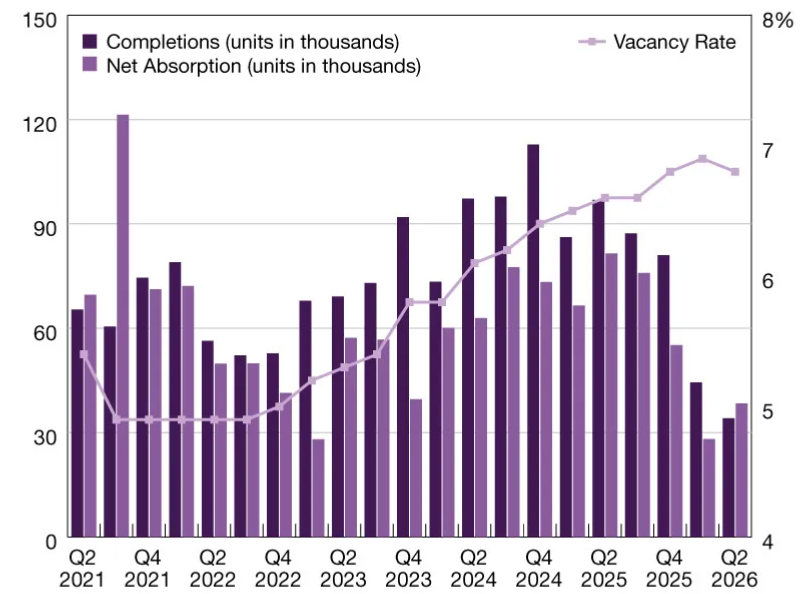
The U.S. multifamily market reached a potential inflection point in the second quarter as the supply surge that weighed on performance for several years began to recede. The national vacancy rate retreated 10 basis points to 6.8 percent, marking its first quarterly decline since 2021.
Demand also outpaced completions for the first time in more than four years, with approximately 39,000 units absorbed against more than 34,000 delivered. At the peak of the construction cycle in late 2024, completions reached more than 112,000 units. Rent growth held positive, with asking rents rising 0.7 percent overall and effective rents posting a second consecutive gain, up 0.8 percent.
View Article Here
| | | |
|
US Multifamily Loan Balances Surge 53% Since 2019
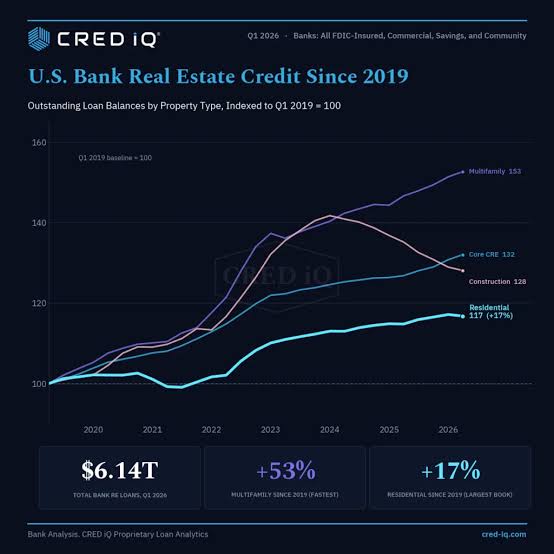
US multifamily loan balances jumped 53% from 2019 to Q1 2026, outpacing other CRE segments in percentage growth, per CRED iQ data.
By the first quarter of 2026, multifamily loan balances indexed at 153 (a 53% jump versus 2019), core CRE at 132 (up 32%), and construction and development at 128 (up 28%). Residential, spanning one- to four-family properties plus home equity, reached an index of 117, a 17% rise. Despite multifamily’s rapid percentage ascent to $665B, it remains much smaller in absolute dollars than residential ($3.1T) and core CRE ($1.92T). Residential and core CRE both expanded by over $440B in loans since 2019, while multifamily gained $229B and construction landed at $453B.
The difference between percentage expansion and dollar growth exposes where risk is most pronounced. While multifamily leads in proportional growth, both residential and core CRE added more net debt—around $445B and $467B respectively since Q1 2019—due to their larger starting base. Multifamily’s growth reflects sectoral enthusiasm but leaves banks with far larger overall exposures to housing and mainline commercial sectors, aligning risk not just with growth trends but portfolio maturity as well.
View Article Here
| | | |
|
Multifamily Development Shifts To Bigger Low-Rise Communities
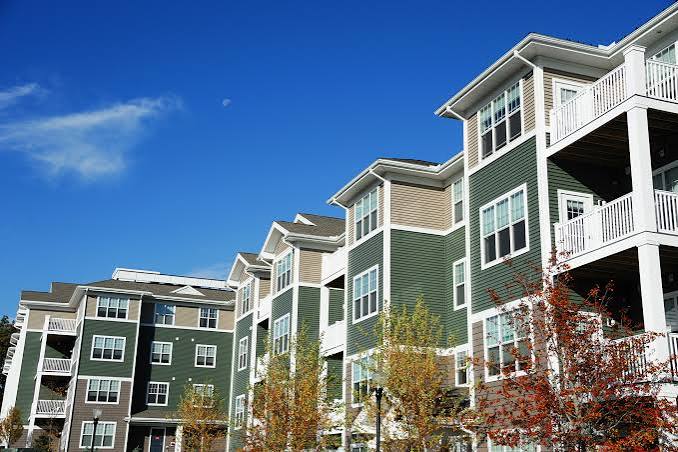
After a record year in 2024, multifamily completions fell sharply in 2025, dropping from 591,000 units to 468,000 units, Chandan Economics finds. The pullback has not been uniform across the sector. Smaller multifamily projects took the bigger hit, with completions in this category falling 27.2% to 190,000 units in 2025. Larger multifamily properties saw a more modest 15.8% decline, ending 2025 with 278,000 completed units.
That divergence points to a structural tilt toward larger properties, even as overall development cools. Some 59.4% of the units completed in 2025 were in buildings with 50 or more units, up from 55.8% in 2024's construction boom, according to the Chandan analysis. The report describes this bias toward scale as "a defining and enduring feature of the past decade's multifamily construction environment."
View Article Here
| | | | |
About CALCAP
California Capital Real Estate Advisors (CALCAP) is a Pasadena-based real estate investment firm founded in 2008. The Company sponsors and manages alternative investment opportunities focused primarily on workforce and attainable housing in growth-oriented U.S. markets.
Since inception, CALCAP has navigated multiple market cycles with a disciplined, research-driven approach centered on capital preservation, operational execution, and long-term value creation. The firm partners with both individual and institutional investors and currently oversees approximately $650 million in assets under management.
CALCAP’s strategy emphasizes selective acquisitions, conservative underwriting, and active asset management designed to deliver durable, risk-adjusted returns across varying market conditions.
To learn more visit www.calcap.com.
Social Impact
CALCAP CARES is the firm’s 501(c)(3) private foundation, created to support the communities where we invest and operate. The foundation encourages team members to give back locally and contribute to causes that strengthen neighborhoods and families.
A primary focus of CALCAP CARES is supporting organizations that serve individuals and families affected by autism. Through financial contributions and community engagement, we aim to make a meaningful difference in the lives of those navigating the challenges associated with autism while reinforcing our broader commitment to community impact
| | |
LOS ANGELES
The Sanborn House
65 N. Catalina Avenue
Pasadena, CA 91106
SAN DIEGO
12626 High Bluff Drive, Suite 360
San Diego, CA 92130
PHOENIX
7014 E. Camelback Rd, Suite B100A
Scottsdale, AZ 85251
| | |
Edward M. Aloe
Founder & CEO
(626) 229-9057
ed.aloe@calcap.com
Patrick A. Wakeman
Executive Managing Director
(858) 764-4890
pat.wakeman@calcap.com
Drew Buccino, President
(602) 419-3381
drew.buccino@calcap.com
Greg Blix, Managing Director
(805) 896-8500
greg.blix@calcap.com
| | |
Mark A. Mozilo
Executive Managing Director
626) 229-9056
mark.mozilo@calcap.com
| | | | |