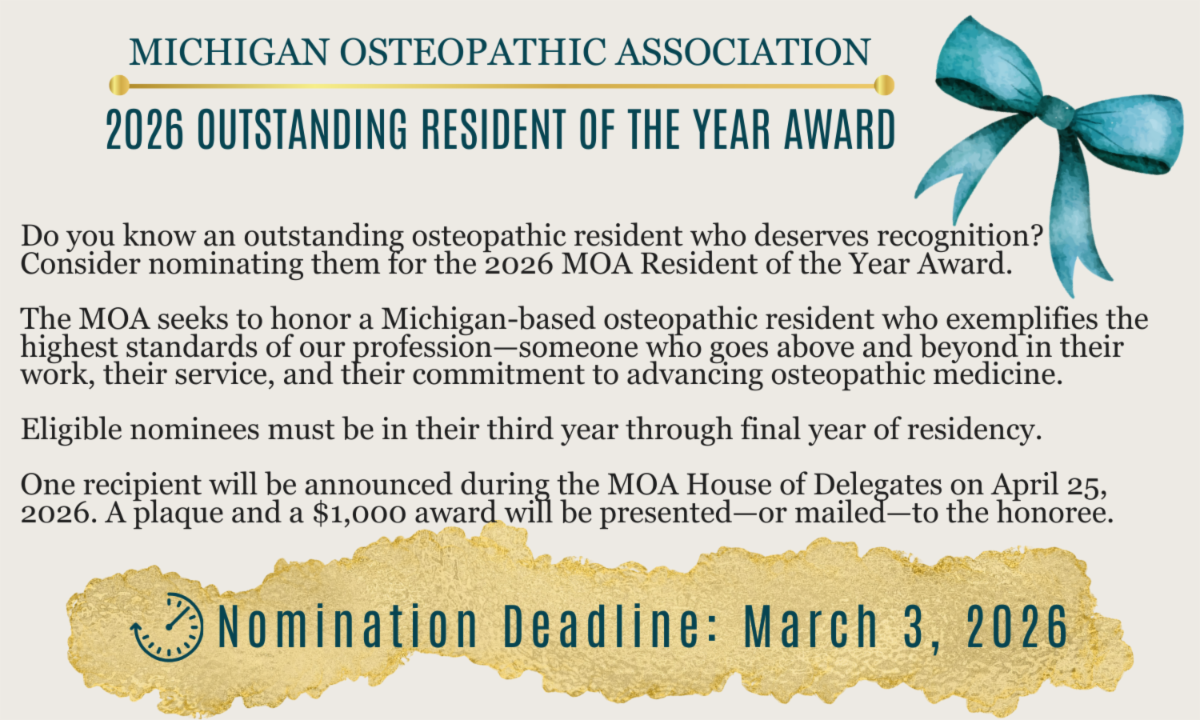
April 25, 2026

MOA HOUSE OF DELEGATES

MOA Headquarters · Okemos, MI

May 14-17, 2026

MOA SPRING CONFERENCE

Somerset Inn · Troy, MI

June 18-21, 2026

NMOA SUMMER CONFERENCE

Mackinac Island

July 16-19, 2026

AOA HOUSE OF DELEGATES

Chicago, IL

NOW ACCEPTING RESOLUTIONS FOR THE 2026 MOA HOUSE OF DELEGATES

The MOA House of Delegates is the legislative and policy-making body of the association. The House is responsible for election of officers and directors, election of AOA delegates and alternates, bylaws amendments, component societies and various policies and positions.


All resolutions for the MOA 2026 House of Delegates must be submitted by February 13, 2026. Any MOA member in good standing may author a resolution; however, introduction of resolutions to the House of Delegates is limited to delegates, alternate-seated delegates, component associations, MOA Departments, Councils, or Board of Trustees. Non-delegate status members in good standing should contact their component association for assistance in identifying an appropriate channel for resolution introduction

Resolutions must be emailed to Nikki Johnston (njohnston@domoa.org) following the guidelines above. 

Are You Interested in Becoming an OMM Mentor?


The Michigan Osteopathic Association is interested in forming a mentorship program that connects medical students and residents with osteopathic physicians experienced in hands-on training and professional guidance in osteopathic manipulative medicine (OMM). 


If you're interested in becoming a mentor, please email Crystal Ash at cash@domoa.org. Thank you for all you DO!

November was Lung Cancer Awareness Month!

a time to spotlight the challenges and hope surrounding Lung Cancer, encourage screening and early detection, and support research and improved care.


We’re proud to introduce two new CME courses:


Paradigm Shift in Lung Cancer Treatment


and


Lung Cancer Screening... What All DOCs Should Know

As we begin planning next year’s issues of The Pulse, we want to hear from you. What topics, stories, or features would you like to see? Share your ideas and help us make the 2026 Pulse even more valuable for MOA members.


Click the link below to submit your suggestions through our quick feedback form!

Patient- or client-centered care delivered by prepared, proactive practice teams is essential for excellent healthcare delivery (Center for Accelerating Care Transformation). Community Health Workers (CHWs) are important members of healthcare teams, bridging gaps between clinical health care and community-based resources (Center for Health Care Strategies, 2025).  


In healthcare, we often talk about the Quintuple Aim, a framework developed by the Institute for Healthcare Improvement (2025) to understand and improve health system performance. The Triple Aim (the initial form of the Quintuiple Aim) was proposed by the Institute for Healthcare Improvement (IHI, 2012) as a purpose statement for simultaneously improving population health, patient experience, and per capita cost reduction. The Triple Aim was adopted by the US Department of Health and Human Services as a framework for the National Quality Strategy, the Centers for Disease Control and Prevention, and the Commonwealth Fund. The Quintuple Aim expanded the Triple Aim beyond quality and cost to include human and equity dimensions of care: population health, patient experience, cost, provider well-being, and health equity.


Over the next several months, we will explore each of these dimensions and how CHWs contribute to improved outcomes.  


The first dimension we will address is population health.


What is population health?


There is ongoing confusion about the difference between population health and public health. These terms are often used interchangeably, but they are separate yet related disciplines. The World Health Organization (2023) describes public health as aiming “to provide maximum benefit for the largest number of people.” Public health agencies are organized at local, regional, state, and federal levels with responsibilities for communicable disease control, chronic disease and injury prevention, environmental health, emergency preparedness, assessment and surveillance, community partnership development, and policy development (Kaiser Family Foundation, 2025).


The term population health initially surfaced in 1990 with a focus on health status and outcomes in specific groups of people (D. Kindig & G. Stoddart, 2003). Groups may be comprised of patients based on location, provider practice, payer, chronic condition(s), age, health behaviors (e.g., cancer screening, emergency department use), or other variables. The goal of population health is to proactively identify and implement interventions to optimize health status within a group. This is done by implementing targeted, evidence-based interventions that often go beyond physical and behavioral health care to address social, economic, and environmental factors impacting health.


What is the community health worker’s role in population health?


CHWs play an important role in population health, particularly with increased recognition of Social Determinants/Drivers of Health (SDOH). CHWs bring lived experience and cultural responsiveness needed to build trusting relationships with patients and families (CHCS, 2025). They are educated in SDOH assessment and evidence-based approaches such as motivational interviewing, goal setting, and action planning. CHWs have a deep understanding of community-based services and assist clients, families, and caregivers with navigating complex healthcare systems.


CHWs provide outreach, education, and social support for issues such as unstable housing, food insecurity, and transportation. CHWs may also support patients with chronic health conditions such as diabetes by reinforcing the importance of medication adherence, monitoring, and follow-up (CHCS, 2025). 


The Practice Transformation Institute (PTI) CHW educational programs strengthen CHW knowledge, performance, and contribution to improved health outcomes. PTI is an approved provider of Community Health Worker (CHW) training by the Michigan Department of Health & Human Services (MDHHS). The approval follows a rigorous application process and more than two years of PTI providing CHW training through community and health system partnerships and support. Among one of the CHW training programs approved by the state, PTI is the only organization with the coveted IACET* accreditation.


The program teaches the National C3 Council skills and health knowledge necessary to function as a CHW in a variety of community settings. This robust training offers teaching excellence along with a leading-edge curriculum that supports the participants in achieving the learning objectives of the program.


For more information on PTI CHW training, visit https://transformcoach.org/learning-solutions/community-health-worker-chw-program/ or call (248) 475-4736


References:


Center for Accelerating Care Transformation, https://www.act-center.org/application/files/1616/3511/6445/Model_Chronic_Care.pdf Institute for Healthcare Improvement, https://www.ihi.org/library/topics/quintuple-aim Kindig, D. & Stoddart, G., (2003, seminal article). American Journal of Public Health, 93, 380-383. 


Michaud, J., Kates, J., Oum, S., & Rouw, A., U.S. Public Health 101. In Altman, Drew (Editor), Health Policy 101, (KFF, October 2025) https://www.kff.org/health-policy-101-u-s-public-health (accessed 11-5-2025).


Roux, A.V. (2016). On the distinction – or lack of distinction – between population health and public health. American Journal of Public Health, 106(4), 619-62. Doi: 10.2105/AJPH.206.303097. PMID: 26959262. PMCID: PMC4816152.


Stiefel, M. & Nolan, K. (2012). A guide to measuring the Triple Aim: Population health, experience of care, and per capita cost. IHI Innovation Series white paper. Cambridge, Massachusetts: Institute for Healthcare Improvement; 2012. (Available on www.IHI.org).


World Health Organization (2023). Population health management in primary health care: a proactive approach to improve health and well-being. Primary health care policy paper series, Copenhagen: WHO Regional Office for Europe; 2023. License CC BY-NC-SA 3.0 IGO.


When it comes to colorectal cancer (CRC) screening, not all available options are created equal. Each test comes with its own benefits, risks, and health insurance coverage. Choosing the right test is crucial, as it can impact patient health and outcomes. It’s critical that patients understand their options and can choose a CRC screening test that works best for them – without compromising performance and quality. Among USPSTF-recommended screening methods, offering the Cologuard® test is the best first step to get more average-risk patients, 45 years and older, screened.


Read More

HAP Partners with Zerigo Health

for a New Way to Deliver Dermatologic Care

We are expanding our population health programs to include dermatologic care options for providers through a new collaboration with Zerigo Health.

Medicare Part D Changes coming in 2026

Click 'Learn More' to see the changes effective January 1, 2026

Removing Clear Claim Connection

from Provider Portal

Effective December 5, 2025, Clear Claim Connection, the tool for validating code editing denials, will be removed from our secure provider portal.

New Incentive for 2025 HEDIS Gap Closure!

Earlier this year, we removed the HEDIS gap care submission through our online portal. Click 'Learn More' to see how you can submit data through our online provider to close the HEDIS gaps.

Reminder - Post Discharge Outreach Support

Our partnership with CipherHealth for an outreach solution designed to enhance post-discharge care and support for our members will go live on November 3, 2025.

Formulary & Prior Authorization Changes

Coming Soon

Click 'Learn More' to see the non-formulary medications effective January 1, 2026.

Reminder - Post Discharge Outreach Support

The HAP Provider Inquiry department is currently experiencing longer than normal wait times to speak to a representative. For faster service, please use our secure provider portal.

Michigan LARA Requirements for Osteopathic Physicians


MI LARA License Renewal Cycle: 3-years


150 hours - A minimum of 60 hours must be earned through MI LARA Category 1 programs, and 40 hours must be AOA approved. 


✔ Implicit Bias Training: 3 hours per cycle

✔ Medical Ethics: 1 hour per cycle

✔ Pain and Symptom Management: 3 hours per cycle

(1 hour must include controlled substance prescribing)


One-Time Training ONLY


✔ Human Trafficking

Opioid and Controlled Substances Awareness

Useful Links

www.cmelearningcenter.com


The Michigan Osteopathic Association (MOA) is committed to the continuum of education and lifelong learning, offering over 150 hours of medical education on-demand. This commitment includes serving as an accredited provider of continuing medical education through the American Osteopathic Association (AOA) to offer AOA Category 1-A Credits. In addition, MOA continues to offer AMA PRA Category 1 Credit(s)TM through a joint providership with the Michigan State University College of Osteopathic Medicine. 

Michigan Health Communications Initiative Newsletter & Resource Center


The Michigan Health Communications Initiative sends insights on the current health narratives happening across Michigan, along with evidence-based messaging recommendations and ready-made content to share in response.


To view the Michigan Health Communications Initiative resource center and subscribe to their newsletter, visit:

The Michigan Osteopathic Association partners with several health care organizations to provide resources and job opportunities for physicians at any point in their career. This section offers links to health care organizations and associations who provide information and job postings for DOs.

At McLaren Health Care, our employees help our communities, make life-changing discoveries, and facilitate positive change in health care as a whole. By working for McLaren, you are part of a leading team of talented professionals across many areas of expertise that create a positive difference every day for those we serve.


Mackinac Strait Health System is one of the area’s largest employers, with over 330 team members serving their patients and residents throughout the MSHS organization. Besides offering competitive wages, they also offer an excellent benefits package for full and part time team members, which includes affordable Blue Cross/ Blue Shield Health, Dental and Vision plans, prescription drug plans, generous paid time off, and a defined pension program for your retirement.


At Corewell Health, clinical opportunity intertwines with a commitment to exceptional and personalized care at all levels. Join a clinical team focused on the personalized experience, driving innovation through new technology and achieving national recognition for quality and excellence, all while maintaining the reason you joined this profession—to help people.


Hillsdale Hospital is dedicated to excellence in healthcare community service, continued improvement, and respect for human life. We manage the health needs of our local community through compassionate and highly-skilled care in our clean, safe, healing environment.

Angelo Stoyanovich, D.O. | July 1, 2025

Dr. Stoyanovich joined the MOA in 1981.

Link to local obituary


Lee A. Rea, D.O. | June 21, 2025

Dr. Rea was a Life Professional who joined the MOA in 1971.

Link to local obituary


Robert Shimmel, D.O. | May 17, 2025

Dr. Shimmel was a Life Professional who joined the MOA in 1957.

Link to local obituary


Roy A. Hills, D.O. | May 5, 2025

Dr. Hills was a Life Professional who joined the MOA in 1954.

Link to local obituary


Kirk Herrick, D.O. | March 2025

Dr. Herrick was an MOA Past President and Life Professional who joined the MOA in 1961.


Gladstone A. Payton, D.O. | Mar 30, 2025

Dr. Payton was a Life Professional who joined the MOA in 1969.

Link to local obituary

Robert J. Stomel, D.O. | Feb 21, 2025

Dr. Stomel was an MOA Past President and Life Professional who joined the MOA in 1985.

Link to local obituary


David K. Best, D.O. | Feb 12, 2025

Dr. Best was an MOA Past President and practiced Family Medicine in Traverse City, MI.

Link to local obituary


John E. Thornburg, D.O. | Feb 9, 2025

Dr. Thornburg was a Life Professional who joined the MOA in 1978.

Link to local obituary


William F. Stanley Jr., D.O. | Feb 9, 2025

Dr. Stanley was a Life Professional who joined the MOA in 1964.

Link to local obituary


Frank L. Donar, D.O. | Feb 7, 2025

Dr. Donar was a Life Professional who joined the MOA in 1967.

Facebook  X  Instagram