| |  | | |
Multifamily Sentiment Rebounds as Housing Rebalances
After a year of uncertainty and softening expectations, investor sentiment in the multifamily housing sector is showing renewed strength. According to Altus Group's Q1 2025 Industry Conditions and Sentiment Survey, 62% of respondents now view multifamily as a top-performing asset class—up from just 46% one year ago. Only 6% now expect it to underperform, signaling a complete reversal in market perception.
What's behind the shift? A combination of frozen single-family housing activity, slowing new multifamily construction, and resilient rental demand has helped tip the fundamentals back in favor of multifamily operators and investors.
Homeowners Locked In, Inventory Locked Out
The single-family housing market continues to be constrained by the mortgage rate "lock-in" effect. Following the refinancing boom of 2020–2021, millions of homeowners secured rates below 3%, and with mortgage rates now holding above 6%, few have financial incentive to move. According to the National Association of Realtors, existing home sales fell to just 4.02 million annualized units in March 2025—the lowest level in over 30 years.
New home sales offered some relief in early 2024, accounting for over 30% of all transactions, per the National Association of Homebuilders. But persistent cost
pressures—including the potential for new tariffs—are beginning to weigh on the development pipeline. As construction slows, housing demand is increasingly spilling over into the rental market.
A Perfect Storm Drives Pricing—and Renters
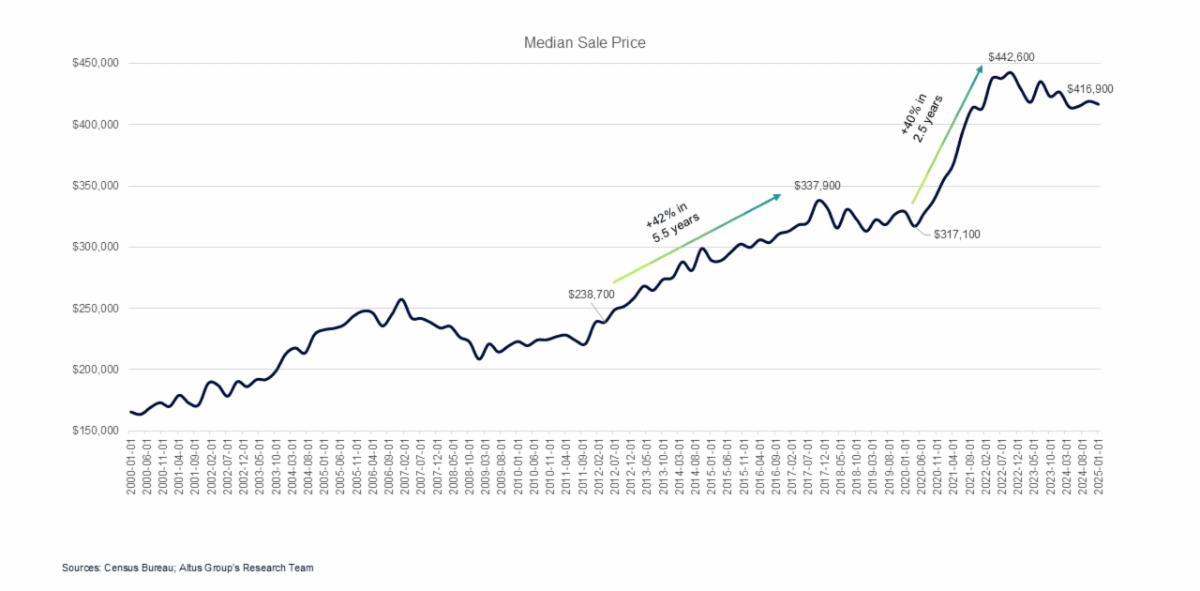
From April 2020 to October 2022, median home prices rose nearly 40%, driven by pandemic-related demand, millennial household formation, and long-standing undersupply. This dramatic rise in prices, combined with higher borrowing costs, has pushed many would-be buyers into the rental market—supporting occupancy and rent stability for multifamily.
| | |
Fundamentals Turning in Favor of Multifamily
Though multifamily rent growth slowed significantly in 2024, signs of stabilization are emerging. Deliveries appear to have peaked mid-2024, and the feared oversupply has not materialized to the extent many anticipated. With new supply now slowing and demand holding steady, multifamily fundamentals are showing signs of strengthening.
According to Altus Group, high-rise and mid-rise apartment rents are once again on the rise in Q1 2025, helping to revive confidence in the asset class. Despite isolated softness in overbuilt Sun Belt markets, the broader multifamily sector appears poised for a more balanced and stable year ahead.
| | |
Edward M. Aloe
President and CEO
626-229-9057
| | |
| | Welcome to the Real Estate Wealth Podcast, where we explore real estate as the most proven way to financial freedom. Join us for insights with leading experts and discover how vibrant health and an abundance mindset are keys to true wealth. | | | |
Apartment Market Pulse Spring 2025
Demand Remains Resilient Amid Economic Uncertainty and Affordability Challenges
The first quarter of 2025 sustained the momentum initiated in late 2024, with multifamily demand significantly outpacing new supply. Annual absorption reached over 700,000 units – an 18.5% surplus over completions – reflecting a sharp recovery and marking the highest absorption volume since Q1 2022. Year-over-year, this represents a net gain of over 400,000 units, with demand more than doubling from Q1 2024, according to RealPage data.
Conversely, while annual supply expanded by 23.6%, surpassing 570,000 completed units in Q1 2025, quarterly growth declined modestly by 1.4%. This contrast between surging demand and decelerating supply led to a steep negative shift in the supply-demand gap, with absorption approaching twice the volume of new completions. If this trajectory persists, it could lead to modest rent increases and signal a looming supply crisis, especially if new construction fails to ramp up in response. Compounding this pressure, construction inputs, especially for imported building components, are expected to become more expensive as effective tariff rates peak in Q2 2025. Higher material and labor costs may constrain future development activity, further intensifying delivery delays and increasing the risk of an extended supply gap.
View Article Here
| | | |
|
Trump’s Call for Implicit Guarantee for Fannie and Freddie Could Safeguard Multifamily Market
But he wants to do that while the two GSEs come out of conservatorship, which could complicate things.
There are potential upsides to a privatization scenario. Agharkar noted to GlobeSt.com that an IPO could unlock shareholder value and raise substantial cash for the Treasury—possibly as much as $250 billion. Management would have more independence and could reinvest profits, rather than channeling all earnings to the government. However, without a government guarantee, Fannie and Freddie would need to maintain larger capital cushion, between 2% to 4% of their mortgage portfolios—and could face credit-rating downgrades. Plus, it would come with increasing borrowing costs and the expense of lending through extension.
Ultimately, keeping the implicit guarantee while ending conservatorship would preserve much of the current system’s stability, especially for multifamily lending. It would enable GSEs to operate with private-sector characteristics while still benefiting from government support, thereby continuing to provide liquidity and support for affordable housing.
However, it would also blur the lines between public and private, raising questions about market competition, risk, and the true independence of Fannie Mae and Freddie Mac.
View Article Here
| | | |
|
Multifamily Continues to Benefit From Sidelined Homebuyers
Household formation remains strong, and real wage growth has continued on an upward trajectory.
After 18 months of muted rent growth, rents are beginning to accelerate and are expected to continue rising through 2025. Of note, insurance costs edged down by 0.2% during the first quarter, marking the first annual decline since the third quarter of 2018. Newmark said this is a result of premiums stabilizing after several years of sharp increases.
Debt origination activity gained momentum during the first quarter, with borrowers benefiting from lower rates, stronger conviction in fundamentals as construction declined and pent-up momentum from the second half of 2024. Investment sales volume reached $30 billion during the first quarter, a 35.5% year-over-year increase. Over the trailing 12 months, sales totaled nearly $158 billion, which signals investor confidence in the multifamily sector.
“Private fund vehicles targeting North American commercial real estate and launched between 2022 and 2024 have amassed $274.5 billion in assets under management, with $78.5 billion deployed,” said the report. “While deal volume has remained limited since the FOMC began raising rates in March 2022, many expect significant dry powder – especially from recent fund vintages – to drive increased deal activity in 2025.”
View Article Here
| | | | |
About CALCAP
California Capital Real Estate Advisors, Inc., and its affiliate entities (CALCAP Asset Management, CALCAP Properties, CALCAP Lending, CALCAP Senior Healthcare, and CALCAP Strategic Opportunities, collectively known as “CALCAP”), is a California-based investment company founded in 2008 and headquartered in Pasadena, California. The Company sponsors alternative real estate investment opportunities focused on demographically driven housing. CALCAP has been able to consistently provide both individual and institutional investors with outstanding returns over the last 14 years. The Company uses a highly selective and disciplined investment approach, focused on delivering superior risk-adjusted returns. CALCAP currently has over $650mm in Assets Under Management. To learn more visit www.calcap.com.
Social Mission
CALCAP CARES is a 501(c)(3) private foundation organized to encourage employees to find a way to give back to the neighborhoods where we invest. CALCAP has created "GiveTime4Autism" as its initial program which gives employees the opportunity to donate unused vacation and sick days for a very worthy cause.
| | |
LOS ANGELES
The Sanborn House
65 N. Catalina Avenue
Pasadena, CA 91106
SAN DIEGO
12626 High Bluff Drive, Suite 360
San Diego, CA 92130
PHOENIX
740 N. 52nd Street
Phoenix, AZ 85008
SANTA BARBARA
1309 State Street, Suite A
Santa Barbara, CA 93101
| | |
Edward M. Aloe, Founder & CEO
(626) 229-9057
ed.aloe@calcap.com
Patrick A. Wakeman, Principal
(858) 764-4890
pat.wakeman@calcap.com
Drew Buccino, Principal and COO
(602) 419-3381
drew.buccino@calcap.com
Greg Blix,Dir. of Investor Relations
(805) 896-8500
greg.blix@calcap.com
| |
Mark A. Mozilo, Principal
(626) 229-9056
| | | | |