|
What happened last week?
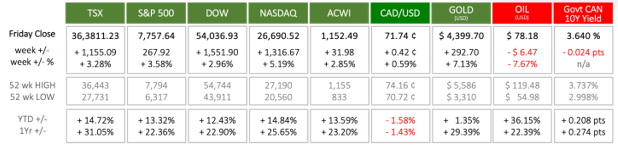
The performances by equities were spectacular. The TSX, S&P 500 and Dow reached new all-time highs. The NASDAQ jumped more than 5% and is approaching its peak achieved in early June. Equity indexes moved upward on positive Canadian jobs data and a negative U.S. employment report that has softened predictions for more restrictive monetary policy from the Federal Reserve.
Canada’s economy added 75,000 jobs in July according to StatsCan's Labour Force Survey. Wholesale and retail trade (+21,000), finance and real estate (+18,000), professional services (+17,000) and construction (+16,000) were the sectors adding the most employment. Gains were split between full and part-time employment, and over 180,000 jobs have been added since April. The unemployment rate fell for the third consecutive month to 6.4 percent, its lowest level in 2 years. It is a much more favourable summer job market for students. CBC and jobs
“Both nonfarm payroll employment (-23,000) and the unemployment rate (4.1 percent) changed little in July” according to the Bureau of Labor Statistics’ Employment Situation Summary. Analysts had expected a gain of 83,000 for July. After downward revisions to previous months, the average monthly gain is down to 34,000. In July, health care (+22,000) continued to increase employment, while local government education (-50,000) and retail trade (-19,000) declined.
The unexpected result has significantly changed the predictions for U.S. interest rates. Previously the Federal Reserve was concentrating on controlling inflation and had signaled that a rate increase was on the horizon. Following the jobs announcement CME's FedWatch tool lowered the likelihood of a rate increase for the next Fed interest rate decision scheduled for September 16th. Delaying or eliminating interest rate increases contributed to the increase in value for North American equity indexes. CNBC and jobs
The Canadian merchandise trade surplus widened slightly from $3.7 billion in May to $3.9 billion in June. Merchandise exports increased 0.4%, more than the increase in imports at 0.2%. June was the fourth consecutive month with a monthly surplus. StatsCan release
What’s ahead for this week and beyond?
In Canada, building permits, capacity utilization, manufacturing and wholesale sales, new motor vehicle sales are scheduled for release.
In the U.S., existing home sales, Consumer and Producer Price Indexes, retail sales and inventories, business inventories, crude oil inventories and gasoline production will be announced.
Globally, Japan’s lending and BoJ’s Summary of Opinions, China’s lending data, and the Eurozone’s investor confidence, industrial production, employment, GDP and trade balance will be reported.
|