|
What happened last week?
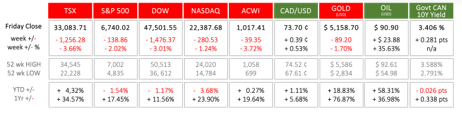
The largest influence on markets was the expanding conflict centred in Iran. Nearly twenty countries are directly involved, including NATO-member Turkey which could draw in many more. The uncertainty politically, militarily and economically associated with unpredictable oil shipments has sent the VIX Volatility Index to its highest level since President Trump’s announcement of tariffs in early April of 2025.
Last week, the price of oil rose more than 35% to close at almost $91 USD per barrel for West Texas Intermediate (WTI) benchmark. The rising price of oil sent corporate values downward (except for most energy and oil stocks) since increased energy prices will threaten their revenue and profits. The contribution of energy price increases to consumer inflation measures will likely delay, or reverse, rate cuts by the Federal Reserve, Bank of Canada and other central banks, which will slow economic expansion and profits.
Additionally, the loss in U.S. jobs pulled indexes down. The last time that the Bureau of Labor Statistics (BLS) delivered a significantly dissatisfying jobs report President Trump fired the lead statistician. On Friday, the BLS announced in its Employment Situation Summary that “payroll edged down by 92,000 in February, and the unemployment rate changed little at 4.4 percent.”
True to his words from his speech in Davos, Prime Minister Mark Carney pursued trade agreements that focus on relatively reliable partners and do not include the United States. Recent deals have been struck with India, Australia and Japan, and further economic integration with these bilateral partners is being negotiated. CBC and Carney trade deals
A bright spot for equities was the conclusion of the S&P 500’s fourth quarter earnings results. 73% of companies exceeded their Earnings-per-Share estimates and earnings growth was 14% higher, the fifth consecutive quarter of double-digit growth. FactSet Earnings Insight
What’s ahead for this week and beyond?
In Canada, building permits, wholesale and manufacturing sales, capacity utilization, imports, exports and trade balance, and a full employment report (employment, unemployment, participation) will be released.
In the U.S., consumer inflation expectations, building permits, housing starts, existing home sales, imports, exports and trade balance, and Gross Domestic Product (GDP) will be released. The Fed’s preferred inflation measure, the Personal Consumption Expenditure Price Index (PCE), will be reported.
Globally, Japan’s wages, leading index, coincident indicator and Gross Domestic Product, China’s imports, exports, trade balance and Consumer Price Index, and the Eurozone’s investor confidence and industrial production are scheduled for release.
|