|
What happened last week?
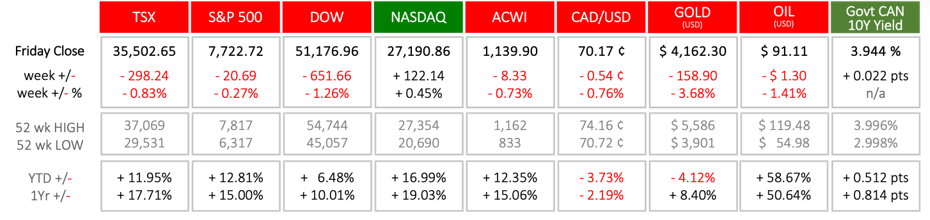
Equities were mixed as the TSX and Dow moved upward and the S&P 500 and NASDAQ fell, the latter by 4½ percent last week. The TSX has regained its top performer status on year-to-date and 1-year results. The price of oil jumped 10 percent and ended the week over $100 per barrel due to increased geopolitical uncertainty in the Middle East, tanker attacks and quickening depletion of U.S. oil reserves.
In economic news, U.S. inflation continues to climb higher and more quickly on a monthly and annual basis.
-
Consumer Price Index (CPI) increased 0.6 percent in September after rising 0.4 percent in August. Over the last 12 months the all-items index increased 3.7 percent, up from 3.4 percent in August. The increase in September was driven by a 9.1 percent increase in the index for gasoline, which accounted for half the monthly increase. BLS CPI release
-
The Producer Price Index, which reports wholesale inflation, rose 1.3 percent in September, up from 0.5 percent in August. In the 12 months ending September, producer prices grew 6.3 percent, the largest increase since December 2022. BLS PPI release
- The Import Price Index rose 1.1 percent in September and 8.1 percent over the last year. This was the highest one-year rate since July 2022. Fuel prices rose 4.8 percent in September.
-
Export prices rose 2.2 percent in September and 11.6 percent for the year ended September 2026, the highest one-year inflation rate since July 2022. BLS I/EPI release
The likelihood of a Federal Reserve rate hike at the Federal Reserve’s December 9th meeting sits at 89% accord to CME's FedWatch tool. At the next meeting at the end of October, no change is predicted, but eventually the Fed may have to act to contain inflation, if it continues its current trajectory.
Opposing most other countries’ situation, China’s CPI rose 0.2 percent in September and 0.9 percent year-over-year according to the National Bureau of Statistics release.
What’s ahead for this week and beyond?
In Canada, inflation data will be released for consumers, industrial producers, raw materials and new housing. Retail and wholesale sales and the Bank of Canada’s Business Outlook Survey will be released. On Monday, Albertans will vote in referenda, which includes whether they will pursue independence.
In the U.S., building permits, housing starts, pending home sales, consumer sentiment and inflation expectations will be reported.
Globally, Japan’s imports, exports and trade balance, and CPI, China’s house prices, gross domestic product, industrial production, unemployment, retail sales, and the Peoples Bank of China’s prime rate, and the Eurozone’s construction output, economic sentiment, consumer confidence will be released.
|