|
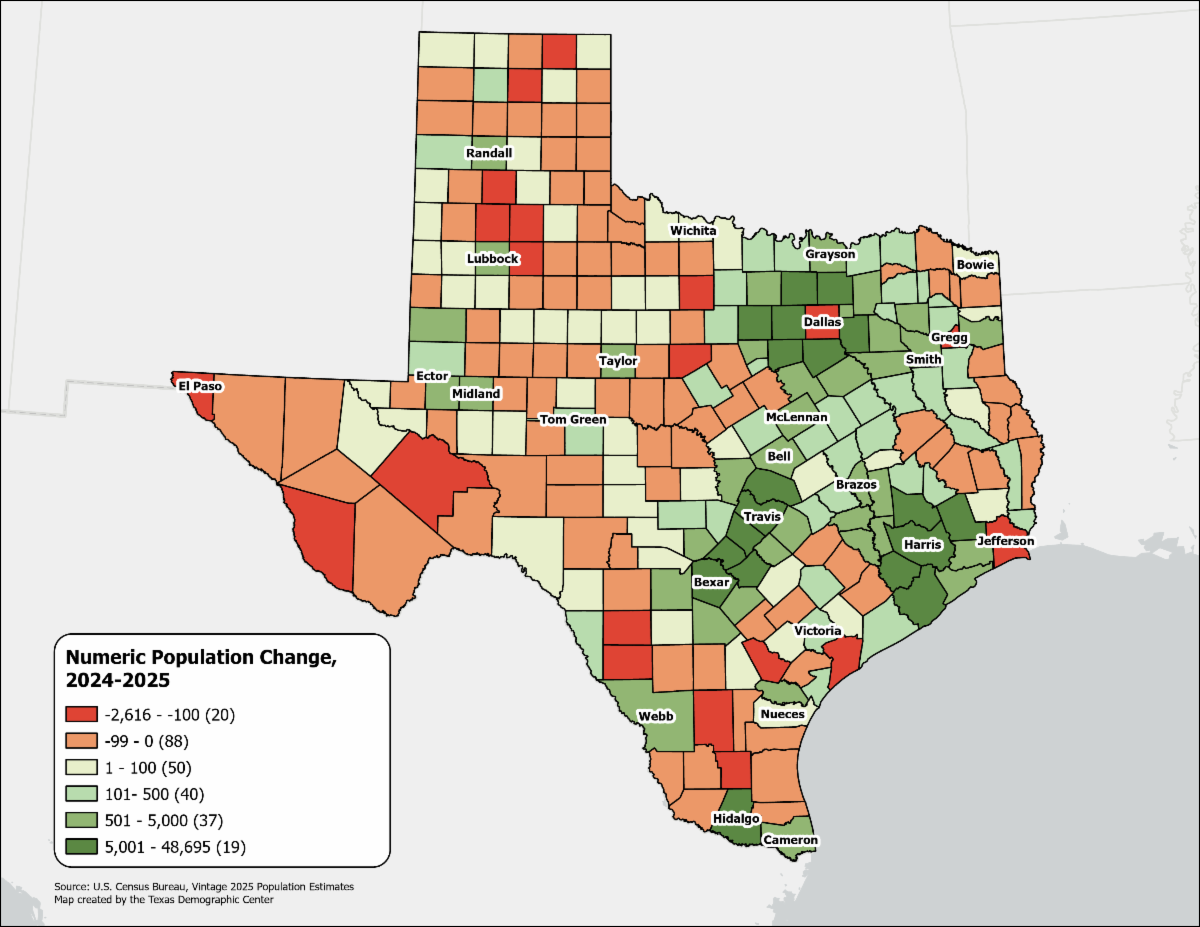
New estimates from the U.S. Census Bureau show that Texas continues to grow, but at a slower pace than in recent years—a trend that reflects a broader national slowdown in population growth, driven largely by reduced net international migration. Between July 2024 and July 2025, 146 Texas counties (58 percent) gained population, while 108 counties (42 percent) experienced population decline or no change. Compared with prior years, growth was more modest overall, and population loss was more widespread geographically.
Counties with large immigrant populations experienced some of the most pronounced shifts. Major international destination counties such as Harris and Dallas saw the steepest declines in net international migration, with immigration levels nearly halving from the 2023–2024 period. Both counties continued to post strong natural increase, partially offset by net domestic out‑migration. Despite these opposing forces, Harris County ranked first nationally in numeric population change, while Dallas County ranked among the top ten counties nationwide for numeric population loss, though its overall decline remained relatively modest—about 2,600 residents.
Border counties such as Hidalgo, Webb, Cameron, and El Paso experienced sharp increases in international migration in 2023 and 2024, followed by some of the steepest declines in 2025— in some cases by an order of magnitude. This volatility underscores the role that international migration plays in shaping year‑to‑year population change in border regions.
|