MONTHLY DATA UPDATE


TDC Estimates coming soon


The Texas Demographic Center released their preliminary Vintage 2025 population estimates for Texas counties and places for July 1, 2025 and January 1, 2026. These preliminary estimates are currently under review by local representatives and officials.


Final estimates will be released later in November. Stay tuned for more important updates.


Children in Texas have the highest risk for poverty

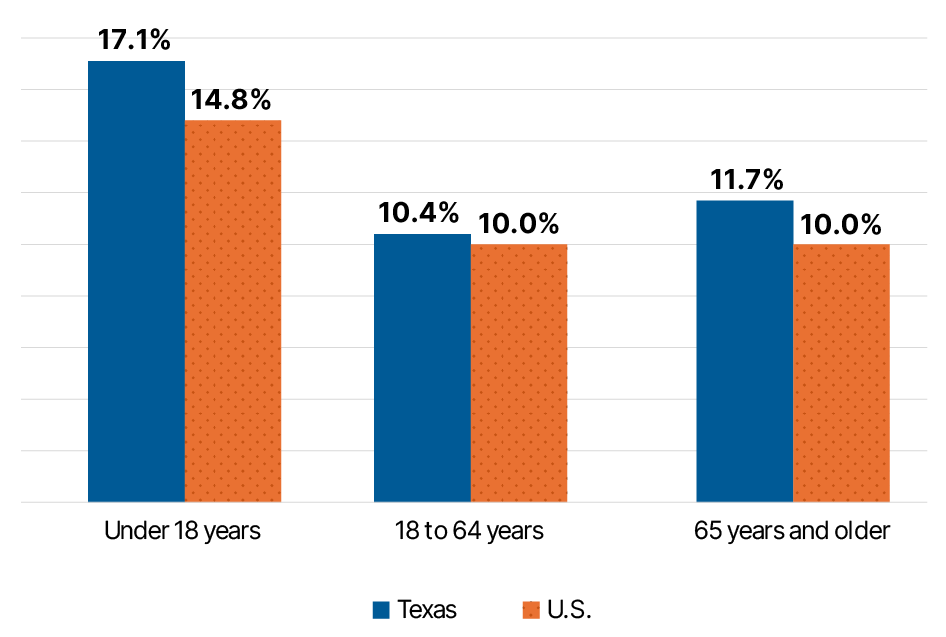
Percent of People in Poverty by Age Group in Texas and the U.S., 2025


Source: U.S. Census Bureau, Current Population Survey 2025 Annual Social and Economic (ASEC) Supplement.


Children continue to face the greatest risk of poverty in Texas, according to the latest U.S. Census data. In 2024, 17.1% of Texans under age 18 lived in poverty, compared with 14.8% of children nationwide. Although poverty affects Texans across every age group, children experience the highest rates of economic hardship, reflecting the unique challenges faced by many families throughout the state.


Texas also reported slightly higher poverty rates than the nation among working-age adults and older adults, highlighting differences in economic well-being across the population. These data provide important context for understanding the circumstances of Texans at different stages of life and the demographic trends shaping communities across the state.


Explore our Social Media Channels

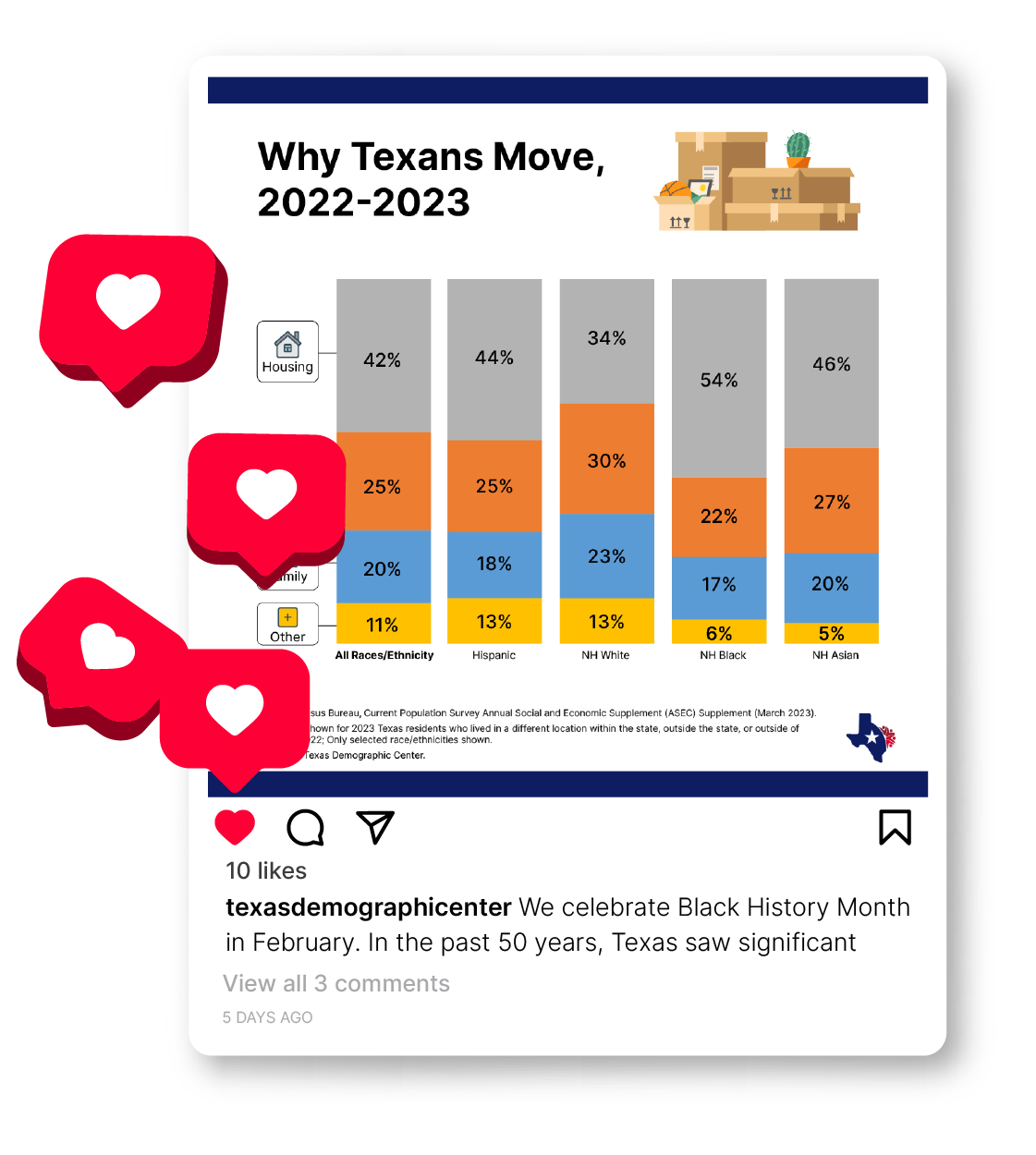
Stay up-to-date with our newest releases, data visualizations, research findings, and engaging content. Like, comment, and share our posts to spread the word and help us reach a wider audience.

Facebook  Instagram  LinkedIn  X
 

DATA UPDATES


Important Federal Register Notice on Proposed Rule for the 2030 Census: Decennial Census of the Population of Americans; Proposed Residence Criteria and Proposed Regulations for Demographic Questions


The Census Bureau is proposing to add two new parts to the Code of Federal Regulations governing the decennial census of population and housing.


First, the Census Bureau is proposing to add a part outlining the residence criteria used for identifying each person's “usual residence,” as needed to determine whether and where to count them in the census of the population throughout the United States. For example, "the Census Bureau proposes to include lawful permanent residents within the apportionment base, while excluding from the apportionment base illegal aliens and aliens whose legal status is less durable and indefinite in length than lawful permanent resident status.” This is a major change compared to the recent censuses that count people at the location where they live and sleep most of the time, regardless of immigration status.


Second, the Census Bureau is proposing to add a part establishing standards and restrictions for the inclusion of certain demographic questions on the decennial census short-form questionnaire and any other questionnaire used for the enumeration of the population. For example, recent decennial censuses have asked questions about race and ethnicity; however, the proposed changes “would prohibit the inclusion of questions about race and ethnicity or sexual orientation on the decennial census short-form questionnaire or any questionnaire used for purposes of the enumeration.” The Census Bureau could, in addition, include a question about legal status on the short-form decennial census questionnaire.


These proposed changes outlined in the Federal Register Notice are significant and represent a notable change in recent decennial censuses. You are encouraged to learn more about the reasons behind the proposed rules and determine how this could affect enumeration in your community and their implications for your work. The deadline for public comment is October 13, 2026. 


Income, Poverty and Health Insurance Coverage statistics


The U.S. Census Bureau recently released its 2025 Income, Poverty, and Health Insurance Coverage in the United States report. Key findings include a record-high real median household income of $87,460, the highest since 1967, and a decline in the official poverty rate to 10.2%. The Supplemental Poverty Measure remained at 13.1%, while 7.9% of Americans (26.7 million people) were uninsured for the entire year.


The report on health insurance coverage in the U.S., includes a table on the “Percentage of Children Under the Age of 19 and Adults Ages 19 to 64 Without Health Insurance Coverage by Income-to-Poverty Ratio and Medicaid Expansion Status of State: 2024 and 2025.” This table also includes a link to the federal government’s Medicaid website that provides information on Medicaid coverage per state. According to the website, as of May 2026, Texas has enrolled 3,941,123 individuals in Medicaid and CHIP — a net decrease of 6.24% since the first Marketplace Open Enrollment Period and related Medicaid program changes in October 2013.


Interested in learning more? Visit the Census Bureau's newsroom highlights and reports to explore the full findings and key trends.


2024 Annual Integrated Economic Survey


The U.S. Census Bureau today released the full dataset from the 2024 Annual Integrated Economic Survey (AIES), offering a single, comprehensive annual snapshot of U.S. employer businesses.


Follow the link below to explore national-level highlights.


AFFILIATE SPOTLIGHT


Texas Water Development Board (TWDB) 


TWDB has compiled guidance on the use of nature-based flood mitigation solutions into a single, statewide manual for Texas communities. Nature-Based Solutions for Flood Resilience in Texas is designed to help communities address flood risk, water quality, groundwater recharge, habitat improvement, and community enhancement goals with independent Nature-Based Solutions or in combination with traditional flood mitigation infrastructure. The manual considers the efficacy of Nature-Based Solutions within the various geographic regions of Texas, supports regional and statewide flood planning efforts, and helps Texas communities to better understand and utilize these approaches.


UPCOMING EVENTS


Conference

Texas GIS Forum

October 19-23, 2026 | Austin, TX


Webinar

Countdown to LUCA : Practical Strategies for Local, Tribal and State Governments 

October 28, 2026 | Online


Conference

Texas Municipal League Conference

November 11-13, 2026 | San Antonio, TX


Data Release

Texas Demographic Center Vintage 2025 Population Estimates

November 2026

Facebook  Instagram  LinkedIn  Twitter

September 2026

View as Webpage