MONTHLY DATA UPDATE


Important Federal Register Notice on Proposed Rule for the 2030 Census


The Census Bureau is proposing to add two new parts to the Code of Federal Regulations governing the decennial census of population and housing outlined the following federal register notice: Decennial Census of the Population of Americans; Proposed Residence Criteria and Proposed Regulations for Demographic Questions.


First, the Census Bureau is proposing to add a part outlining the residence criteria used for identifying each person's “usual residence,” as needed to determine whether and where to count them in the census of the population throughout the United States. Furthermore, the notice states that the Census Bureau “proposes to include lawful permanent residents within the apportionment base, while excluding from the apportionment base illegal aliens and aliens whose legal status is less durable and indefinite in length than lawful permanent resident status.” Only including U.S. citizens and individuals who are lawful permanent residents could affect population counts for Congressional representation and result in a loss of federal dollars to the state and local communities. The Census Bureau could, in addition, include a question about an individual’s legal status on the short-form decennial census questionnaire. These are major changes compared to the recent censuses that count people at the location where they live and sleep most of the time, regardless of immigration status.


Second, the Census Bureau is proposing to establish standards and restrictions for the inclusion of certain demographic questions on the decennial census and any other questionnaire used for the enumeration of the population. For example, recent decennial censuses have asked questions about race and ethnicity; however, the proposed changes would prohibit the inclusion of questions about race and ethnicity for purposes of enumeration. This could affect public health and health disparities monitoring, business market analyses, economic development decisions, school planning, public outreach campaigns, and workforce assessments.


These proposed changes are significant and represent a notable change in recent decennial censuses. You are encouraged to learn more about the reasons behind the proposed rules and determine how this could affect enumeration in your community and their implications for your work. This is a good resource for submitting public comments on federal regulations: Regulations.gov


The deadline for public comment regarding the proposed rule on the Decennial Census of the Population of Americans; Proposed Residence Criteria and Proposed Regulations for Demographic Questions is November 2, 2026.  


Texas Educator Trends: Ten Years of Growth

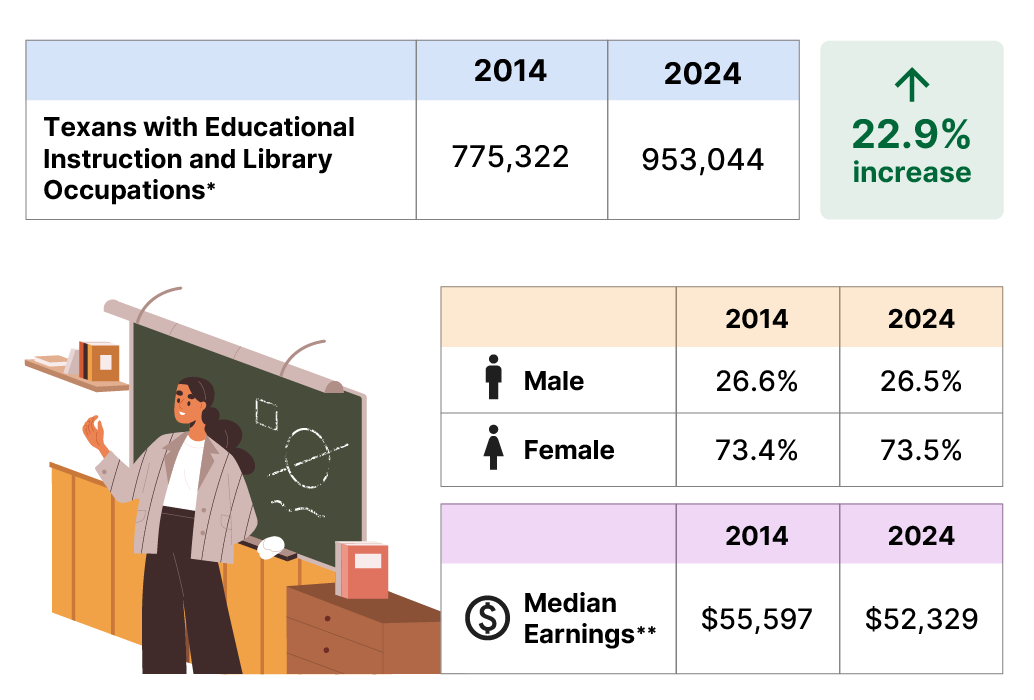
Educational Instruction and Library Occupations in Texas, 2014 and 2024


Source: U.S. Census Bureau, American Community Survey 1-Year, 2014 and 2024

Note: *Civilian employed occupation 16 years and older

**2024 inflation adjusted dollars


More Texans are helping educate and inspire the next generation. Over the past decade, the number of Texans working in educational instruction and library occupations grew by 22.9%, reaching more than 953K workers in 2024.


Despite this growth, the workforce's demographic makeup, sex distribution, and median earnings remained largely stable, highlighting areas for continued improvement. Educators play a vital role in shaping future generations and preparing Texas' workforce for tomorrow.


Explore our Social Media Channels

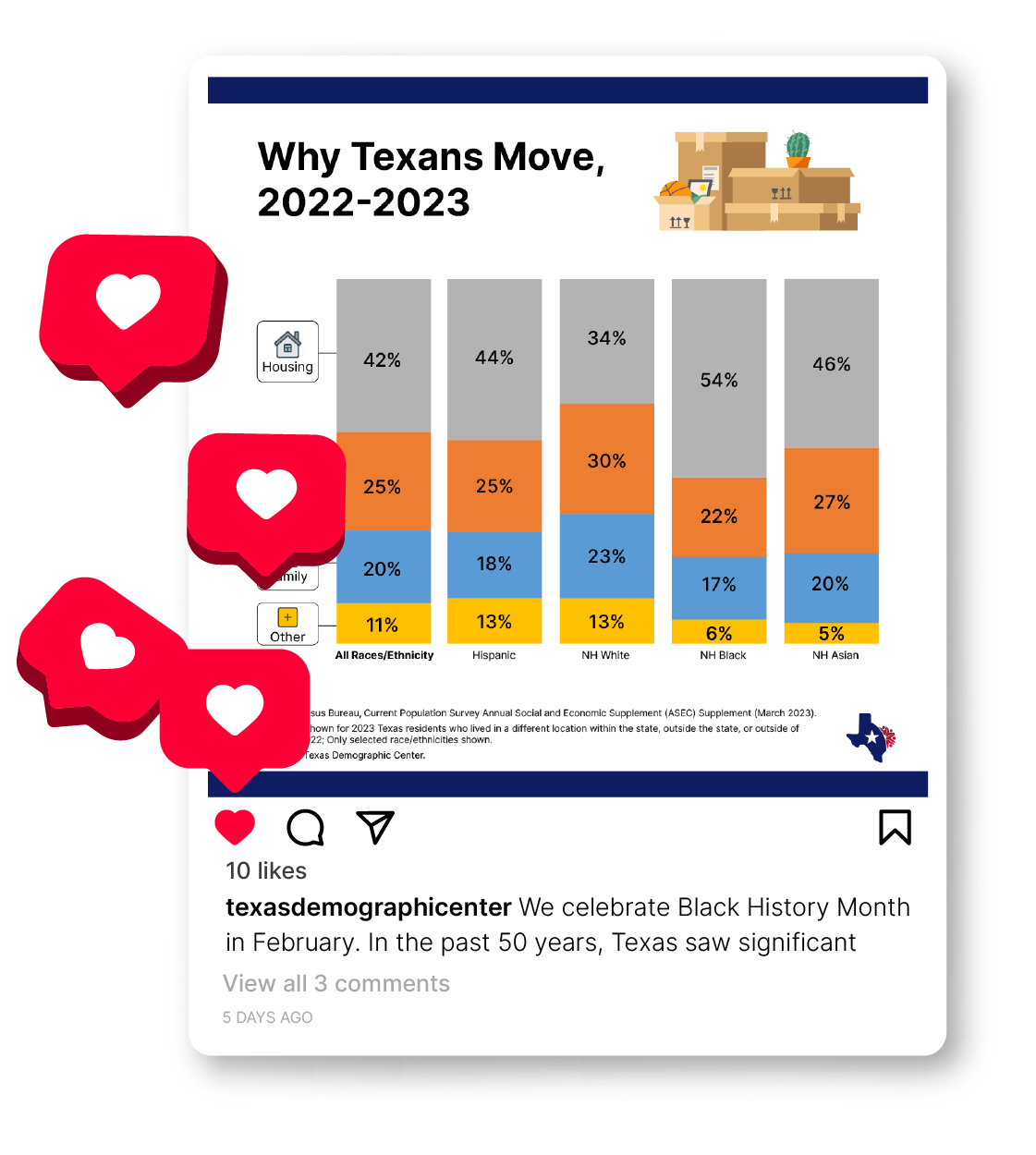
Stay up-to-date with our newest releases, data visualizations, research findings, and engaging content. Like, comment, and share our posts to spread the word and help us reach a wider audience.

Facebook  Instagram  LinkedIn  X
 

DATA UPDATES


What Sources of Income Do People Rely On?


The U.S. Census Bureau released a visualization based on the Current Population Survey Annual Social and Economic Supplement (CPS ASEC). This interactive visualization shows how adults in the United States receive their income and how those income sources vary across different demographic groups. Users can explore the share of income that comes from earnings, assets, Social Security, government transfers, and other sources by selecting a year and filtering by characteristics such as age, sex, race and ethnicity, education, employment status, and more.


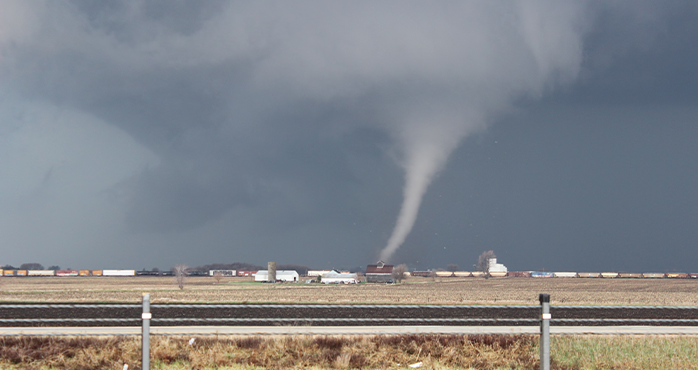
Tornado Activity Shifts East — Heightening Risks in the South


The U.S. Census Bureau’s Community Resilience Estimates and American Community Survey (ACS) provides data that helps communities assess vulnerabilities and prepare for disasters, including tornadoes. According to the National Oceanic and Atmospheric Administration (NOAA), the U.S. recorded about 1,559 tornadoes last year, 27% above the 1991-2020 average. Tornado activity has also shifted eastward, declining 25% in the west and increasing 12% in the east.


This trend is especially concerning for southern states, where many residents live in mobile homes that are more vulnerable to severe weather. In 2024, mobile homes accounted for an estimated 6.2% of housing units in Texas. While Texas is not among the states with the highest share of mobile homes, preparedness remains important for reducing the risks these vulnerable households face during severe weather.


Continue reading about how Census Bureau data can help identify communities at risk of tornadoes.


Preparing for the 2030 Census Starts Now


The National League of Cities and the National Association of Counties will host Countdown to LUCA: Practical Strategies for Local, Tribal and State Governments on October 28 at 12pm CST. The webinar will highlight how communities can begin preparing for the 2030 Census Local Update of Census Addresses (LUCA), the only opportunity to review and correct the Census Bureau's address list before the census.


Attendees will learn practical strategies for improving address data, engaging partners, and ensuring an accurate count that helps communities receive their fair share of federal funding and resources.


UPCOMING EVENTS


Webinar

Countdown to LUCA : Practical Strategies for Local, Tribal and State Governments 

October 28, 2026 | Online


Conference

Texas Municipal League Conference

November 11-13, 2026 | San Antonio, TX


Data Release

Texas Demographic Center Vintage 2025 Population Estimates

November 2026


Conference

Water for Texas

 January 25–27, 2027 | Austin, TX

Facebook  Instagram  LinkedIn  Twitter

October 2026

View as Webpage