|
Quarterly Newsletter
Oct 2025
| | |
National Conference on Tobacco or Health
| | |
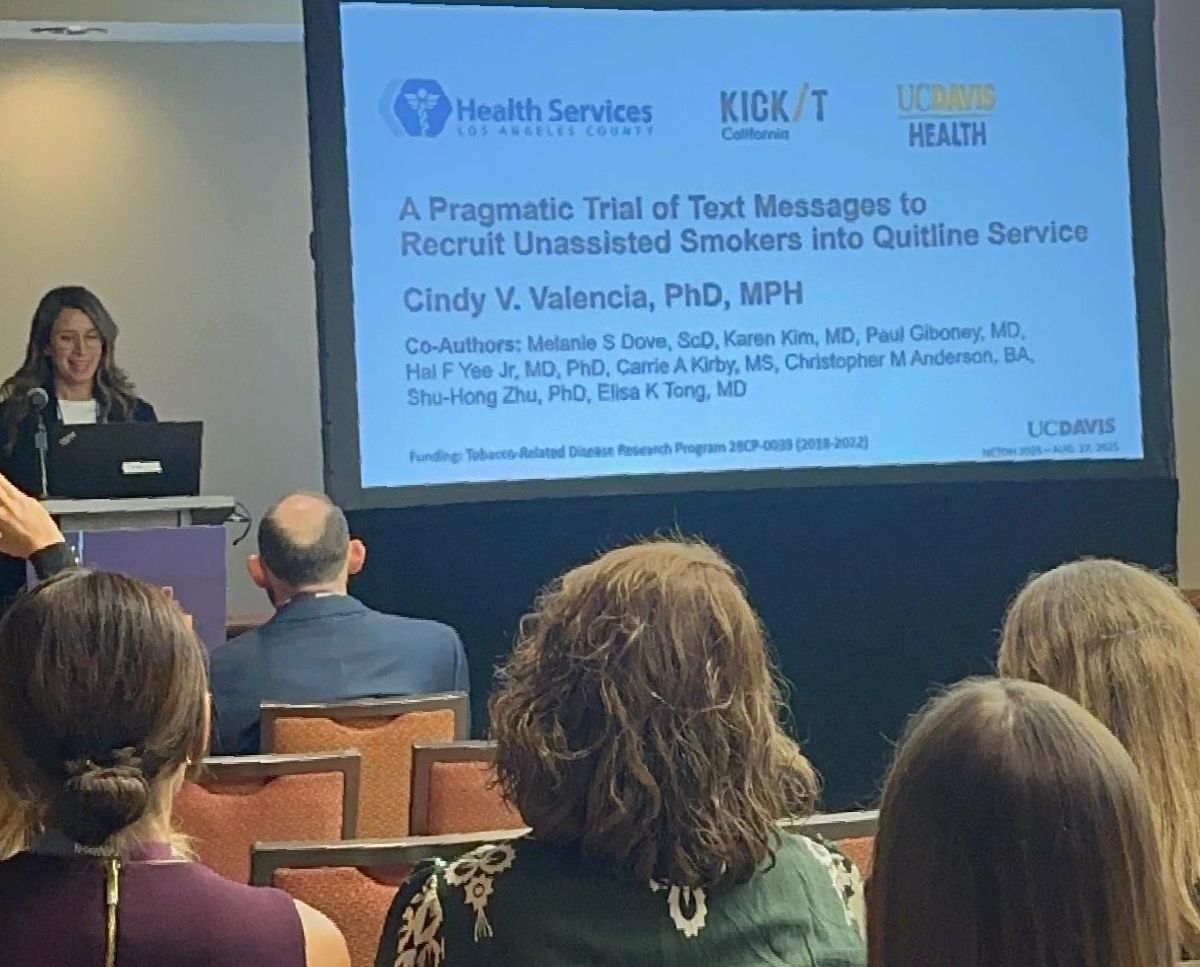
At the 2025 National Conference on Tobacco or Health (NCTOH), Dr. Cindy Valencia, Director of CA Quits presented findings from a pragmatic trial exploring how text messages can connect unassisted smokers to quitline services. Over 4,000 adult smokers from Los Angeles County Department of Health Services were randomized to receive one of two texts: offering either free quitline coaching or free nicotine patches. Among those who responded, Spanish-speaking callers were significantly more likely to enroll in the quitline compared to English-speaking callers.
This population health approach complements provider referrals by reaching tobacco users between clinical visits. Future efforts could explore opt-out strategies, increased message frequency, and mobile treatment options.
| | |
New Quality Standard for Smoking Cessation
Programs in Cancer Accreditation
| | |
Starting January 1, 2026, the Commission on Cancer (CoC) will require all accredited cancer programs to have a process in place to screen every newly diagnosed cancer patient for current tobacco use. Patients identified as current smokers must be offered or referred to evidence-based cessation treatment. In California, 106 accredited cancer programs will be impacted by this standard. To learn more, join the upcoming webinar: CoC: Smoking Cessation Standard on Tuesday, October 28, 2025.
There are 15 public hospitals (11 large and 4 district/municipal) in the DHCS Quality Incentive Pool program whose cancer programs are accredited by CoC. These include:
- Contra Costa Regional Medical Center
- Kern Medical Center
- Riverside University Health System
- Santa Clara Valley Medical Center
- UC Davis Health
- UC Irvine Health
- UC San Diego Medical Center
- UC San Francisco Medical Center
- UCLA Health
- Ventura County Medical Center
- Zuckerberg San Francisco General Hospital
- Antelope Valley Medical Center
- Salinas Valley Health Medical Center
- Tahoe Forest Health
- Washington Hospital Healthcare System
For more information about the CoC Standard, please contact Moreen Sharma, mmsharma@health.ucdavis.edu. Dr. Elisa Tong served on the CoC task force that helped launch the standard and is working on next steps to engage California's cancer centers on implementation.
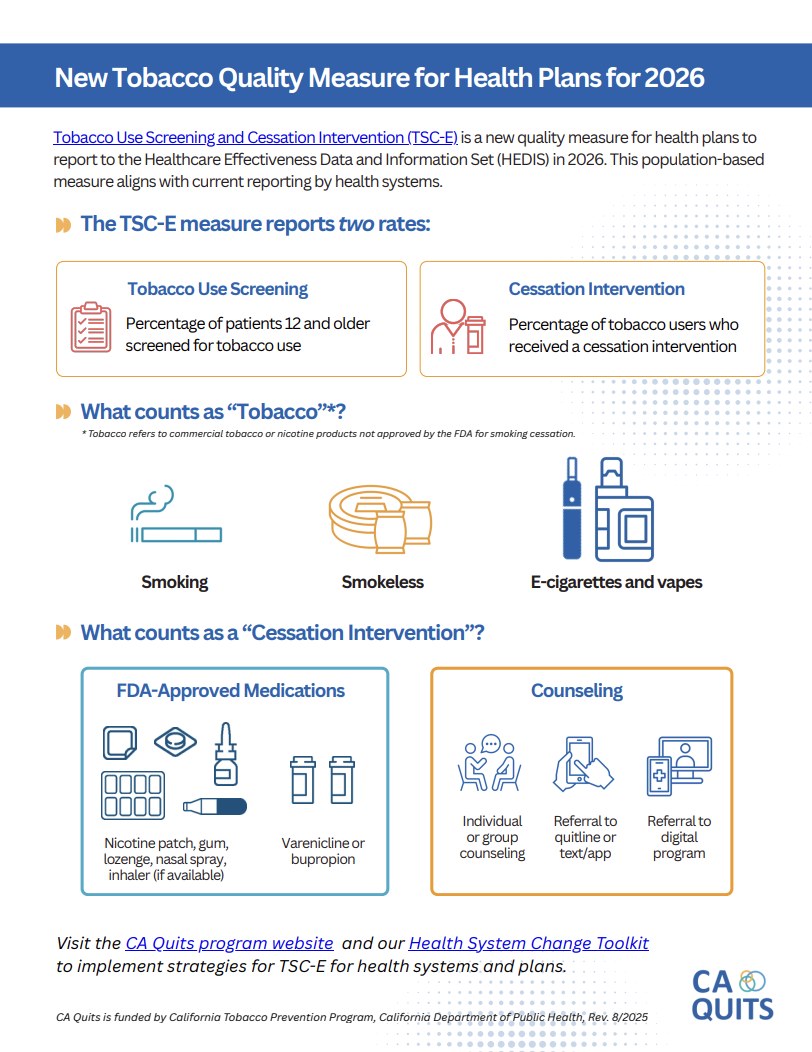
| | Medi-Cal Managed Care Plans | | At the September 29 CA Quits Medi-Cal Managed Care Plan (MCP) tobacco cessation workgroup meeting, we discussed the preparation for the implementation of the new NCQA HEDIS quality measure, Tobacco Use Screening and Cessation Intervention (TSC-E), which requires health plans to report on tobacco use screening and cessation intervention for patients ages 12 and older in 2026. | | |
The MCPs identified three key areas of need: data access and infrastructure, connecting with providers and health systems, and using multi-modal member outreach efforts. The TSC-E measure aligns with both the DHCS public hospitals and federally qualified health centers that currently report on this measure.
There were 21 attendees, with 14 MCPs and 3 representatives from DHCS.
For more information about the MCP workgroup, contact Shannon Haggitt, Plan & Partner Manager, srhaggitt@ucdavis.edu.
| | | |
November is Tobacco and Lung Cancer
Screening Awareness Month
| |
November 8th is Lung Cancer Screening Day and November 20th is Great American Smokeout to quit tobacco. It’s also an opportunity to ensure consistent documentation of Tobacco History with smoking pack-years and quit dates among patients who are 50-80 year old and current or former smokers.
Explore resources and tools to support your team in preparing for Lung Cancer Awareness Month activities.
|
-
Guide for Primary Care Practices: A new evidence-based toolkit from the National Lung Cancer Roundtable offers step-by-step ways primary care providers can increase lung cancer screening rates.
-
National Lung Cancer Screening Day (Mark your calendar): This annual awareness campaign promotes early detection and aims to open screening access (including on the second Saturday in November) via low-dose CT scans.
-
The Great American Smokeout 11/20/2025: A great opportunity to engage patients around quitting tobacco. Find ready-to-use flyers, social media graphics, and planning tools from the American Cancer Society and CDC.
| | |
Teens in Distress Turn to Tobacco,
But Need More Help to Quit
| | A new UC Davis study in Pediatrics Open Science, with CA Quits Principal Investigator Dr. Elisa Tong, highlights that adolescents experiencing psychological distress are more likely to be screened for tobacco use compared to their peers. However, these vulnerable teens are not more likely to receive counseling or support to quit, leaving a critical gap in care. Researchers stress the importance of strengthening cessation interventions in both clinical and community settings to better reach youth struggling with mental health and nicotine use. | | Health and Human Services Prioritizes Youth Vaping Resources on Legally Marketed Tobacco Products | | Youth vaping continues to be a priority for the Health and Human Services in this press release and fact sheet, "Sound the Alarm: Youth Vaping Can Harm", which includes a call to action for healthcare providers. The Food and Drug Administration (FDA) is educating retailers that more than half of vaping products sold nationally are illegal. Currently, only 39 e-cigarettes and 20 nicotine pouch products are authorized for sale in the U.S. (see FDA Authorized E-Cigarettes and FDA Authorized Nicotine Pouches). To support compliance, the FDA has also launched a Searchable Tobacco Database with details on over 17,000 products, including cigarettes, cigars, hookah, and e-cigarettes that may be legally marketed in the United States. | | |
Youth Vaping Linked to Increased
Health and Behavioral Risks
| | A review of 56 studies found that youth vaping is linked to increased smoking, substance use, respiratory issues, and mental health concerns. The findings support stronger policies to limit youth access to vaping products. | | |
Nicotine Replacement Therapy as a Smoking
Cessation Tool for Adolescents: An Update
| A recent review found nicotine replacement therapy (NRT) to be safe for adolescents, helping reduce smoking and ease withdrawal symptoms. However, long-term quit rates are modest, highlighting the need for counseling and follow-up support. | | |
-
California Facts and Figures 2025: California’s 2025 tobacco data show overall tobacco use is declining, but large gaps remain in helping people quit, especially among low-income, mental health, and priority populations. The report emphasizes the quit ratio (proportion of ever-smokers who are former smokers) and shows that many smokers are still not getting the needed cessation support.
-
9/9/25 Archived Webinar: UCSF Smoking Cessation Leadership Center on The Tobacco Endgame: History, Headwinds, exploring what it means to set ambitious “endgame” goals beyond traditional tobacco control, the barriers ahead, and how cessation services can align with policy strategies.
| | | | |