Credit Score-A numerical value that ranks a borrowers credit risk at a given point in time based on a statistical evaluation of information in the individuals credit history that has been proven to be predictive of loan performance
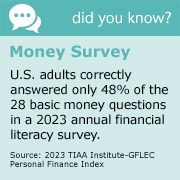
U.S. adults correctly answered only 48 percent of the 28 basic money questions in a 2023 annual financial literacy survey
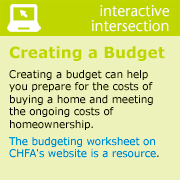
Creating a budget can help you prepare for the costs of buying a home and meeting the ongoing costs of homeownership- click for worksheet

keeping your spending in check around the holidays

Hands typing on a keyboard and holding a credit card with gifts in the background

It may seem difficult to think about saving money around the holidays. From gifts to gatherings, the costs can add up. But there are ways you can still enjoy the holidays without overspending and going into debt.


Creating a Holiday Budget


  1. Set your spending limit: It is important to set your limit before you start budgeting and then stick to that limit.
  2. Reduce your spending: Consider things like planning with your family and friends to draw names for gifts, rather than buying for everyone. It can also be helpful to create a gift list with price limits for each person.
  3. Plan for as many expenses as possible: Anticipating your expenses can help you avoid overspending.


Once you have your budget created, be a smart shopper and resist too many sales. It can be enticing to want to take advantage of every flash sale, coupon, or rewards program, especially when you’re trying to save money. But taking part in too many seemingly good deals may end up costing you in the long run.


Tips to Save


With all the spending that can happen around the holidays, it’s still important to continue saving too. Financial experts say to develop a habit of saving and stick to it by making saving money a ritual.


  1. Set up a “sinking fund”: This is one way you can start planning now to gradually save for holiday spending next year. A sinking fund is a savings account you dedicate for a certain expense, and you put money aside each month to pay for it. Tying a goal to your savings can turn the experience into something positive.
  2. Automate your savings: This is one way to make saving easier, especially if you’re on a tight budget. Try having a set amount of money automatically transferred from your checking account into your savings account, even a small amount can make an impact in the long run. With auto transfer, you’re not putting yourself in the position to decide whether or not to save. You can talk with your bank about your options. 
  3. Take a closer look: While automation can work well, financial experts advise you to check your statements regularly. That will help you make sure there are no surprise fees, deductions, or unauthorized transactions.
  4. Find an accountability partner: This can be a family member or friend who will help keep you accountable with saving money. Your accountability partner should be someone who you know is going to check in and look out for your best interest.


Click here to view 105 ways to save money on CHFA’s website, under the Creating a Budget section.

chfa partners with savings collaborative for personal finance education

Two people on a couch looking at a laptop

As part of CHFA’s Own Your Tomorrow efforts to expand access to homeownership by providing equitable homeownership resources, CHFA launched a financial education series in September with Colorado-based nonprofit, Savings Collaborative. The courses in the series provided information on credit, debt, savings, setting goals, and building generational wealth. 


The series was launched as a pilot program.  The nonprofit also has an app with built-in tips and incentives to learn how to make it easy to save


Free CHFA webinar


Attend a free, one-hour webinar to learn the steps to homeownership and about CHFA’s homeownership programs.

Learn more

Online resources


Learn more about and prepare for homeownership:

Help for Homebuyers
Mi Hogar

Colorado Housing and Finance Authority


www.chfainfo.com


This eNewsletter may contain links to other websites or third party materials. Links to external or third party websites or materials are provided solely for your convenience. The presence of a link does not imply any endorsement of the third party material, the website, its content or any association with the third party or website's operators by CHFA. Third-party websites or materials may be governed by their own privacy policy and terms of use, and the third party is solely responsible for the content and offerings presented on its website or in its materials. CHFA makes no representation and accepts no responsibility or liability regarding the accuracy, quality, safety, suitability or reliability of any third party material(s), external website or the content or materials of such websites. Use of linked sites is strictly at your own risk. 

With respect to its programs, services, activities, and employment practices, Colorado Housing and Finance Authority prohibits unlawful discrimination against applicants or employees on the basis of age 40 years and over, race, sex, sexual orientation, gender identity, gender expression, color, religion, national origin, disability, military status, genetic information, marital status or any other status protected by applicable federal, state or local law. Requests for reasonable accommodation, the provision of auxiliary aids, or any complaints alleging violation of this nondiscrimination policy should be directed to the Nondiscrimination Coordinator, 1.800.877.2432, TDD/TTY 800.659.2656, CHFA, 1981 Blake Street, Denver, Colorado 80202-1272, available weekdays 8:00am to 5:00pm.

Facebook  Instagram  LinkedIn  X